How One Artist Is Using 3D Printing to Tell Stories About the Ocean

Artist Kimberly Callas sees something different when she looks at a 3D printer. Where others see a machine for making parts, she sees a way to tell stories about the ocean, climate change, and humanity’s relationship with nature.
That vision has now earned her a place in the New York Academy of Art‘s 2026 Summer Exhibition, where her piece Ocean Reach combines hand-painted details with 3D printed biofilament to explore the beauty and fragility of marine ecosystems.
Oceans, coral reefs, marine life, and the challenges facing our planet have become the foundation of her work.
Callas, an artist and professor at Monmouth University in New Jersey, combines traditional art techniques with modern technologies, including 3D printing. Her piece Ocean Reach wasn’t just selected for the New York Academy of Art’s Summer Exhibition; it was also featured in the latest issue of WEAD Magazine, a publication focused on women working in environmental art.
What makes the piece especially interesting to the 3D printing community is that it contains PLA biofilament, one of the most widely used materials in desktop 3D printing. This shows us how additive manufacturing is being used in creative fields beyond engineering and manufacturing.
-
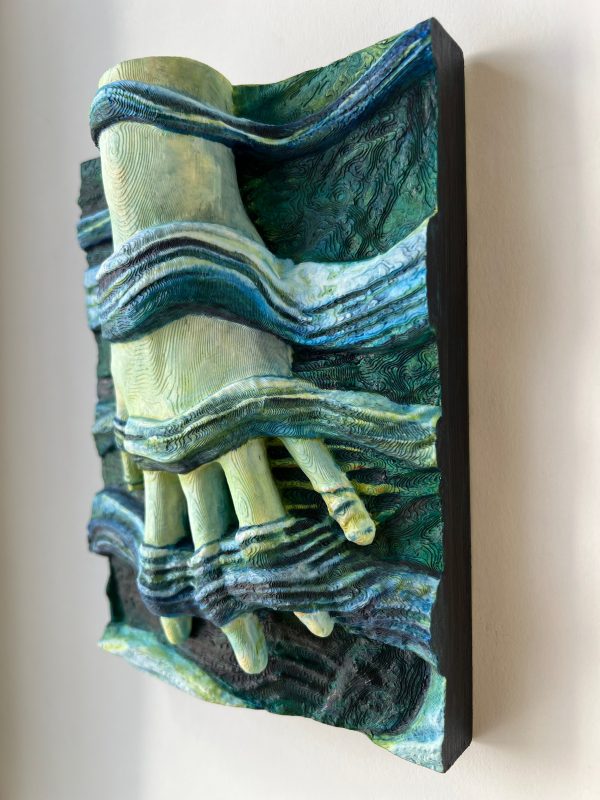
- Ocean Reach (2026) by Kimberly Callas. Image courtesy of Kimberly Callas.
-

- Ocean Reach (2026) by Kimberly Callas. Image courtesy of Kimberly Callas.
Art Meets Technology
For years, 3D printing has given artists incredible new creative possibilities. In Callas’ work, however, the technology is just one part of the artistic process. Her work often explores humanity’s relationship with nature, particularly the oceans. Through sculpture, drawing, installation pieces, and 3D printed elements, she creates works that encourage viewers to think differently about the environment.
In Ocean Reach, 3D printed PLA biofilament is combined with acrylic ink and graphite to create a piece that feels both organic and futuristic at the same time. It’s amazing how the technology almost disappears into the artwork itself. But that’s part of what makes it interesting. The goal isn’t to show off a 3D printer, it’s to tell a story. And here, the visible print layers add texture and movement that look like waves, currents, and other natural forms.
Measuring 8 x 6 x 2 inches, the piece, Callas says, “continues my interest in the visceral meeting point between humans and nature.”
A Different Side of 3D Printing
Callas chose to create the piece using PLA biofilament, one of the most common materials used in desktop 3D printing. Made primarily from renewable resources such as corn starch or sugarcane, PLA isn’t a perfect environmental solution. Although it still has an environmental footprint, Callas’ decision to use it in artwork inspired by the oceans creates an interesting connection between the material itself and the environmental themes she explores.
Ocean Reach was selected for exhibition by the New York Academy of Art as part of its summer exhibition program.
Anyone interested in seeing Ocean Reach can visit the New York Academy of Art’s 2026 Summer Exhibition, which runs through July 13 at the Academy’s Tribeca campus at 111 Franklin Street and features more than 75 works by alumni, students, and faculty.
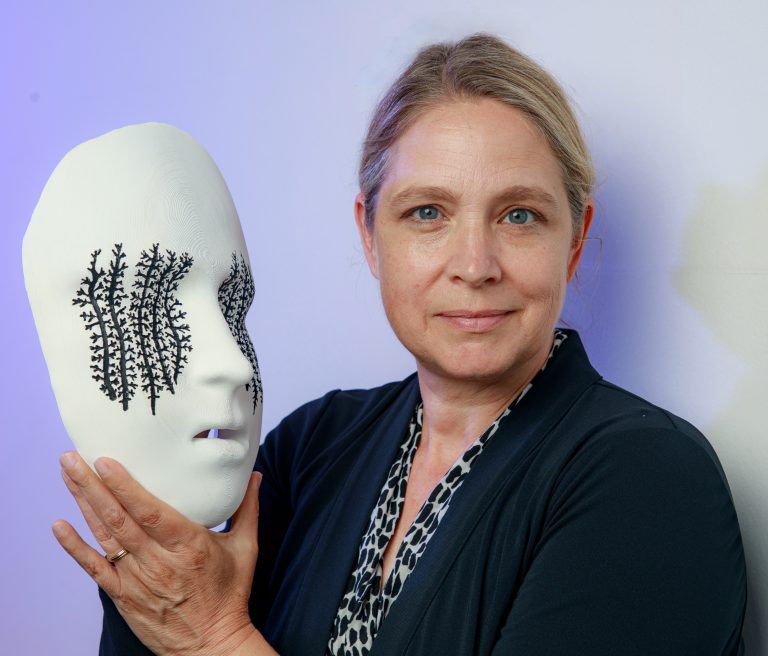
Sculptor Kimberly Callas. Image courtesy of Kimberly Callas.
Ocean Reach isn’t the first time Callas has worked with 3D printing. She has been using the technology for several years in sculptures inspired by the ocean and the environment. Her solo exhibition, Ocean Bodies, shown at Monmouth University in 2025, featured a series of works made with 3D printed biofilament. Other projects have included her long-running Portrait of the Ecological Self series, as well as Ocean Swimmers (Entanglement), a solo exhibition in Budapest inspired by marine ecosystems.
Art like Callas’ reminds us that 3D printing is also a creative medium. Artists around the world are using the technology to experiment with form, texture, and materials. Some create large sculptures. Others produce wearable pieces, jewelry, furniture, or interactive installations. Callas is part of this growing group of artists who are exploring how digital fabrication can support this type of environmental storytelling.
Subscribe to Our Email Newsletter
Stay up-to-date on all the latest news from the 3D printing industry and receive information and offers from third party vendors.
Print Services
Upload your 3D Models and get them printed quickly and efficiently.













You May Also Like
3D Printing Financials: $28M in China, U.S. Deals and a Metal AM Comeback
Money continues to go into additive manufacturing (AM). From a $30 million raise for a Chinese metal 3D printing company to new funding for naval AM and a European company...
AmeraLabs Offers New Dental 3D Printing Resins
Lithuania-based AmeraLabs is putting new dental 3D printing resins on the market. Its new Made in Europe resins will include one material for impression trays, one for surgical guides, and...
AM Pulse Asia: Consumer Metal AM, Nuclear Parts and Rockets Push New Ground
The second half of August produced financing milestones, facility openings, and qualification results across Asia-Pacific additive manufacturing. Rongsu Technology closed a CNY 100 million Series A+ and launched a consumer...
3D Printing Financials: New Money Flows Into Medical, Industrial and AI 3D
Money continued to move into 3D printing in the second half of August. Hike Medical raised $22.5 million as it grows its 3D printed custom medical device business. Swiss additive...