
Loughborough University Using Freemelt’s EBM Technology to Drive AM Research

To help drive additive manufacturing (AM) research, Loughborough University in England is using Electron Beam Melting (EBM) technology from Swedish metal AM company Freemelt. This work is being led by Moataz Attallah, Professor of Advanced Materials Processing (Metallics) and the Dean of the School of Aeronautical, Automotive, Chemical, and Materials Engineering. Loughborough is only the latest in an ever-growing list of research institutions and companies around the world, from the U.S. and Italy to Sweden, Hungary, and the U.K., to adopt Freemelt’s solutions.
Professor Attallah has been working with laser-based AM for over 15 years, and knows well the strengths, as well as the restrictions, of laser technologies, especially when it comes to printing challenging metals like copper, molybdenum, niobium, tungsten, and tantalum. One of the main reasons Professor Attallah and Loughborough chose Freemelt is due to its open architecture design.
“Electron beam technology succeeds where other additive techniques have struggled. The Freemelt system stands out by being open, flexible, and accessible for researchers. It allows us to experiment with parameters, explore new alloys, and develop processes that are impossible on closed commercial platforms,” Professor Attallah explained.
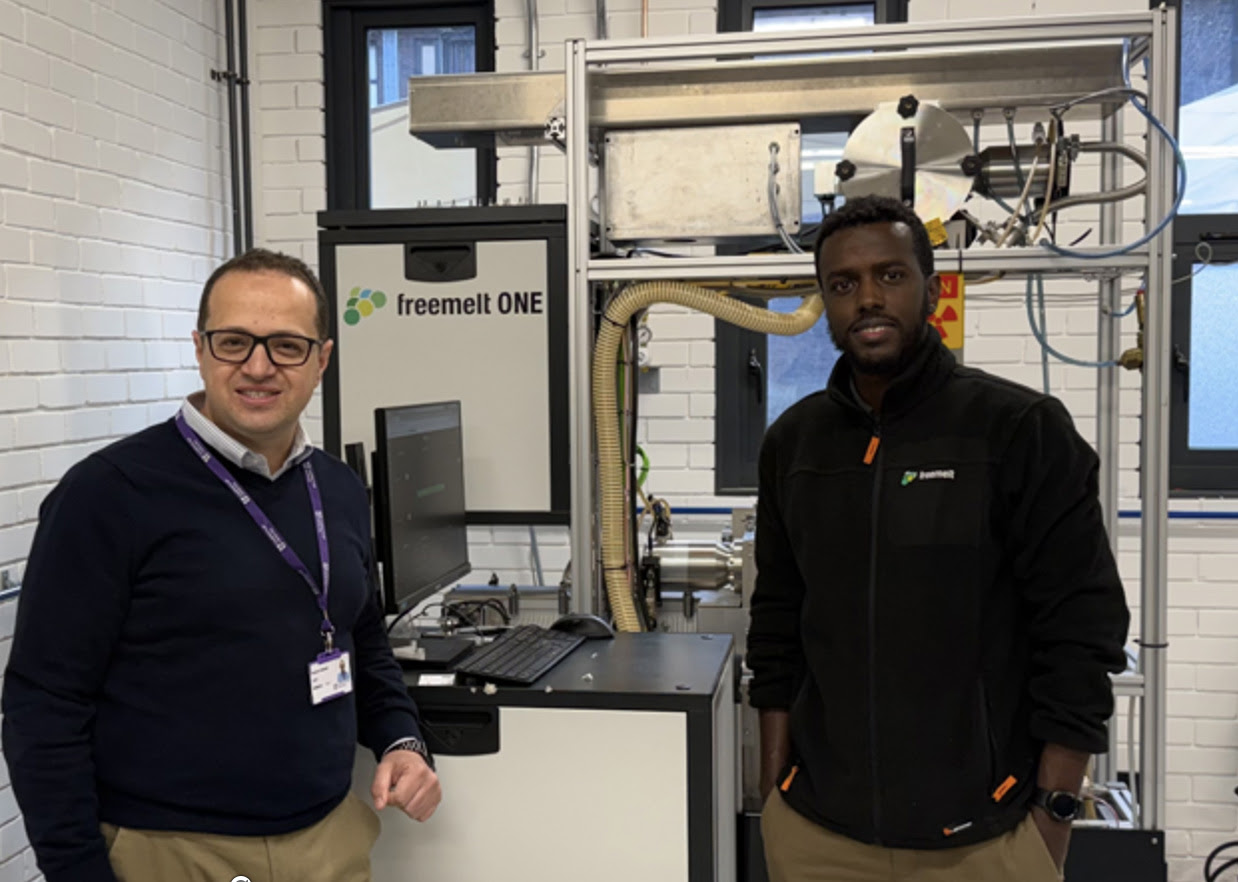
L-R: Professor Moataz Attallah, Loughborough University, and Mohamed Said, Service Technician at Freemelt. Image: Loughborough University.
Open systems offer users more control over printing process parameters, and make it possible to experiment with proprietary and commercial alloys. All of these factors are very useful in a research setting. With open architecture designs like Freemelt’s, researchers can enjoy much more flexibility, but without the typical barriers that come with industrial machines and jam up the process.
“The uniqueness of Freemelt lies in its open-source approach, affordability, and capability to push boundaries in materials science. It empowers universities and research labs to do the real science that drives the field forward,” Professor Attallah continued.
Freemelt has been steadily making a name for itself in the industry. The company prides itself on being a “productivity partner,” as its website states, offering customers strong technical support right from the start, all the way to full-scale production. The company also currently offers free sample parts, so potential customers can carry out initial testing and determine technical feasibility before acquiring a Freemelt system.
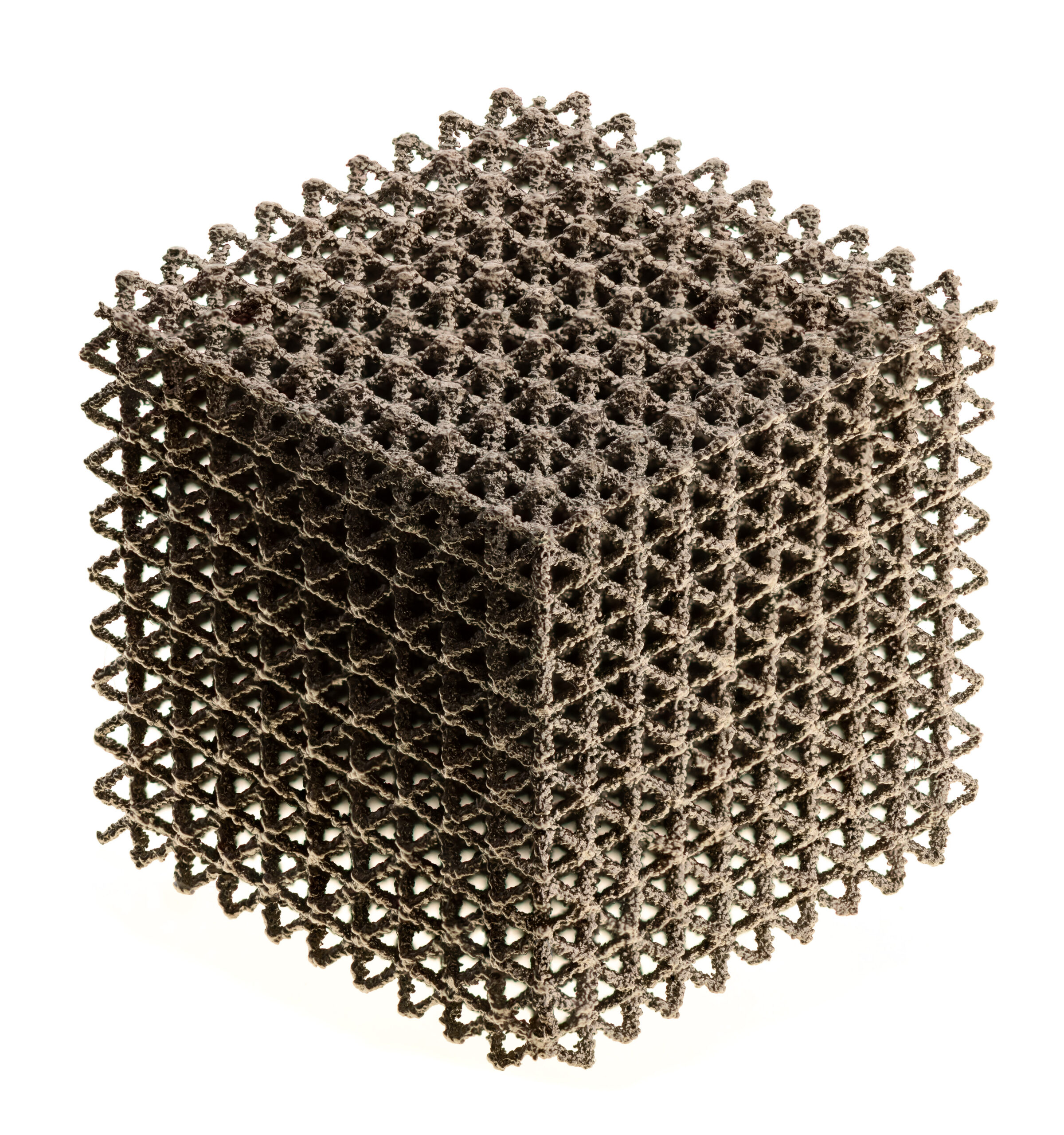
Cube lattice in Ti64. Image courtesy of Freemelt.
The Freemelt ONE, developed specifically for materials research, has already been fully integrated into the materials lab at Loughborough University. As opposed to other laser-based systems, EBM technology operates in a vacuum environment, which makes it a good choice for highly reflective and oxygen-sensitive materials for aerospace, defense, and energy applications. It features a 6 kW electron gun for fast processing, >1200 °C powder bed temperatures, and a small, 70L vacuum chamber. It also has exchangeable panels for easy cleaning access, which makes it a particularly good fit for a research setting.
The university says its Freemelt ONE is already being used for several high-impact research projects, including the exploration of niobium-based alloys for spacecraft propulsion systems, investigating 3D printing of refractory alloys and the role of oxygen uptake in a collaborative project led by the University of Birmingham, and developing advanced tungsten structures with Tokamak Energy and Metamorphic.
“If we want to build nuclear fusion reactors or next-generation spacecraft, we need sustainable manufacturing methods for critical materials,” Professor Attallah said. “EBM not only enables this but also offers the scalability and efficiency to make it viable.”
By combining Freemelt’s open architecture with process optimization driven by artificial intelligence/machine learning and alloy development, the Loughborough University researchers can speed up print parameter discovery, make builds more robust, and grow their qualified materials window.
Featured image courtesy of Freemelt
Subscribe to Our Email Newsletter
Stay up-to-date on all the latest news from the 3D printing industry and receive information and offers from third party vendors.
Print Services
Upload your 3D Models and get them printed quickly and efficiently.













You May Also Like
3D Printing News Briefs, September 26, 2026: Bioceramic Implants, 3D Concrete Printing, & More
In this weekend’s 3D Printing News Briefs, we’ll start with an integration between PanOptimization and AMCM, before moving on to healthcare news from KLS Martin and Lithoz, and then UltiMaker...
3D Printing News Briefs, September 24, 2026: Metallic Alloys, Nanobone, Alternative Meat, & More
In this week’s 3D Printing News Briefs, we’ll discuss some materials news: a reference material for standardizing photopolymer manufacturing, metallic alloys that help reduce energy loss in electric motors, a...
AMAsia Pulse: AM Investment Picks Up Across Asia-Pacific
The first half of September brought fresh investment and expansion activity across Asia-Pacific’s additive manufacturing sector. China’s Xinjinghe secured funding for an aerospace AM hub, South Korea’s Lincsolution outlined plans...
3D Printing News Briefs, September 17, 2026: 3D Printed Boat, UAS Development, & More
We’ll start with maritime manufacturing in this week’s 3D Printing News Briefs, and continue on to defense 3D printing. We’ll end with funding for Tripo AI. Read on for all...























































