3D Printing Financials: Stratasys Tightens Operations in Slow Market

Stratasys (Nasdaq: SSYS) is entering 2026 after a difficult year for revenue, but with tighter cost control and improved cash flow. The company’s latest financial results show that revenue remains under pressure, but management says its focus on discipline and stability is helping it prepare for the industry’s next phase of growth. That message feels even more relevant right now, coming just days after Stratasys CEO Yoav Zeif delivered the keynote address on the “State of the AM Industry” at Additive Manufacturing Strategies (AMS) 2026 in New York, where he positioned Stratasys as a company prepared for the next phase of AM growth.

Stratasys CEO Yoav Zeif at AMS 2026. Image courtesy of 3DPrint.com.
For the fourth quarter of 2025, Stratasys reported revenue of $140 million, down from $150.4 million in the same period a year earlier. The company posted a net loss of $18.9 million, or 22 cents per share. Last year’s quarter included a one-time loss tied to Stratasys’ investment in UltiMaker, the desktop 3D printing company created when MakerBot merged with Ultimaker. Still, on an adjusted basis, Stratasys remained profitable, reporting net income of $6.2 million, or 7 cents per share.
For the full year, revenue came in at $551.1 million, compared to $572.5 million in 2024. The company recorded a full-year net loss of $104.3 million, or $1.28 per share. Meanwhile, adjusted net income rose to $12.7 million, or 15 cents per share, up from $4.2 million, or 6 cents per share, the year before.
And that’s really the main story here. Revenue is still under pressure, especially for new systems, but Stratasys has been able to keep parts of the business stable through cost controls, recurring revenue, and tighter operations.
In the fourth quarter, product revenue fell to $97.6 million from $105.1 million a year earlier. Within that, system revenue was $37.8 million, down from $46.7 million in the prior-year period, as many customers continued to hold back on capital purchases. Consumables revenue, however, rose to $59.8 million, up 2.4% year over year. That is an important point, because consumables sales often say a lot about how actively customers are using their printers.

Stratasys booth at MILAM 2026. Image courtesy of 3DPrint.com.
On the services side, revenue also declined, falling to $42.4 million from $45.3 million in the fourth quarter of 2024. Customer support revenue was $29.6 million, down from $30.6 million.
For the full year, product revenue totaled $380.3 million, compared to $392 million in 2024. System revenue was $131.6 million, down from $140.3 million, while consumables revenue fell to $248.7 million from $261.7 million. Service revenue for the year was $170.8 million, compared to $180.5 million in 2024, and customer support revenue declined to $119 million from $124.7 million.
Margins also moved lower. Fourth-quarter gross margin was 36.8%, down from 46.3% a year ago. At the same time, adjusted gross margin came in at 46.3%, compared to 49.6% last year. For the full year, gross margin was 41.2%, down from 44.9%, while adjusted gross margin fell to 46.9% from 49.2%.
During an earnings call with investors, CFO Eitan Zamir said the year-over-year change in gross margin was “the result of the tariff impact, lower revenues, and change in mix.” Even so, Stratasys was able to improve expenses. Fourth-quarter operating expenses fell to $72.2 million from $79.4 million.
That helped the company improve some profitability measures, even though sales were weaker. Fourth-quarter adjusted operating income was $4.1 million, down from $9.4 million, while adjusted EBITDA came in at $9.2 million, or 6.6% of revenue, compared to $14.5 million, or 9.6%, a year earlier. What’s more, for the full year, the company showed improvement. Even with lower revenue, Stratasys managed to increase its adjusted profitability.
Cash flow is another area that management highlighted heavily during the earnings call. Stratasys generated $4.8 million in operating cash flow in the fourth quarter and $15.1 million for the full year, nearly double the $7.8 million generated in 2024. It ended 2025 with $244.5 million in cash, cash equivalents, and short-term deposits, and no debt.
“Our fourth quarter performance caps a year in which we successfully maintained our operational discipline, delivered solid cash flow generation and protected our margin profile, demonstrating once again the resilience that distinguishes Stratasys. Importantly, even in a market environment marked by macro spending constraints, we continued to improve our position in our focused target areas as we drove positive cash flow and profitability, setting us apart from our industry peers,” Zeif told investors.
For Stratasys, that balance sheet remains one of the company’s strongest talking points. At a time when much of the additive manufacturing sector is still dealing with weak demand, restructuring, or financial uncertainty, Stratasys is trying to show that it has the flexibility to keep investing while also exploring acquisitions and partnerships.
Zeif noted that “Combined with our strong balance sheet, this positions us to capitalize on inorganic opportunities that we continue to explore.” He also told investors that “our commitment to innovation remains unwavering, supported by a strong balance sheet and continued R&D investment.”

Stratasys booth at MILAM 2026. Image courtesy of 3DPrint.com.
Zeif also spoke about the company’s broader strategy during the call. He said Stratasys’s “operational discipline” and “financial resilience” set it apart from peers, and pointed to aerospace and defense, automotive tooling, dental, and medical as some of the company’s most important growth areas.
The executive also pointed to a longer-term trend: more of Stratasys’ revenue is now coming from manufacturing applications. In 2025, those uses accounted for 37.5% of revenue, up from 36% in 2024 and just over 25% in 2020. That matters because the company, like much of the industry, has spent years trying to move beyond prototyping and into real production. Management wants investors to see that the move toward production is real, even if spending is still recovering.
The company also used the call to shed light on several application wins and partnerships. For example, in aerospace, it pointed to its Airbus relationship, saying more than 25,000 flight-ready parts were produced last year using Stratasys’ ULTEM 9085 material, with more than 200,000 certified Stratasys parts now in active service across Airbus platforms. Zeif also highlighted Boeing activity, drone-related demand, and growth in defense.
In automotive, Stratasys pointed to Subaru of America’s use of its new T25 high-speed head for the F770 printer, as well as Rivian’s deployment of 28 Stratasys systems. The company also emphasized newer partnerships in software, post-processing, and channel distribution, including Novineer, PostProcess Technologies, and Hawk Ridge Systems.
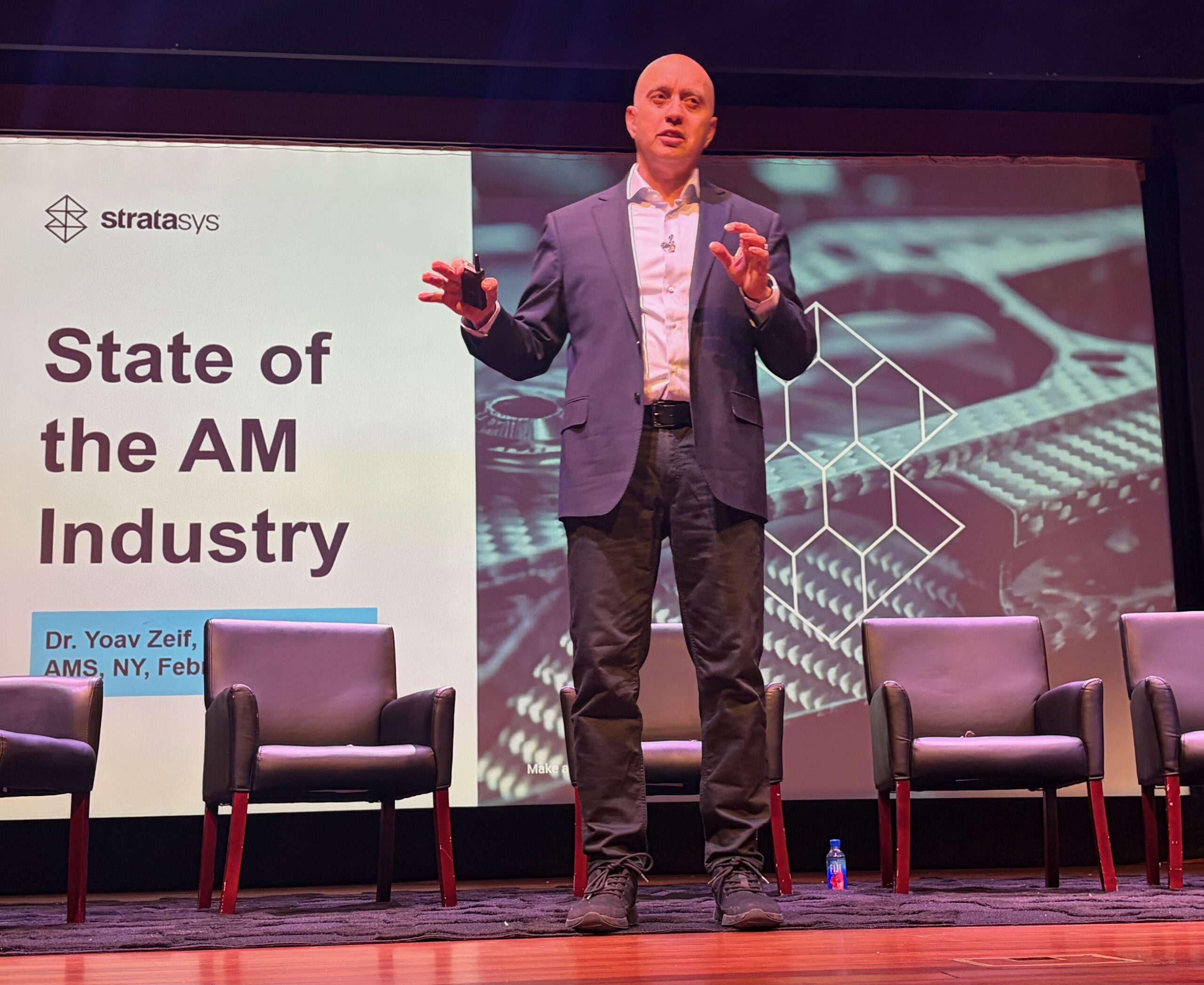
Stratasys CEO at AMS 2026. Image courtesy of 3DPrint.com.
For 2026, Stratasys’ guidance estimates revenue of $565 million to $575 million, which would mark a return to growth. Management said revenue should improve sequentially through the year, with the second half stronger than the first.
At the same time, Stratasys said tariffs and currency changes are putting pressure on the business. The company also warned that tariffs and currency changes could hurt results in 2026. Together, they are expected to have a roughly $17 million negative impact compared to 2025.
Stratasys slightly beat Wall Street’s expectations for the quarter, reporting revenue and adjusted earnings above analyst forecasts. However, sales were still down year-over-year, and the company issued cautious guidance for 2026.
For Zeif, growth is returning, but not in a straight line and not without outside pressures. Management also said the first quarter will likely be the weakest quarter of the year. Still, that caution probably makes sense. The company is still operating in a market where customers are interested, but many are quite careful with their capital spending. On the call, Zeif said Stratasys has seen sales cycles start to shorten over the last three quarters, which he considered a positive sign that demand is there, even if some of the decisions are still taking time.
That context also helps explain why Zeif’s AMS 2026 keynote matters. At the conference in New York, he spoke about the next phase of growth for additive manufacturing. The company’s latest earnings suggest Stratasys is preparing for that moment by tightening operations, building cash, and focusing on production applications while the market remains slow.
Subscribe to Our Email Newsletter
Stay up-to-date on all the latest news from the 3D printing industry and receive information and offers from third party vendors.
Print Services
Upload your 3D Models and get them printed quickly and efficiently.











You May Also Like
Nikon Records $591M Metal AM Write-Down, Maintains Long-Term Focus
Nikon (OTCMKTS: NINOY) has announced a large impairment loss tied to its Digital Manufacturing business, the part of the company that includes metal 3D printing and advanced manufacturing operations. This...
Championing a Made-in-America Future for Additive Manufacturing
As the additive manufacturing industry continues its rapid global evolution, one theme has risen to the top of strategic conversations: the importance of strengthening domestic production to support national competitiveness...
3D Printing News Briefs, December 11, 2025: Circular 3D Printing Farms, Depowdering, Composites, & More
In this week’s 3D Printing News Briefs, Dyndrite signed an Expression of Interest to partner with IAM3DHUB, while Batch.Works and E3D are partnering to scale circular 3D printing farms. Farsoon...
SwissTo12 Expands To Spain
I’m a huge SWISSto12 fan. The company is quickly expanding by using additive manufacturing to engineer better satellite Radio Frequency (RF) components. Satellite RF is one of the best applications...