Stratasys Makes Navy Parts for Trident Warrior 25

The US Navy’s Trident Warrior 25 is a live fire manufacturing exercise hosted by FLEETWERX, an organization that wants to bring together companies and academia to drive Navy innovation, along with the Naval Postgraduate School’s Consortium for Advanced Manufacturing Research and Education (CAMRE). Together, these groups are working to apply new manufacturing techniques, train people to use them, and test manufacturing technologies in real-world scenarios. In that context, Trident Warrior is the perfect event for them to organize, as it creates a realistic scenario where actual parts are made under real conditions, usually on board ships.
This year’s Trident Warrior is right up our alley, too, with the exercise being the “JAMC, a mobile manufacturing team that allows deployed forces to produce mission-critical parts using 3D printing, machining and augmented reality. This capability enables faster repairs, reduces downtime, and strengthens sustainment operations in forward deployed or contested environments.” It “connects assets across more than 8,000 miles and two continents to demonstrate how distributed production can meet real-world defense needs.”
Distributed manufacturing has long been a buzzword, but actually doing it with additive manufacturing is a little to a lot more difficult than we would like. In this case, the distributed manufacturing was not only done with multiple machines at different locations but also complemented by centralized manufacturing performed by Stratasys’ service bureau, Stratasys Direct. This kind of combination, between lower-cost, smaller-footprint machines and other technologies, along with more centralized production, will be essential for any future austere manufacturing or military MRO program. It is great that they’re testing it here. Very practical considerations can make such an implementation much more difficult than it would seem. Think of things such as a snap-fit part made for material extrusion not fitting with a snap-fit powder bed part, or a hole designed for a material extrusion part working less well with another material, slicer, or machine. Or a hinge that just doesn’t work on another machine or technology. It’s these practical considerations that tend to come to light with these exercises.
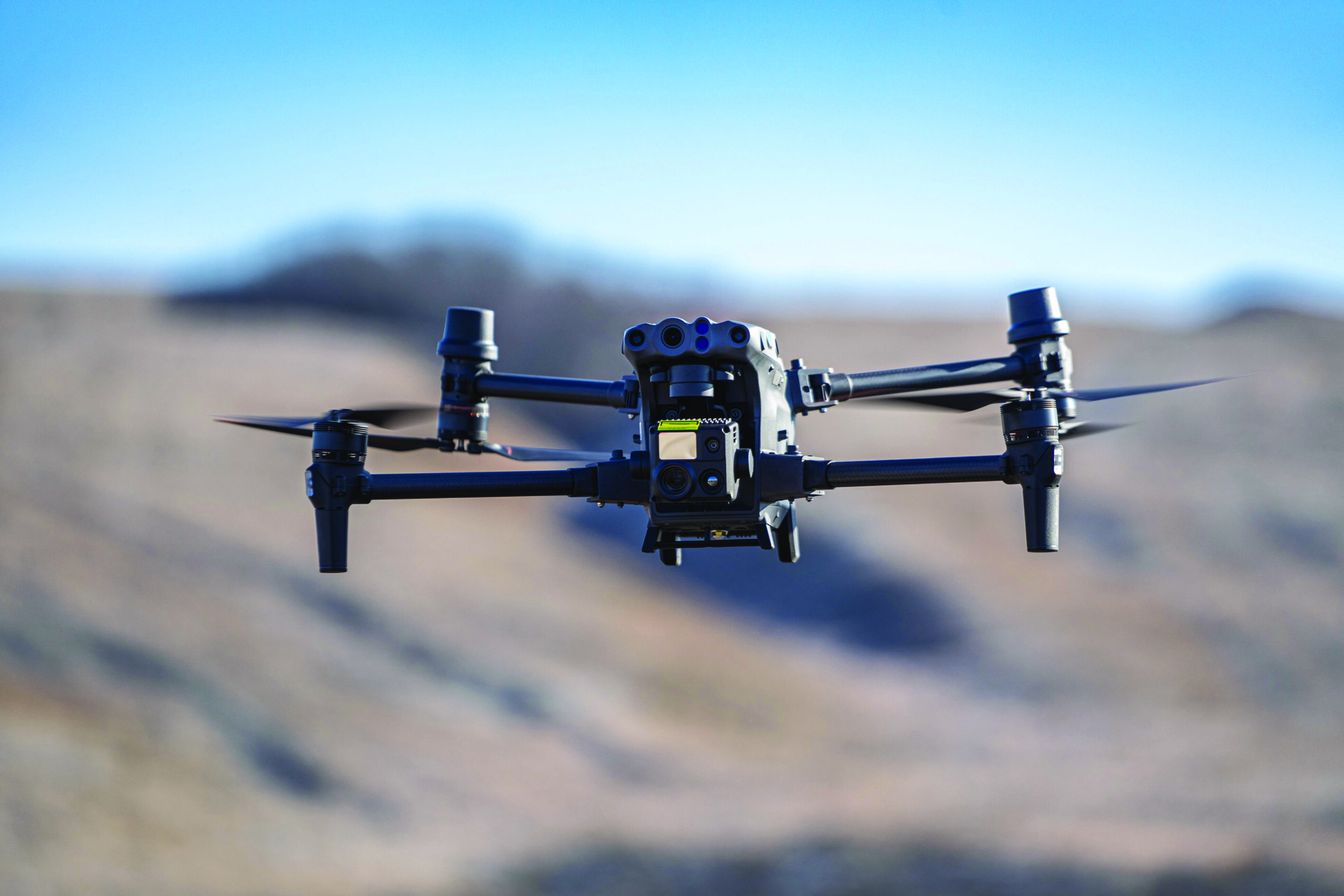
Military drone in flight observing positions. Image courtesy of Stratasys.
The JAMC, or Joint Advanced Manufacturing Cell, brought together seven teams, spanning a distance of up to 12,800 kilometers. In this case, the company says that “Trident Warrior 25 also demonstrated that by deploying 3D printers in the field, there is reduced reliance on traditional logistics chains.” In this case, teams created new parts and made spares.
Morgan Bower, Program Manager, FLEETWERX, said,
“Trident Warrior 25 demonstrated the value of a multi-echelon polymer advanced manufacturing network. By pairing field-ready solutions in forward-deployed environments with cutting-edge manufacturing expertise, the team cut lead times for critical components and boosted mission resilience.”
Meanwhile, CAMRE Program Manager Chris C. Curran said,
“Our collaboration with Stratasys and FLEETWERX during Trident Warrior highlights how academia, industry, and the military can work together to validate and accelerate new technologies.These efforts are crucial to building resilient, distributed manufacturing ecosystems for the fleet.”
While Lieutenant Colonel Michael D. Radigan, U.S. Marine Corps. Marine Innovation Unit stated,
“We’re focused on integrating advanced manufacturing into logistics and maintenance operations to enhance readiness and resilience. Exercises like Trident Warrior demonstrate how distributed manufacturing will add resilience to supply chains and deliver increased readiness and lethality to combatant commanders.”
This is an important win for Stratasys. The company is a supplier of Fortus systems to the Air Force. These have been used for years to create improvised parts, refit existing parts, and produce spares in Ultem. The central promise of the Stratasys FDM ecosystem is also centered on its commitment to reliability, repeatability, and uptime. If Stratasys can parlay its early success in the Air Force into wider success throughout the military, it stands to gain big. The market opportunity in just the US military is massive. With all of its exquisite gear, the US military needs a far-flung rapid MRO capability. Any comfort about Stratasys machines’ ability to make parts on a ship or at a remote location, exactly the same way, will be meaningful progress for the firm.
Subscribe to Our Email Newsletter
Stay up-to-date on all the latest news from the 3D printing industry and receive information and offers from third party vendors.
Print Services
Upload your 3D Models and get them printed quickly and efficiently.













You May Also Like
AI Design and Point-of-Care Integration Headline ADDITIV Medical 2026
Medical additive manufacturing is expanding rapidly inside major healthcare institutions. In 2026 alone, hospital systems including Indiana University Health and Sheffield Teaching Hospitals launched dedicated point-of-care 3D printing facilities to...
GKN Aerospace’s UAV Demonstrator with 3D Printed Engine Avoids ITAR Regulations
The US CIA director recently made an unannounced visit to Moscow that has naturally raised much speculation, while the EU and NATO have now officially accused Russia of being behind...
The Business Case for 3D Printed Stents
A new 3D printed stent developed at New York University (NYU) does not look like the devices doctors typically use today. Instead of a simple tube, the prototype resembles a...
3D Printing Financials: 3D Systems, Prodways, and Align Build on Positive Momentum
The latest earnings from 3D Systems (NYSE: DDD), Prodways (EPA: ALPWG), and Align Technology (Nasdaq: ALGN) show that the 3D printing market continues to move forward. Some businesses are growing...