
Generative AI Is Moving From Design to Factory Floors: TCT Asia 2026 Shows the Full Workflow


Generative AI is rapidly moving beyond digital experimentation and into real manufacturing environments — but the key challenge remains: can AI-generated 3D models move seamlessly from creation to production?
At TCT Asia 2026, technology developers across the AI-driven 3D ecosystem will present integrated solutions that demonstrate how generative design, engineering optimization, printable model preparation, and editable 3D assets are converging into a complete production-ready workflow.

Unlike early-stage demonstrations focused on isolated capabilities, exhibitors at TCT Asia 2026 will highlight end-to-end digital-to-physical pipelines, including AI-based 3D model generation, engineering-grade geometry optimization, printable model preparation, high-resolution texture generation, and editable AI-generated 3D content. Together, these developments signal a shift from AI as a creative tool toward AI as an operational manufacturing technology.
From AI Creation to Production-Ready Assets
Platforms such as Tripo Studio will present next-generation AI-driven 3D creation systems capable of generating high-precision models directly from text, images, or sketches. Its latest release, Tripo High-Poly 3.0, introduces dual-output workflows designed to balance production efficiency with ultra-high geometric fidelity, supporting applications ranging from product design and gaming assets to additive manufacturing.
Bridging Generative AI and Printable Manufacturing
Meanwhile, MeshyAI Creative Lab focuses on closing the gap between generative design and manufacturing execution. The platform automatically repairs geometry, validates manufacturability, and recommends materials, surface finishing methods, and printing parameters. Through integrated manufacturing partner networks, users can obtain real-time quotations and production options, enabling a direct pathway from AI-generated design to physical parts — even without advanced CAD expertise.
Foundation Models Reshaping the 3D Pipeline
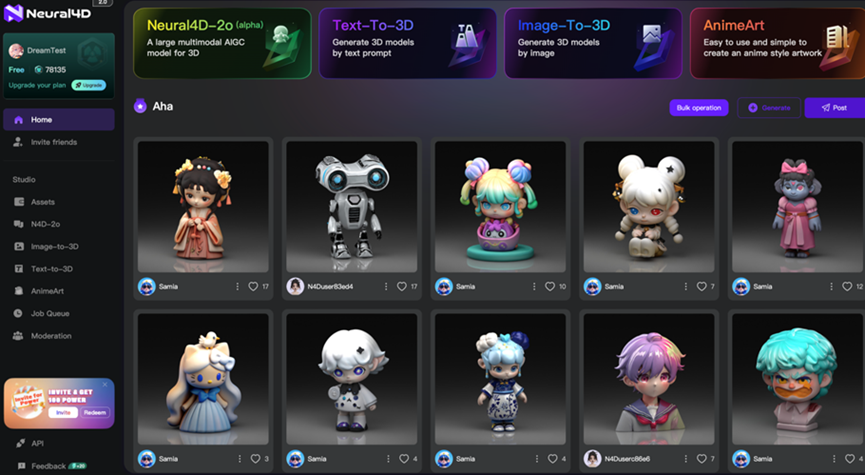
Advances in native 3D foundation models are also accelerating industrial adoption. DreamTech (Booth 8N118) will showcase its Neural4D series, demonstrating how large-scale 3D/4D generative models can support digital content creation, engineering design, and physical manufacturing applications while significantly reducing training costs through sparse 3D learning architectures. These developments highlight how AI infrastructure is rapidly maturing to support production-level deployment across industries.
Structurally Aware Texturing for Real Manufacturing
Beyond geometry generation, high-resolution texture systems are becoming increasingly important for downstream manufacturing and visualization. Hitem3D (Booth 8C35) will introduce Hitem3D 2.0, featuring structurally aware PBR texture generation that integrates material and geometric logic directly into the generation process, producing more realistic results while improving consistency for additive manufacturing workflows.

Entering the Era of Editable AI-Generated 3D
Another emerging frontier is the ability to edit and iteratively refine AI-generated 3D assets. Hyper3D.AI, developed by Yingmou Technology, will present its approach to enabling localized editing, versioned iteration, and controlled evolution of AI-created 3D models. The company will debut this framework during the TCT Introducing product launch sessions, highlighting how editable AI-generated 3D content could fundamentally reshape long-term digital design and manufacturing workflows.

A Convergence Point for AI-Driven Manufacturing
Together, these innovations reflect a broader industry transition: generative AI is moving beyond visual experimentation to become an integrated component of real production pipelines. TCT Asia 2026 will serve as one of the first major international stages where the full AI-to-manufacturing workflow — from generative modeling to physical output — is demonstrated at scale.
TCT Asia 2026 will take place 17–19 March 2026 at the National Exhibition and Convention Center (Shanghai). For manufacturers, designers, and technology leaders evaluating the readiness of AI-generated 3D models for real-world production, the event offers a comprehensive view of how rapidly these technologies are advancing from concept to industrial reality.
Don’t miss the chance to witness the full AI-to-manufacturing workflow in action. Reserve your visit to TCT Asia 2026 today.
Subscribe to Our Email Newsletter
Stay up-to-date on all the latest news from the 3D printing industry and receive information and offers from third party vendors.
Print Services
Upload your 3D Models and get them printed quickly and efficiently.













You May Also Like
3D Printing News Briefs, August 22, 2026: Polymers for CubeSats, Animal Mobility Devices, & More
We’re starting with defense news in this weekend’s 3D Printing News Briefs, before moving on to polymers for CubeSats and 3D printed prosthetics. We’ll end with a story about engineering...
Pusan National University & ORNL Develop Elastomeric Liquid Crystal Actuators
Researchers from Korea’s Pusan National University and Oak Ridge National Laboratory (ORNL) have developed 3D printed elastomeric actuators. In a paper published in Nature, the team used elastomeric liquid crystal...
Scientists Use BMF to 3D Print Seal Whiskers That Track Prey Long After It’s Gone
Seals use their whiskers to hunt. Not Navy Seals, although they may in some way also, but this article is about lowercase seals. Not Seal the musician either; as far...
Harvard’s Jennifer Lewis Lab Is 3D Printing Artificial Muscles That Twist and Bend on Demand
Researchers at Harvard John A. Paulson School of Engineering and Applied Sciences (SEAS) have developed a new way to 3D print materials that can move on their own, bending, twisting,...























































