UpNano Enters Chinese Market

Viennese firm UpNano has successfully commercialized 2-photon polymerization (2PP) technology for the research market and beyond, leading to its global rollout. Now the firm has made the decision to enter the Chinese market, working with distributor Husun Technologies to drive growth there.
Husun will deploy a NanoOne 1000 printer in a lab to demonstrate the efficacy of the technology to clients. The company wants to enter the Chinese market for perceived growth there and is aiming for success in “microfluidics, optics, biomedical engineering, and electronics” — all fields where China is strongly positioned. Husun will target clients in both universities and industries, such as “medical devices, semiconductors, and photonics.” UpNano will also train Husun staff in operating the machine.
UpNano CEO Bernhard Küenburg,
“China is an important and challenging market. We are very pleased to have found in Husun an experienced and reliable partner to build our presence there. Husun will be part of our extended team, and together we want to establish our 2PP technology in China. For us, this is a major step, and we are confident it will open new opportunities for customers across research and industry.”
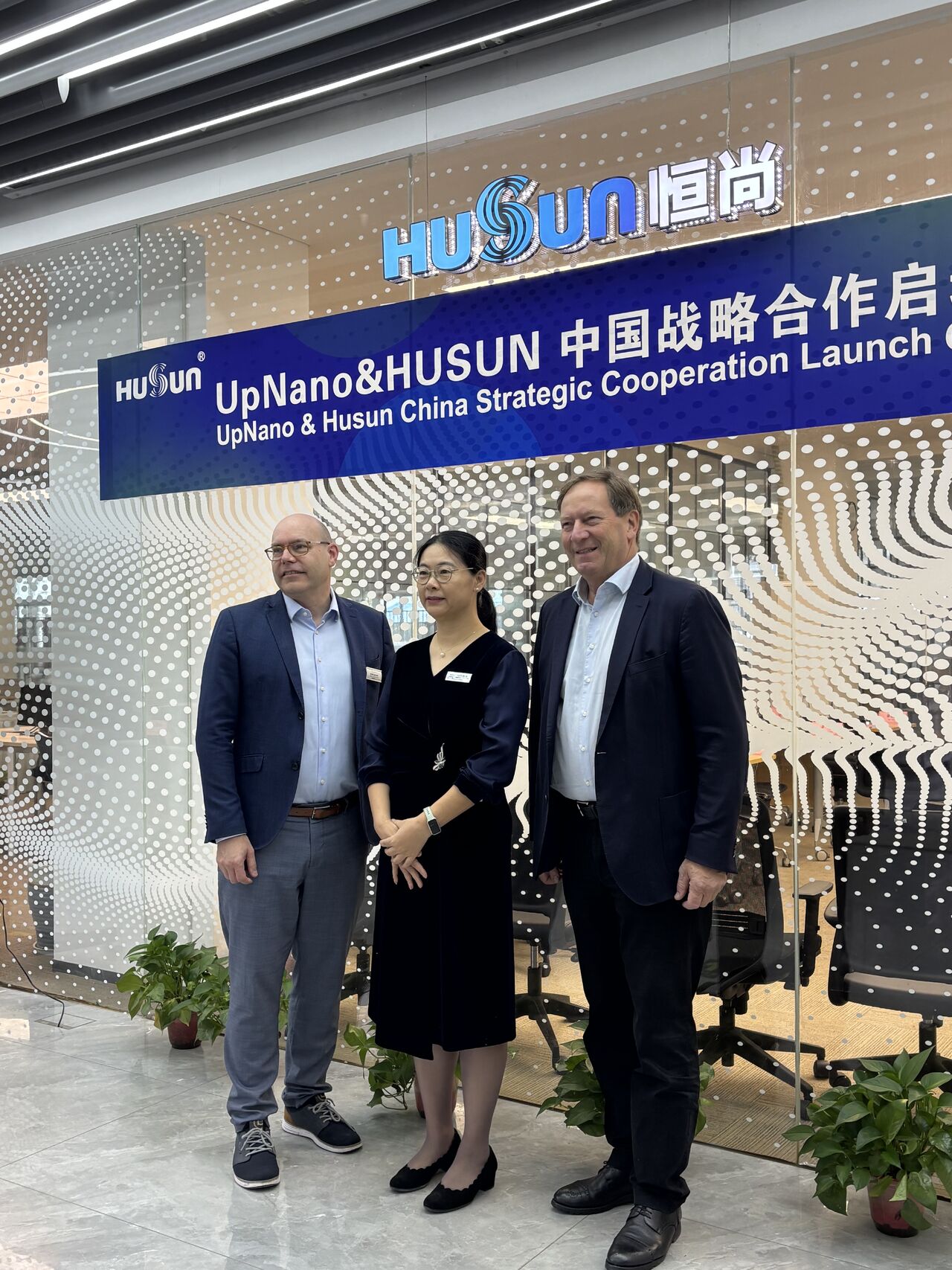
Henrik Akesson and Bernhard Kueenburg, CBO and CEO of UpNano, at Husun Technologies. Image courtesy of UpNano via LinkedIn.
Husun CEO, Ms Yongfeng Qiao, said,
“The technology of UpNano is a valuable addition to our portfolio of high-performance 3D printing solutions.Together we will develop a strong customer base in both academia and industry. At a time when precision requirements are rising across sectors, a system capable of tolerances below 100 nm is a perfect fit with excellent prospects.”
The Chinese economy has been struggling with capital flight, a deteriorating business climate, and a multiyear slowdown. Having said that, there is a real thirst to be on the edge of semiconductors and photonics. The research money on offer there for those research areas is very generous indeed. As a research machine, UpNano could well find much broader adoption there than in other parts of the world. Husun, meanwhile, is already a partner for EOS. Previously, the firm was the Chinese partner for Arburg, Farsoon, and Optomec. They have experience in the field and should have a network.

Bernhard Kueenburg, CEO of UpNano, at Husun Technologies. Image courtesy of UpNano via LinkedIn.
For China to catch up in the latest chip foundries, as well as in the development of the latest chips and bleeding-edge photonics, is strategic. If China were to dominate photonics in particular, it could give itself a leap forward over competitors. There’s only so much to be gained from assembling blenders and making plastic Christmas trees. But owning the development, innovation, and production of photonics would be a high-value, strategic industry that could control the future of lasers, communications, and computing. Many developments, from data centers to quantum, AI, and improved inertial navigation, are converging in photonics. And if it wins there, it won’t get parity, as billions invested in chipmaking are trying to accomplish, but rather own the future. If I were to hazard a guess at which countries will invest the most in photonics research, I’d put China in first place.
So on the one hand, this at first glance looks like it’s an almost inevitable deal that will bring growth to UpNano. UpNano’s multiscale additive technology can not only make small things but also bigger objects with small details, and this is a unique ability to add performative features and capabilities to many objects from microns to centimeters. That is why people want to invest in working with this technology. But, at the same time, this makes it very likely that one or more players will copy the Austrian company’s technology. I know that China also innovates and is at the forefront of a lot of innovation now. But generally, many Chinese companies steal technology and reverse engineer machines and then put copies on the market. I know I’m not supposed to talk about this, but it’s true. In additive, we’ve seen this happen many times. And what’s more, it works; four of the largest Chinese Additive firms have based their fortunes on one-to-one copies of known, identifiable machines by Western firms. And I fear that this is exactly what will happen to UpNano here.
Subscribe to Our Email Newsletter
Stay up-to-date on all the latest news from the 3D printing industry and receive information and offers from third party vendors.
Print Services
Upload your 3D Models and get them printed quickly and efficiently.













You May Also Like
Why the AM Industry Should Pay Attention to Schneider Electric’s $22.6B PTC Acquisition
By late 2024, there was already enough signaling of the additive manufacturing (AM) industry opportunity in the data center infrastructure market for AM Research to write a report on the...
How Does Nike’s 3D Printing Approach Fit Into Its Restructuring Plan?
Shares of Nike stock hit all-time highs in late 2021 but have cratered in the years following, with the company losing nearly 80 percent of its market cap since peaking....
3D Printing News Briefs, October 1, 2026: Defense, Enclosures, & More
In today’s 3D Printing News Briefs, we’re starting with defense news, first from Massivit and then from AML3D. Then we’ll move on to U.S. manufacturing of a new large-format LPBF...
South Korea’s Lincsolution Lands Hanwha Defense Deal as Hanwha Invests Billions in US
I recently wrote about how the South Korean additive manufacturing (AM) firm Lincsolution is building an aerospace and defense hub, part of the company’s construction of “the largest AM facility in...