UT Southwestern Medical Center Receives $25 Million ARPA-H Award to 3D Print Livers


UT Southwestern Medical Center (UTSW) was awarded a $25 million grant from the Advanced Research Projects Agency for Health (ARPA-H) to use patient stem cells to 3D print livers. The Vascularized Immunocompetent Tissue as an Alternative Liver (VITAL) project is a part of ARPA-H’s Personalized Regenerative Immunocompetent Nanotechnology Tissue (PRINT). ARPA-H is a fantastic initiative, and one of the smartest things that the US does. It takes very smart, experienced program managers and gets them to invest in impossible, high-impact research that isn’t getting funded. The team looks at where pharma, universities, and startups are already making headway, and then looks towards where headway is not being made. Every single country on earth should do something similar. It’s a great way to fund completely new approaches, new science, and new products.
Muhammad Rizwan, Ph.D., Assistant Professor of Biomedical Engineering and Ophthalmology at UT Southwestern.
UTSW Assistant Professor of Biomedical Engineering and Ophthalmology Muhammad Rizwan is the principal investigator. He says,
“Over the last two decades, researchers have made remarkable progress toward the goal of creating lab-made organs, including innovations in biomaterials, stem cell differentiation, and bioprinting. UT Southwestern is an ideal environment to bring together the recent advances that have never been combined before.”

Samuel Achilefu, Ph.D., inaugural Chair of Biomedical Engineering and Professor in the Harold C. Simmons Comprehensive Cancer Center and of Radiology at UT Southwestern.
Another investigator, Dr. Achilefu, Biomedical Engineering and Professor in the Harold C. Simmons Comprehensive Cancer Center and of Radiology at UTSW, said,
“This project represents a bold step toward advancing patient care through biomedical innovation. It unites engineers, clinicians, and scientists to transform discovery into real-world solutions, shaping a future where functional organ printing becomes reality.”
In the project, harvested cells will be turned into induced pluripotent stem cells and then converted into a hydrogel bioink. The team hopes to test these liver constructs in animals. Vascularization is the major roadblock in bioprinting, and the team thinks that it has solved this issue. The researchers hope to industrialize this process, and also believe they can successfully create bile ducts. They hope to be able to make livers in 13 weeks that would not require expensive immunosuppression. If true, then this team will leapfrog nearly all similar initiatives in creating functioning organs.
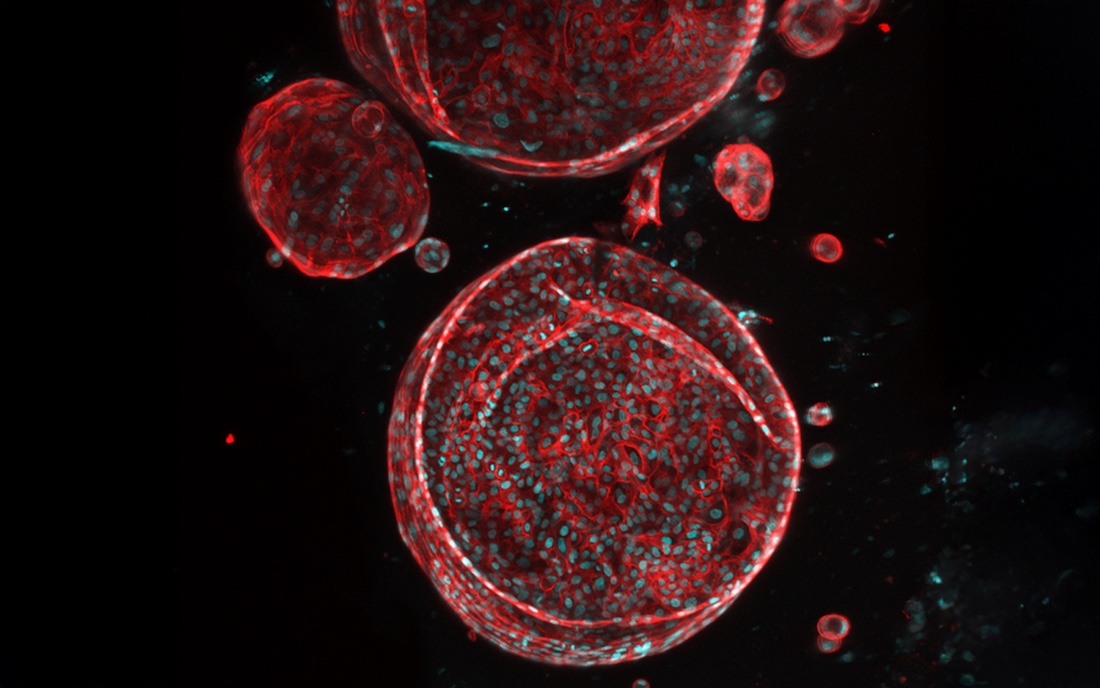
Patient biopsy-derived liver organoids can serve as building blocks for biofabrication of a personalized, patient-specific whole liver. This image shows liver organoids generated from a patient liver biopsy with alcoholic liver disease. CD44 is shown in red marking liver organoids, and cell nuclei are shown in blue. (Photo credit: Sunil Shrestha, Ph.D., postdoctoral fellow, Rizwan Lab)
This project unites many researchers across the UTSW system via a $24,939,120 award under Award Number D25AC000239-00. UT Southwestern is a large, very prestigious, deep-pocketed health research network with many excellent scientists. And this is a substantial award. It’s also not looking to become a drug or to result in one procedure. No, this award is just to generally implement the entire cell as a functioning organ system. So this may work. But kids, don’t hold your breath, and it’s probably still a good idea to drink less. In 2014 we wrote about liver organoids, and in 2016, we wrote hopefully about breakthroughs in 3D printed liver tissue. Wake Forest had a wild ride, as did Organovo, which was talking about 3D printed tissue in animal models in 2014. This long time span and historical optimism is part of the reason why commercial funding for liver 3D printing is hard to come by.
3D printing living tissue, or any tissue at all, is complex because of the sheer number of moving parts, procedures, and other developments needed to make it work. Human organs are very complex and have been very well made naturally over millions of years. Replicating them is hard. Think of it not as a breakthrough in one lab, but rather lots of factories making tools that all get put together in various labs to make a technology possible. It’s more like the way that ASML is making its EUV machines. A globe-spanning series of firms, labs, and tens of thousands of dollars work together to make machines that make parts that go into the machines. 3D printing needs something similar, a kind of Manhattan Project approach rather than a guy with a vial in a lab approach.
Now, $25 million is a lot of money and is well spent on this work. But, it’s the systematic approach of moving all the different parts simultaneously that is notable here. This network-like approach is what is needed, and this project will expose where further research and roadblocks are required in a system-wide approach towards implementation. So far, a lot of people are approaching this issue like, I’m Bob the super scientist and I’ll own this process and the glory in my own lab and make it all here. This more involved, multiple stakeholder approach, using all of these connected scientists, like what’s happening with UTSW, could very well be a more fruitful approach. And, if it doesn’t work, we will actually learn where the roadblocks are, not just hear the same story over and over again.
Subscribe to Our Email Newsletter
Stay up-to-date on all the latest news from the 3D printing industry and receive information and offers from third party vendors.
Print Services
Upload your 3D Models and get them printed quickly and efficiently.













You May Also Like
HeyGears Reflex RS Turbo Sets a New Standard for Resin 3D Printing
When creating highly detailed resin prints, speed only matters if the finished result still captures the details that made the model worth printing in the first place. The HeyGears Reflex...
IFA 2026 Shows Where Multicolor 3D Printing Is Headed
Innovation For All (IFA) is best known for televisions, appliances, and consumer electronics. But this year’s show in Berlin also gave 3D printing companies plenty of room to show where...
3D Printing News Briefs, September 12, 2026: Rebranding, Cybersecurity, Project Call, & More
We’ve got a lot of business news from ATLIX to start off this weekend’s 3D Printing News Briefs, with a new identify for its additive manufacturing (AM) portfolio and some...
Quickparts Builds a Four-Country 3D Printing Network for Space and Defense
For manufacturers trying to win more space and defense work, adding 3D printers is only part of the challenge. They also need to make the same parts to the same...