3D Printing Financials: Invisalign Demand Keeps Align’s 2025 Growth on Track

Align Technology‘s (Nasdaq: ALGN) third quarter showed a company tightening its operations while keeping growth steady. Demand for its Invisalign clear aligners continued to drive growth, led by rising demand among younger patients, while scanner sales cooled, as expected. Profit declined due to restructuring costs, but Align’s global expansion and new digital tools show it’s still moving forward.

Invisalign aligners. Image courtesy of Align Technology.
Align’s revenue came in at $995.7 million, up 1.8% year-over-year but down 1.7% from the previous quarter, a result the company said was expected. The clear aligner segment remained the main driver, with revenues reaching $805.8 million, up 2.4% year-over-year and just 0.1% higher than in Q2 of 2025. Case volume rose nearly 5% from last year and slightly from Q2 of this year. Teen and child treatments were the standout, climbing 8.3% year-over-year and 14.7% sequentially to 256,000 cases, as Invisalign First, Align’s clear aligner line designed for children ages 6 to 10, continued to gain traction. Most of the momentum came from international markets in Europe, the Middle East, and Africa (EMEA), Asia-Pacific (APAC), and Latin America, which helped offset mixed demand in North America.
Earlier in the year, Q1 and Q2 also showed gains in aligners, and Q3 continued that steady trend. Shipment volume rose from 617,220 in Q3 2024 to 647,750 now, making the year-over-year increase modest but real. The small 0.5% rise from Q2 to Q3 shows that while Align faces some headwinds, its core aligner business remains stable.
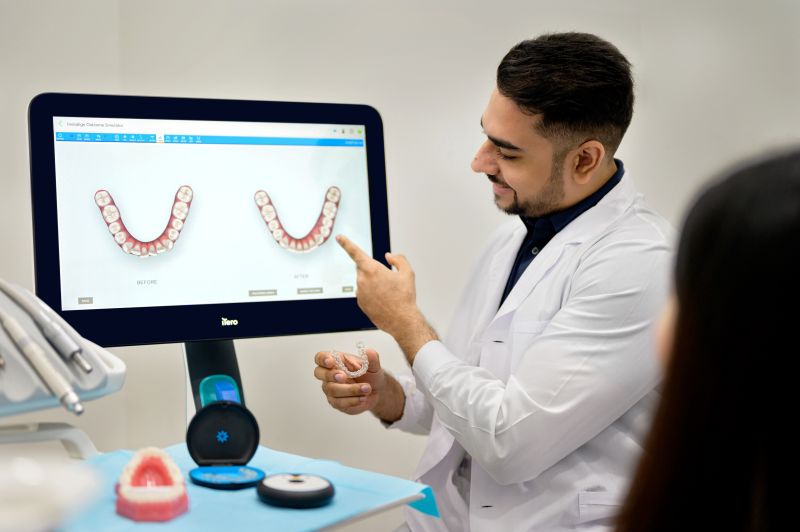
Invisalign treatment transforms dental problems. Image courtesy of Align Technology.
The Imaging Systems and CAD/CAM Services segment, which includes iTero scanners and exocad dental software, generated $189.9 million, down 8.6% from Q2 and 0.6% from Q3 last year. The drop is mainly described as “seasonal,” as large equipment orders tend to slow this time of year. It also shows that services are holding steady, even as equipment sales remain unpredictable.
Profit margins came under pressure this quarter. Operating income was $96.3 million, or a 9.7% margin, down about 6 to 7 points from both last year and the previous quarter, mainly because of $88.3 million in restructuring and other one-time costs. On an adjusted basis, the margin improved to 23.9%, showing that without those temporary expenses, Align’s main business is performing better.
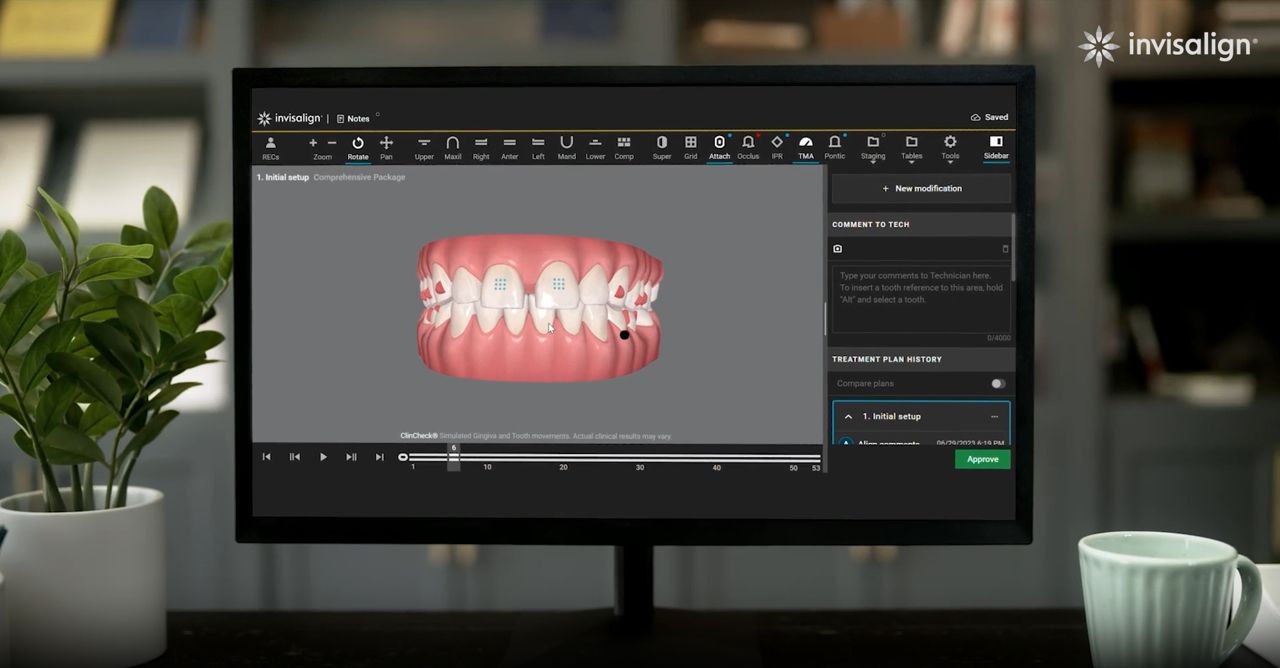
Invisalign’s platform helps with orthodontic treatment. Image courtesy of Align Technology.
Align closed the quarter with over $1 billion in cash and equivalents, up from $901.2 million in Q2. The company repurchased half a million shares at an average price of $136.77, with nearly $928.4 million still available under its ongoing repurchase program.
Looking ahead, Align expects Q4 revenue to be between $1.025 billion and $1.045 billion, with both Clear Aligner volume and average selling price expected to increase sequentially. For the full year 2025, the company projects mid-single-digit volume growth and flat to slightly up revenue compared to 2024, with an adjusted operating margin of around 22.5%.
For the full year 2025, Align expects aligner volume to grow by mid-single digits and total revenue to be flat to slightly higher than 2024. In 2024, the company generated roughly $4 billion in revenue, up about 3.5% from 2023. Based on its current outlook, 2025 revenue is expected to stay around that same level, showing a year of stabilization after modest growth in previous years.
Subscribe to Our Email Newsletter
Stay up-to-date on all the latest news from the 3D printing industry and receive information and offers from third party vendors.
Print Services
Upload your 3D Models and get them printed quickly and efficiently.












You May Also Like
The Manufacturing Race Behind the Drone Revolution
We are in the middle of a major manufacturing shift focused on the production speed and payload capacity of uncrewed aerial systems (UAS), or drones. A recent Manufacturing Dive article...
ADDMAN to Buy Up to $10.8M in Nickel 718 Powder from 6K Additive Over 30 Months
After years of buildup, we’re finally starting to see what the US metal additive manufacturing (AM) market could look like at scale. To be sure, it’s still not quite there,...
Metal AM in a Multipolar World, Part 2: How PBF and DED Could Change by 2035
The first decades of PBF development were heavily shaped by machine capability: more power, more lasers, larger build volumes, better recoating, and improved process monitoring. These developments will continue, but...
Advanced Manufacturing at IMTS 2026: 3D Printing and AI and Drones, Oh My!
Last week’s International Manufacturing Technology Snow (IMTS) in Chicago welcomed over 90,000 attendees to the jungle that is McCormick Place. With over 1.17 million square feet of exhibit space, and...