Tiny Bioprinter Could One Day Repair Vocal Cords During Surgery


A team of engineers and surgeons at McGill University in Montreal, Canada, has created the world’s smallest 3D bioprinter, and it could change how doctors repair damaged vocal cords.
At just 2.7 millimeters wide, the device can 3D print hydrogel directly inside a patient’s throat during surgery. The team calls their invention the Minimally Invasive In Situ Bioprinter (MIISB), a one-of-a-kind system small enough to operate safely within the delicate space of the vocal folds.
The work, described in the study “A continuum robotic bioprinter for in situ vocal fold repair,” published in Device on October 29, was supported by the U.S. National Institutes of Health. By rebuilding tissue removed during procedures, the MIISB could help patients recover their voices faster and reduce the scarring that often makes speaking difficult.
A Big Problem for a Small Organ
Between 3% and 9% of people will experience a voice disorder at some point in their lives. These problems often come from cysts, growths, or even cancer on the vocal cords. When surgeons remove the growths, they sometimes leave small scars that stiffen the vocal folds, a condition called fibrosis. This stiffness can make it painful or nearly impossible to speak normally.
Doctors have tried using hydrogels that help tissue heal to prevent this scarring. But getting hydrogels exactly where they’re needed has always been a challenge. What’s more, injecting them by hand isn’t accurate enough for such a small and sensitive area.
That’s where the McGill team stepped in. They designed a miniature 3D printer, small and flexible enough to fit through a patient’s open mouth, guided by a surgical microscope.
“Our device is designed not only for accuracy and printing quality but also for surgeon usability,” said biomedical engineer Swen Groen, the study’s first author. “Its compact and flexible design integrates with standard surgical workflows and provides real-time manual control in a restricted work environment.”
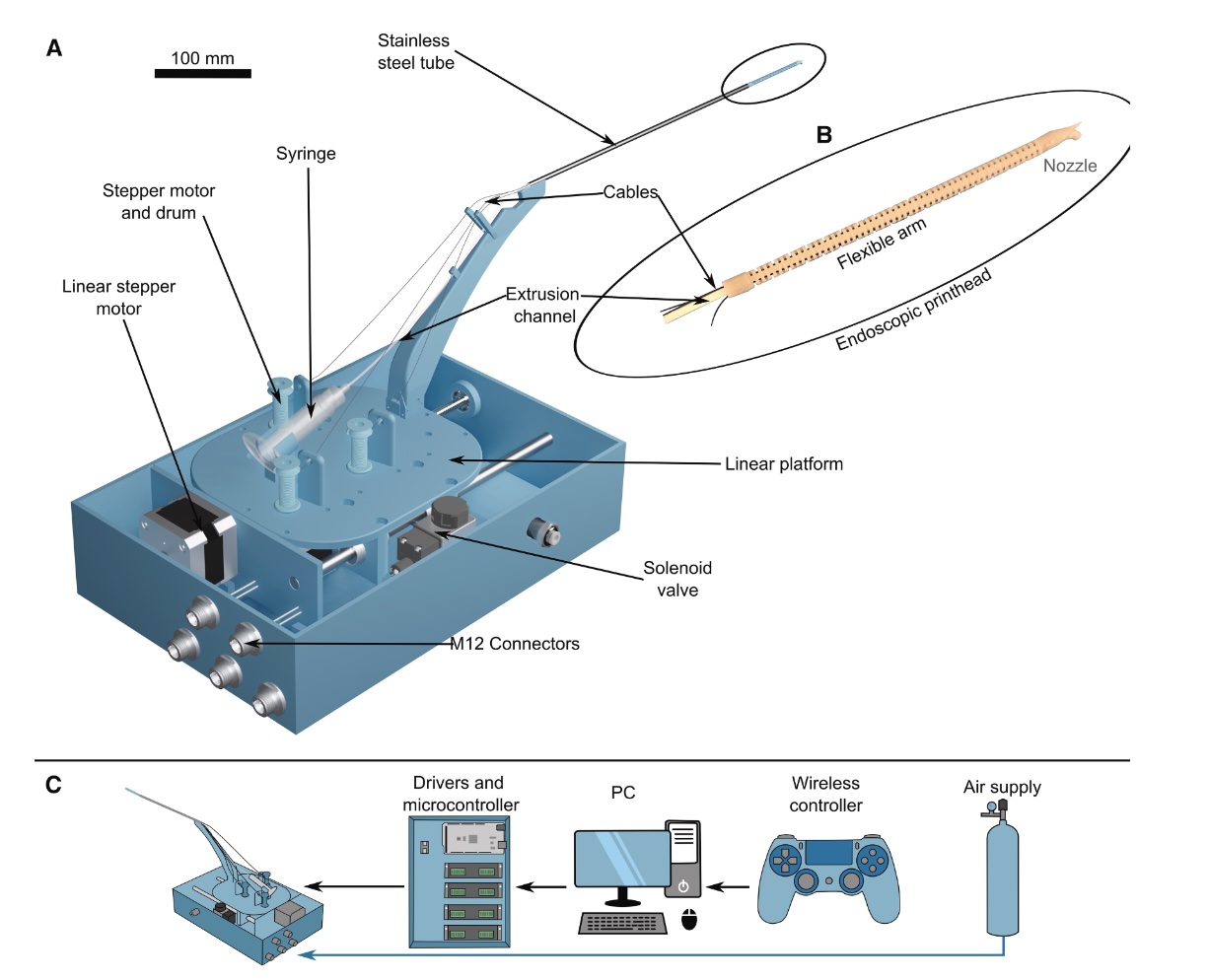
Overview of the minimally invasive in-situ bioprinter.
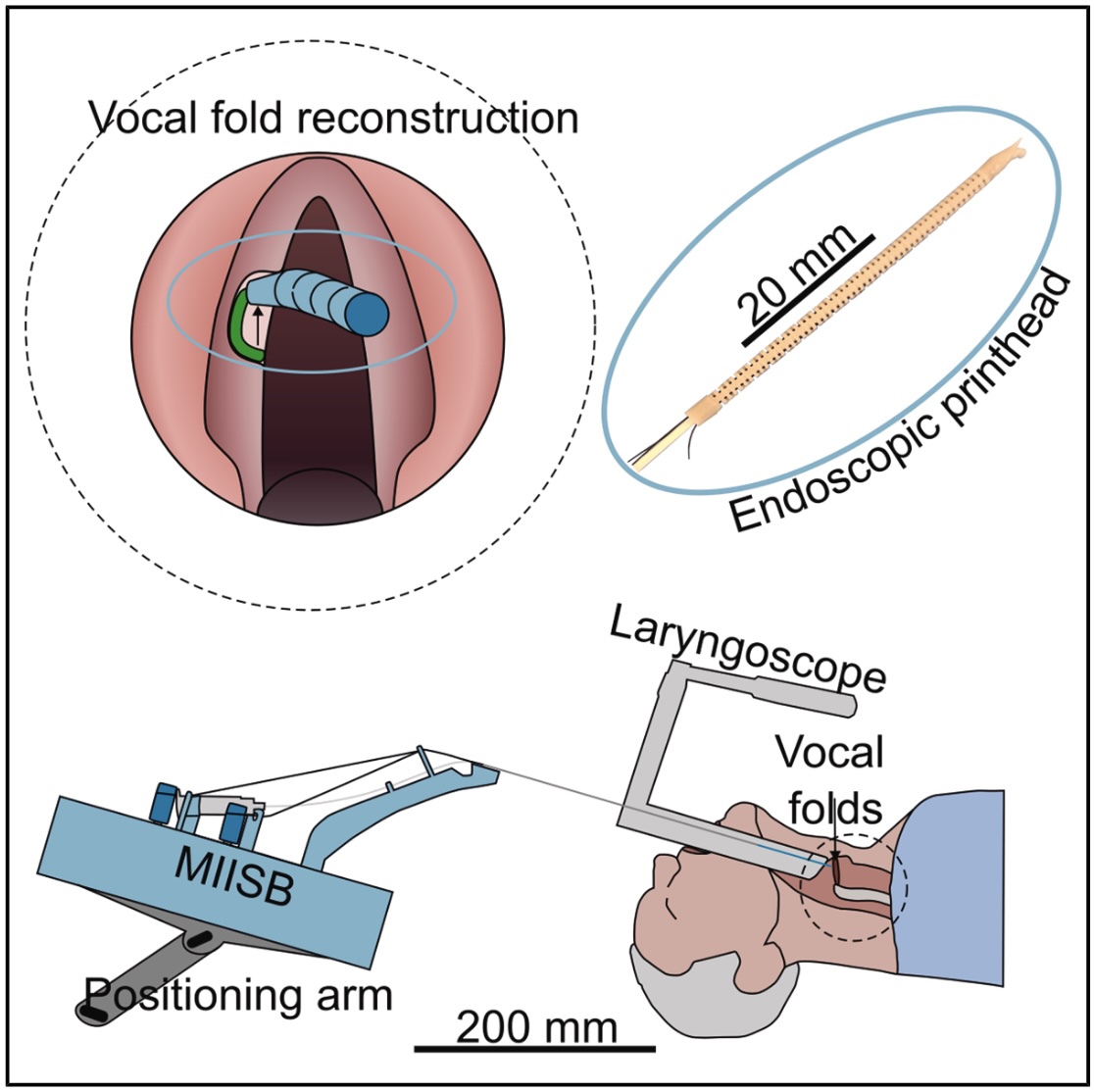
At the tip of the device is a nozzle attached to a “flexible trunk,” inspired by an elephant’s nose. The trunk is moved by thin cables, “giving the surgeon full manual control to print hydrogels precisely inside the throat.” Despite its size, it can “draw” lines just 1.2 millimeters wide and repeat the same movement over and over with incredible accuracy.
“I thought this would not be feasible at first — it seemed like an impossible challenge to make a flexible robot less than 3 mm in size,” said senior author and McGill biomedical engineer Luc Mongeau.
To demonstrate the printhead’s ability to deliver hydrogels with precision, the researchers used it to manually “draw” shapes, including 2D spirals, heart shapes, and letters on a flat surface. Then, they used the device to deliver hydrogels to simulated vocal folds used to train surgeons. In these tests, the MIISB “accurately reconstructed the vocal fold geometry in these models,” which represented tissue defects, filling cavities left by removed lesions, and a full vocal fold reconstruction.
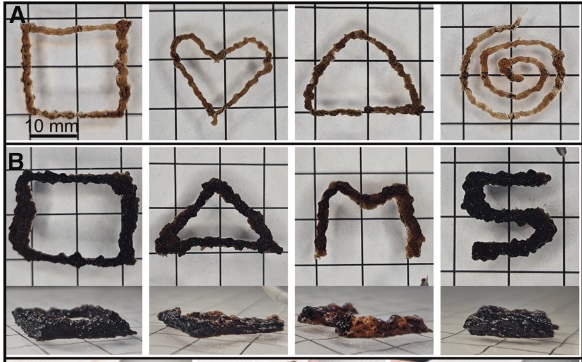
3D printing demonstration with the MIISB. Single-line constructs, with a target length and width of 20 mm.
“Part of what makes this device so impressive is that it behaves predictably, even though it’s essentially a garden hose—and if you’ve ever seen a garden hose, you know that when you start running water through it, it goes crazy,” said coauthor Audrey Sedal, also a biomedical engineer at McGill.
Right now, surgeons control the printer manually. They have already begun testing the device and its hydrogels in animal models, a key step before human trials. These in vivo studies will show how well the printed hydrogels integrate with living tissue and whether the tiny 3D printer can safely operate inside the body during real surgical conditions.
“We’re trying to translate this into the clinic,” noted Mongeau. “The next step is testing these hydrogels in animals, and hopefully that will lead us to clinical trials in humans to test the accuracy, usability, and clinical outcomes of the bioprinter and hydrogel.”
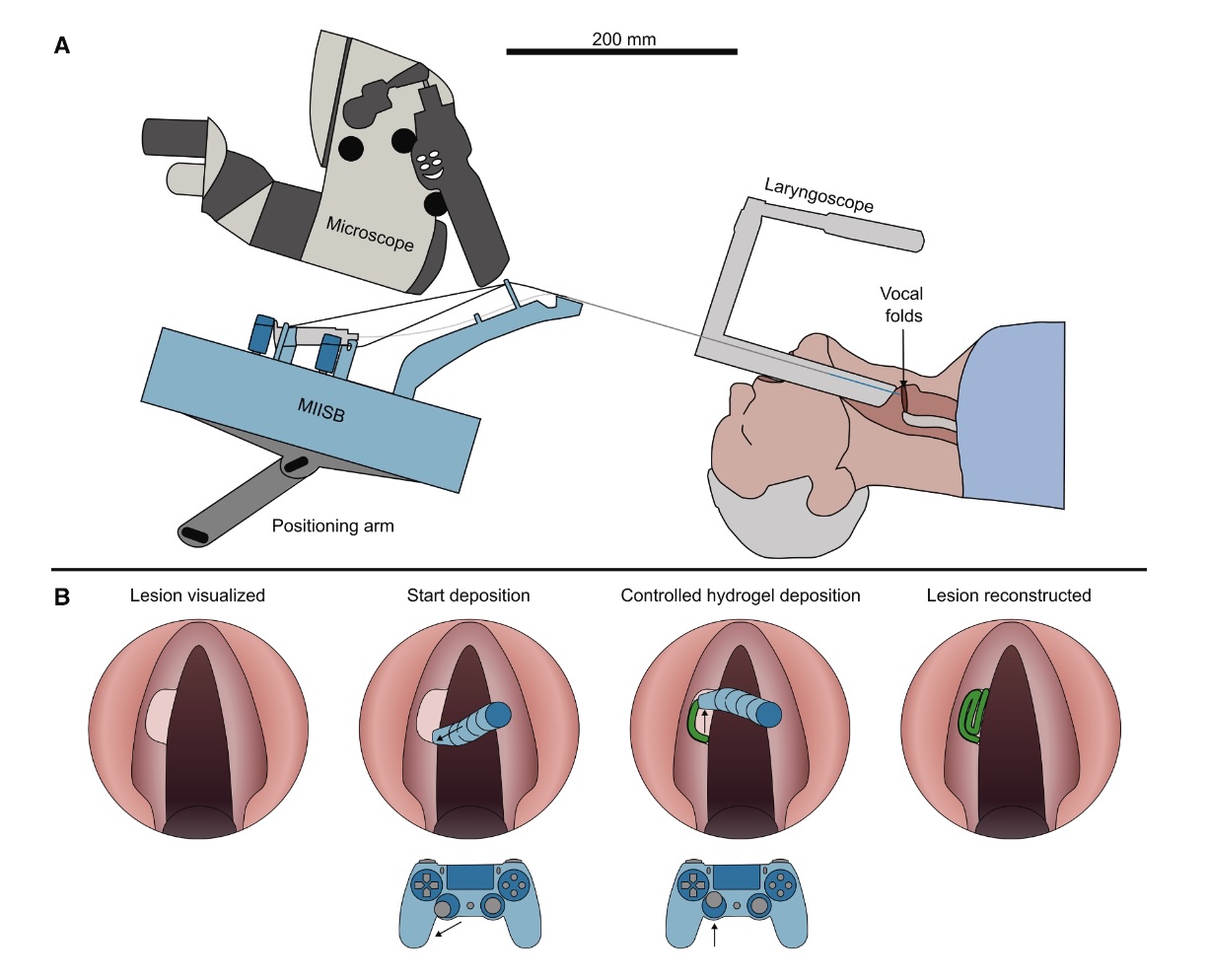
Overview of the clinical workflow. Above: suspension laryngoscopy with the MIISB. Below: procedure of reconstruction of vocal fold geometry with the MIISB.
In the future, the researchers plan to build a version of the tiny printer that combines manual and autonomous control, allowing it to adjust in real time during surgery. They are also improving the printers to make them even more precise, while experimenting with new bioinks, including ones that could carry living cells, to one day repair other delicate tissues beyond the vocal cords.
Images courtesy of McGill University/Groen et al., Device (2025)
Subscribe to Our Email Newsletter
Stay up-to-date on all the latest news from the 3D printing industry and receive information and offers from third party vendors.
Print Services
Upload your 3D Models and get them printed quickly and efficiently.













You May Also Like
Bambu Lab 3D Printers Bring a 166-Million-Year-Old Dinosaur Back to Life
Fourteen desktop 3D printers spent seven weeks producing the bones of a dinosaur that lived roughly 166 million years ago. The result is now on display at Blenheim Palace in...
3D Printing Financials: Creality Warns of H1 Loss Ahead of Earnings Report
Creality (HKG: 3388) is expecting to report a loss for the first half of 2026, just months after the 3D printer maker went public in Hong Kong. In a profit...
Kupros Launches Cu29 V2, Announces Process for Embedded Electronics from Desktop FFF & FDM
In addition to its more traditional uses, the centrality of copper to an unusually large number of high-growth industries has led more than a few observers to argue that it...
Bambu Lab and Insta360 Invite Makers to Build Custom Camera Gear
Bambu Lab is expanding the role of MakerWorld, its community platform for 3D printable models. The company has partnered with camera maker Insta360 to launch the Luna Ultra Design Challenge,...