3D Printed Habitat Prototype Encourages Natural Regeneration of Marine Ecosystems

Recently, the World Design Organization (WDO) and the UK Design Council hosted the World Design Congress (WDC) 2025 in London. The tagline for the event was “Design for planet,” and attendees from the global design community came together to talk about how they can design a better future by tackling critical environmental problems: lowering carbon emissions, reviving biodiversity, and creating a circular economy through reusing waste and reimagining materials.
One innovative concept that was presented at the event is Nereid, a digitally created marine habitat to help heal marine ecosystems. The project is aptly named: a nereid can either mean a type of marine worm, or one of the 50 sea nymphs who are daughters to the sea god Nereus, the “Old Man of the Sea,” in Greek mythology.
Zaha Hadid Architects (ZHA), in collaboration with D-Shape and sponsored by the Hong Kong Science & Technology Parks Corporation (HKSTP), specifically designed the habitat prototype to restore the environment at Hong Kong’s North Lantau Marine Park conservation area. As ZHA put it, this project, and several others it brought to the WDC, demonstrate “design as an effective catalyst for ecological resilience.”
Christos Passas, Design Director, Zaha Hadid Architects, said, “Driven by a deep understanding of the requirements needed to support local ecosystems, this prototype is part of a wider approach developed in collaboration with partners in innovative technologies to research and progress initiatives that enhance environmental sustainability.”
3D printing has been used many times to help with marine ecosystem conservation efforts, from making coral reefs, seawalls, and barnacles to cultivated seafood, or simply raising awareness. For their Nereid project, ZHA and D-Shape wanted to address climate change, land reclamation, marine pollution, and urbanization. So they reached out to marine physiologist and toxicologist Professor James Fang from Hong Kong Polytechnic University, whose research promotes seafood sustainability and ocean health.
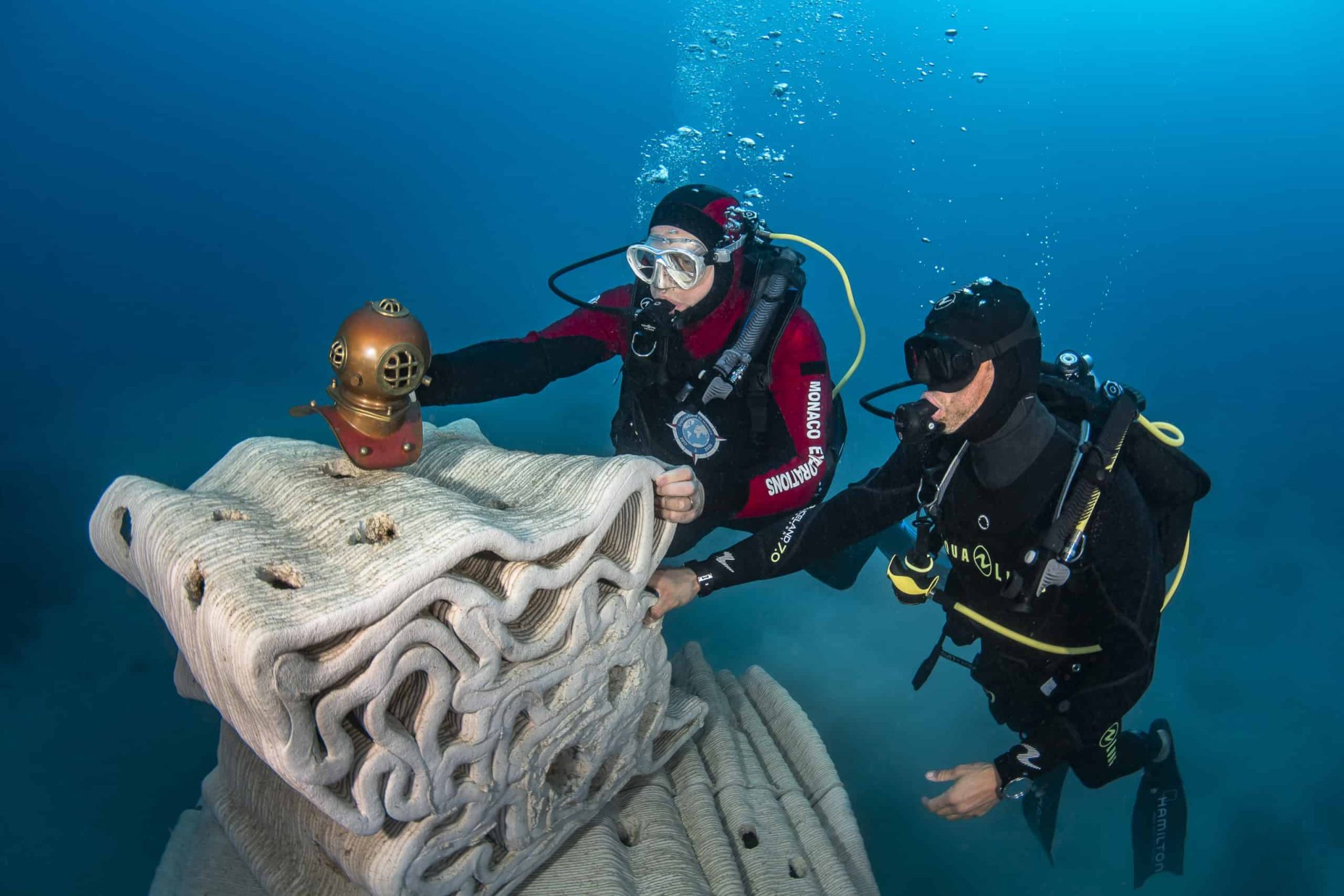
Underwater, 3D printed coral reef architecture. Image courtesy of XtreeE.
The prototype habitat focuses specifically on increasing marine biodiversity. It features some unique restorative and hydrodynamic advantages that will encourage natural regeneration of coastal ecosystems, and specifically their food resources, with a focus on fostering the growth of filter-feeding shellfish and phytoplankton.
“Nereid demonstrates large-scale 3D printing can support the regeneration of marine ecosystems,” said Mario Nuzzolese, Director, D-Shape. “By opening our technology to partners, we’re turning bold ideas into habitats where nature and innovation thrive.”
D-Shape is one of 2,400 tech companies within the ecosystem of HKSTP, an award-winning incubator that nurtures companies to drive solutions for a better future. The Nereid initiative fits right in with its mission to foster innovation and restore the region’s marine habitats.
Hilda Chan, Chief Marketing Officer of HKSTP, said, “The collaboration highlights the visionary design of Zaha Hadid Architects, the ingenuity of D-Shape, and our commitment to innovative solutions for environmental challenges.”
Using its large-scale 3D printing technology, D-Shape produced biomimetic structures that replicate the texture and porosity of natural reefs. The forms were made using pH-neutral ingredients in a low-carbon concrete mixture that’s safe for marine environments. ZHA explained that the “design emulates the geometries of benthic systems such as kelp forests,” so the fish will be more attracted to the structure.
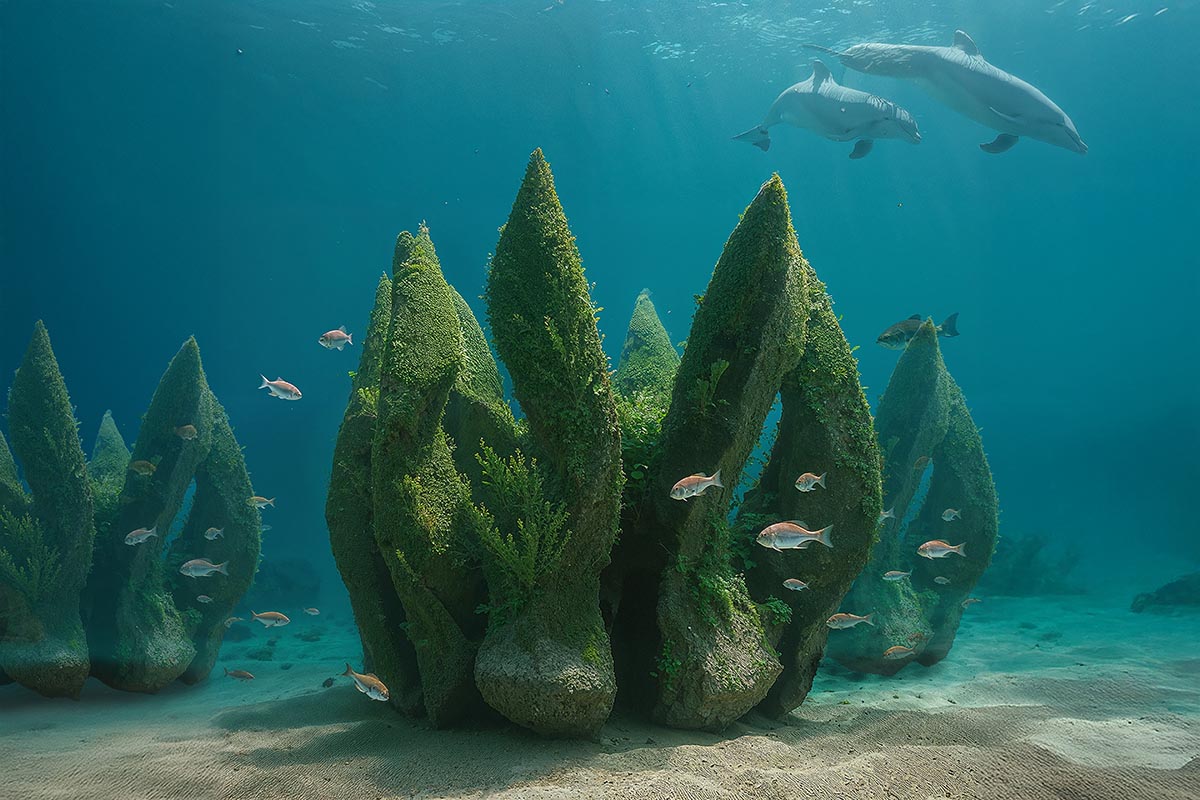
Rendering courtesy of ZHA
Artificial reefs are immensely helpful when it comes to improving marine biodiversity. The idea is that Nereid, once past the prototyping phase, will be able to create regenerative marine infrastructure that can act as a protective barrier against activities, like fishermen trawling the bottom of the seabed, that could harm the ecosystem. It could even contribute to ongoing marine habitat restoration efforts that support the repopulation of the critically endangered Chinese White Dolphin, affectionately referred to as the Hong Kong Pink Dolphin.
This initiative is a great example of how collaboration and creative design can truly help tackle the issues that threaten our planet.
Subscribe to Our Email Newsletter
Stay up-to-date on all the latest news from the 3D printing industry and receive information and offers from third party vendors.
Print Services
Upload your 3D Models and get them printed quickly and efficiently.













You May Also Like
AM & National Competitive Advantage, Part One: the Real Problem with US Manufacturing
The problem with US manufacturing is the productivity growth rate. Depending on the source, US manufacturing productivity has either been flat or slightly declined since 2010. Before going any further...
Advanced Manufacturing at IMTS 2026: 3D Printing and AI and Drones, Oh My!
Last week’s International Manufacturing Technology Snow (IMTS) in Chicago welcomed over 90,000 attendees to the jungle that is McCormick Place. With over 1.17 million square feet of exhibit space, and...
Let the Games Begin! Xi Throws Down the Advanced Manufacturing Gauntlet
Sangmin Lee went to TCT Asia back in March and reported on the event for 3DPrint.com. He wrote two articles arguing that China’s AM industry looks “ready to scale.” This...
What 3D2GO Says About 3D Printing’s Growth in Southeast Asia
The Philippines offers an interesting case study in how 3D printing can develop in Southeast Asia, and Manila-based 3D2GO helps illustrate it. 3D printing in Southeast Asia doesn’t have to...