
Read the Stratasys & AM Research Tooling White Paper, Then Attend the Webinar October 16


Earlier this month, AM Research released a white paper produced in collaboration with Stratasys titled “3D Printed Tooling: A Generational Opportunity to Reshape Supply Chains,” which you can download here. Now, AM Research and 3DPrint.com are pleased to announce that we will be hosting a webinar based on the white paper on October 16 at 12:00 PM Eastern, for which you can register here.
I’ll be moderating the webinar, which will feature Allen Kreemer, Manager of Performance Partnerships, Auto Segment at Stratasys, and Jeff McGarry, Managing Partner at Automation Intelligence. If you haven’t heard of Automation Intelligence, it’s an Atlanta-based provider of industrial automation solutions to firms across a broad range of sectors, including automotive.
Automotive tooling will be the focal point of the webinar, as we dive deeper into one of the most noteworthy developments detailed in the white paper: Stratasys’s launch of the North American Stratasys Tooling Center (NATSC), located in Flint, Michigan, a joint project between the AM industry pioneer and Automation Intelligence. While AM for automotive tooling has been a popular area of interest in the industry for years, there remains a vast untapped opportunity for automotive suppliers — especially small and medium enterprises (SMEs) — to increase their AM tooling programs across whole enterprises.
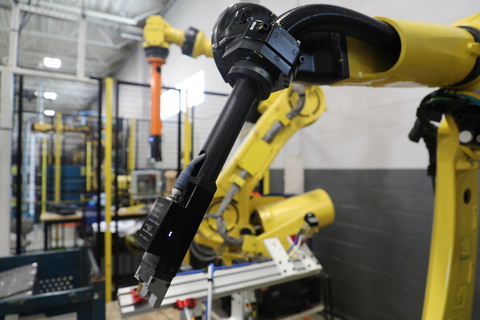
Robotic arm in use at the NATSC. Image courtesy of Stratasys.
That is one of the main objectives for the establishment of the NATSC:
As Jeff McGarry noted in Stratasys’s announcement of the tooling center’s launch, “Tooling is the heartbeat of manufacturing. The NASTC offers an environment where manufacturers can see for themselves how additive tools can address today’s challenges with faster turnaround times, digital flexibility, and lower costs. We believe this partnership will demonstrate the positive impact additive can have across production.”
The endeavor has become especially relevant given how disproportionately the automotive sector is impacted by the global tariff situation and the related trade wars, which seem to have become the new baseline reality for the world economy. Some of the most common strategies that automotive suppliers are using to respond to the economic volatility include limiting their need for imported metals and localization of production, two goals that can be greatly aided by implementing AM tooling programs. You can also learn more about this by watching a video that Stratasys recently created in collaboration with its longtime strategic partner, Toyota.
Join me, Allen, and Jeff on October 16 at 12:00 PM Eastern to see how 3D printing is helping automakers assert control of their tooling supply chains! We’ll break down real use cases from the North American Stratasys Tooling Center in Flint, show where the ROI comes from, and answer questions live.
Don’t miss out — register here, and download the white paper in advance to get the background before we dive in. See you on October 16!
Subscribe to Our Email Newsletter
Stay up-to-date on all the latest news from the 3D printing industry and receive information and offers from third party vendors.
Print Services
Upload your 3D Models and get them printed quickly and efficiently.













You May Also Like
3D Printing News Briefs, September 26, 2026: Bioceramic Implants, 3D Concrete Printing, & More
In this weekend’s 3D Printing News Briefs, we’ll start with an integration between PanOptimization and AMCM, before moving on to healthcare news from KLS Martin and Lithoz, and then UltiMaker...
3D Printing News Briefs, September 24, 2026: Metallic Alloys, Nanobone, Alternative Meat, & More
In this week’s 3D Printing News Briefs, we’ll discuss some materials news: a reference material for standardizing photopolymer manufacturing, metallic alloys that help reduce energy loss in electric motors, a...
AMAsia Pulse: AM Investment Picks Up Across Asia-Pacific
The first half of September brought fresh investment and expansion activity across Asia-Pacific’s additive manufacturing sector. China’s Xinjinghe secured funding for an aerospace AM hub, South Korea’s Lincsolution outlined plans...
3D Printing News Briefs, September 17, 2026: 3D Printed Boat, UAS Development, & More
We’ll start with maritime manufacturing in this week’s 3D Printing News Briefs, and continue on to defense 3D printing. We’ll end with funding for Tripo AI. Read on for all...






















































