Handheld 3D Printer Repairs Bone Like a Glue Gun — Tested in Rabbits, Planned for OR Use

A team of researchers from Korea and the U.S. has created a handheld 3D printing device that works like a glue gun, but instead of glue, it prints bone-like material directly onto fractures. The tool was tested in rabbits and successfully helped repair large bone defects. Although still in the early stages, the device could one day allow surgeons to perform faster, more customized bone procedures in humans.
The findings, published in Device on September 5, 2025, come from a multi-institutional collaboration led by Korea University — where the device was developed — alongside researchers from Sungkyunkwan University, MIT, Seoul National University, KAIST, Incheon National University, and Harvard-affiliated institutions like Massachusetts General Hospital and Brigham and Women’s Hospital.
The goal was to develop a portable device that lets surgeons print bone grafts on demand, during surgery, instead of relying on pre-made implants.
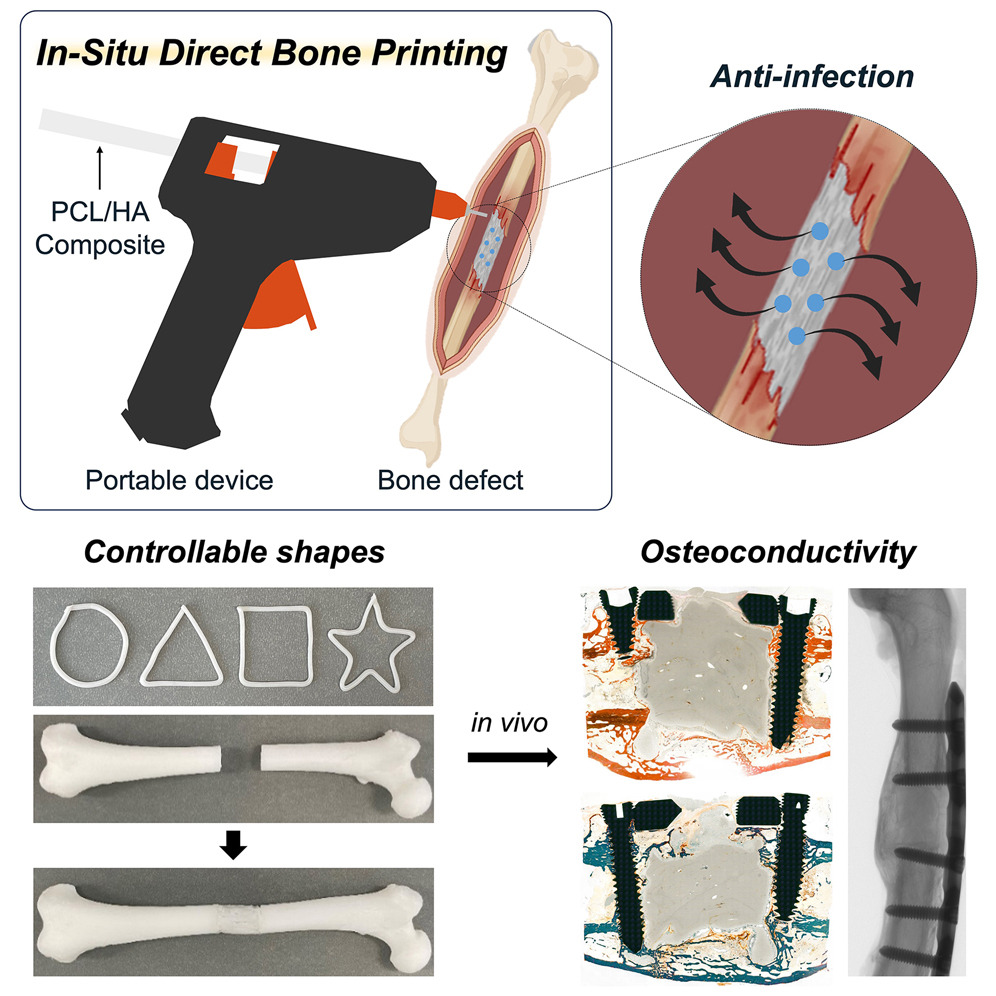
Handheld 3D printer for bone implants.
How It Works
The device looks like a glue gun but is modified to extrude a special biodegradable, synthetic material made of polycaprolactone (PCL) and hydroxyapatite (HA). Both materials are biocompatible and commonly used in medical research. PCL is a soft plastic that melts at low temperatures, making it safe to apply directly onto living tissue. Meanwhile, HA is a synthetic version of a mineral found in real bone and is known to support healing. By adjusting the ratio of HA to PCL, the researchers can fine-tune the strength, flexibility, and how quickly the implant degrades, depending on the needs of the patient and the type of bone being repaired.
According to the study, the composite filament can be loaded into the handheld 3D printing device, which heats and deposits it directly into the bone defect during surgery. After surgeons open the site to expose the fracture, they can manually guide the printer, adjusting the angle, depth, and direction of the print in real time. The team showed that this process can be done quickly, even in complex fractures, and without the need for scanning or using pre-surgical models.
“Our results suggest that the printed scaffold is not only biocompatible but also actively promotes osteogenesis and vascularization,” the authors wrote in the study.
Bone Healing and Antibiotic Protection
To reduce the risk of post-surgical infection, the team added two antibiotics to the filament. These drugs are slowly released over time at the site of the injury, helping prevent bacterial growth directly where the implant is placed.
The device was tested in rabbits with severe fractures in their femurs. After 12 weeks, the researchers saw that bones treated with the printed implants healed better and were stronger than those treated with standard bone cement. There were also no signs of infection or tissue damage.
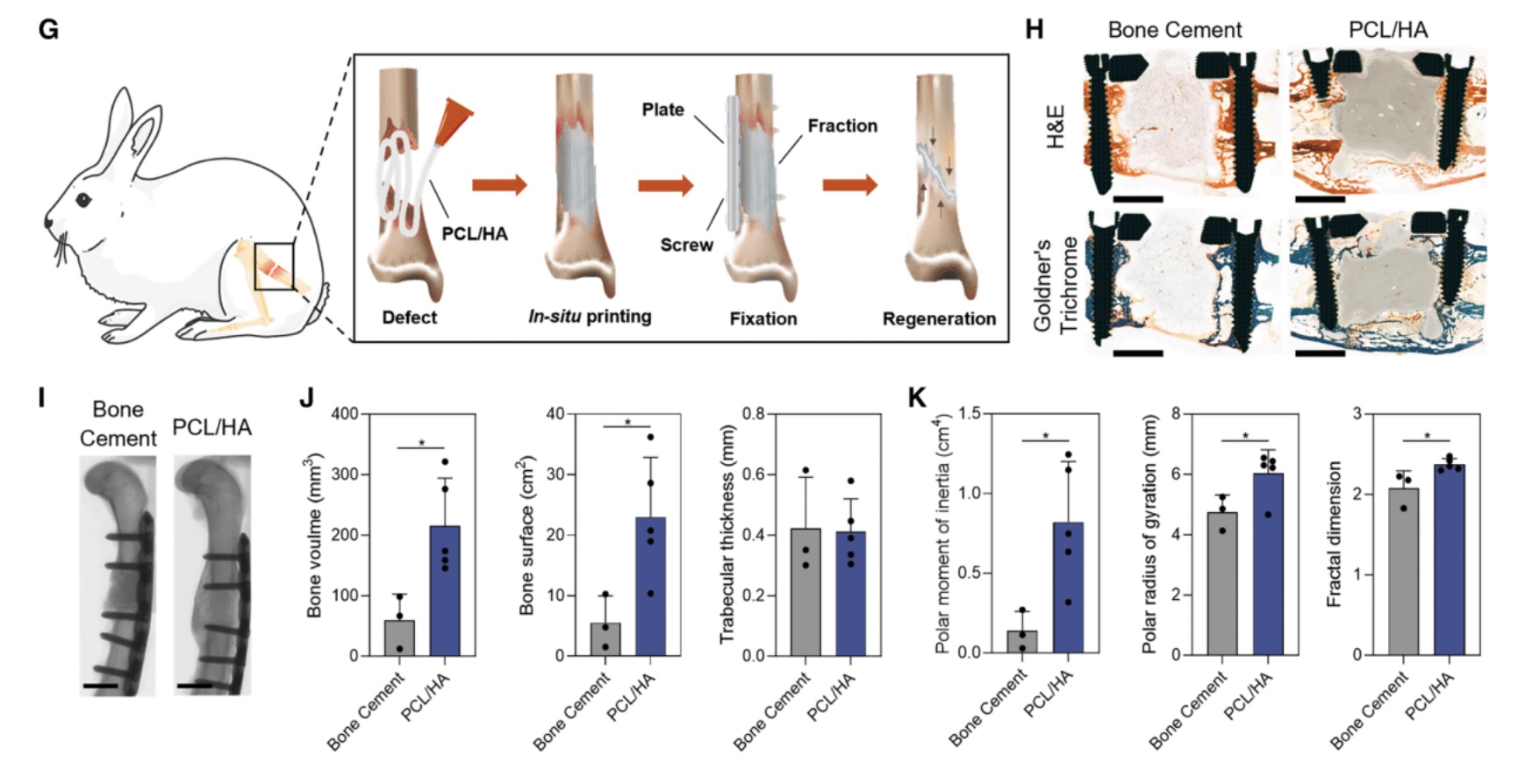
In vitro and in vivo evaluation of the biocompatibility, osteoinductivity, and therapeutic efficacy of the PCL/HA scaffolds.
Currently, bone implants, whether metal, ceramic, or 3D printed, are usually made before surgery. This works well for simple cases, but it’s a challenge for complex or irregular injuries, where the bone is broken in uneven or unusual ways. In these cases, the implant has to match the shape of the injury.
For this type of injury, this new method is ideal; it lets doctors print the bone implant directly in the operating room, with the shape perfectly matching the defect. What’s more, the biodegradable material gradually dissolves and is replaced by natural bone while the patient heals.
“We believe this approach has the potential to fundamentally change the paradigm of bone defect treatment by enabling surgeons to fabricate customized, biodegradable, and antibacterial implants directly in the operating room without the need for extensive preoperative planning.”
This technology is still in the experimental phase. So far, it has only been tested in rabbits. The next steps will include scaling up testing to larger animals and preparing the groundwork for future human clinical trials.
Before that can happen, the researchers explain that there is a need to meet several key requirements, including standardizing how the device is made, making sure it can be properly sterilized, and getting approval from health authorities before it can be used in people.
“Successful translation will require addressing these challenges,” the researchers concluded, “but our findings provide a solid foundation for the clinical adoption of this technology.”
If it passes regulatory approvals, the researchers say this handheld device could eventually become a practical tool for orthopedic surgeons, trauma teams, and even field hospitals, offering quick, personalized bone repair without the need for costly equipment or even pre-surgical planning.
Images courtesy of Jeon et al., In situ printing of biodegradable implant for healing critical-sized bone defect, Device (2025)
Subscribe to Our Email Newsletter
Stay up-to-date on all the latest news from the 3D printing industry and receive information and offers from third party vendors.
Print Services
Upload your 3D Models and get them printed quickly and efficiently.













You May Also Like
Kickstarter is Testing the Next Wave of Desktop 3D Printing
3D printers are raising serious money again…on Kickstarter, that is. Over the last few months, a new group of 3D printer campaigns has attracted millions of dollars and thousands of...
Stratasys vs. Bambu Lab: What’s Really Behind the $27.6M Patent Verdict?
Editor’s note: This is Part 1 of a two-part series by Xu Fanglei examining the technology and patent issues behind the Stratasys-Bambu Lab dispute. Part 1 looks at the U.S....
Bambu Lab and SUSAN FANG 3D Print for London Fashion Week
At London Fashion Week, some of the more unusual pieces on the runway came from 3D printers. Chinese fashion designer SUSAN FANG presented her Spring/Summer 2027 Air-Illusion collection at the...
Stratasys Wins $27.6M in Patent Case Against Bambu Lab; Bambu Challenges Verdict
Update, September 21, 2026: This article has been updated with a statement from Bambu Lab responding to the verdict, along with additional information about the company’s ongoing patent challenges against...