How Portland’s Old Town Is Becoming a Footwear Innovation Hub

Portland’s Old Town district is taking on a new role as a hub for footwear and apparel innovation. The project, called Made in Old Town (MiOT), is a 323,000-square-foot campus bringing together designers, suppliers, researchers, and brands under one roof.
One of the first companies involved is HILOS, a Portland-based startup that uses 3D printing to rethink how shoes are made. After our interview with co-founder and CEO Elias Stahl, we now turn to Matthew Claudel, Managing Director at MiOT, for a closer look at how the campus is coming together. Claudel also founded Field States, an urban design firm with projects in cities from Boston to Detroit. In this conversation, he explains how MiOT is bringing advanced manufacturing together with urban renewal.
From Blocks to Boots
The MiOT project is turning nine historic warehouses that were sitting vacant into a new kind of campus for footwear and apparel, one that combines design, manufacturing, and even housing.
The project is still taking shape, but progress is already visible. In early 2025, MiOT secured a $7 million loan from Prosper Portland, which, in addition to state funding, has allowed the group to acquire three buildings. Two of these buildings make up the historic Mason Ehrman complex, a 110,000-square-foot facility called the Hub and Tower that brings together advanced sample making and testing capabilities with offices and event space.
In June 2025, MiOT also announced its Materials Library, a resource where suppliers can showcase new textiles, foams, and polymers directly to brand design teams. For startups and independents, it offers rare access to the same materials global giants use, leveling the playing field. For suppliers, it creates a direct line to future customers. The library is also intended to support research into sustainable materials, making it a bridge between labs, manufacturers, and designers. At the same time, MiOT opened membership for individuals, students, and businesses. Membership opens again in October.
“Made in Old Town is a visionary initiative to create a district-scale hub for footwear and apparel design and manufacturing in Portland,” Claudel said.
Beyond footwear, the campus is also being designed to support 3D printed apparel and small-batch garment production. Tools like 3D printers and knitting machines will make the Hub a place where brands can go from concept to finished product in as little as a day, reducing what was once a 24-month development cycle into rapid development on a daily basis. For startups, it’s a chance to test ideas without the cost of owning specialized equipment; for bigger brands, it offers a faster, lower-waste alternative to overseas prototyping.
What makes MiOT different, Claudel explained, is that it’s built for many kinds of users. “Innovation ecosystems thrive on diversity and proximity,” he said. Startups and independent designers will work alongside established brands, suppliers, researchers, and students. For mid-sized companies, being able to make samples locally could be a game-changer. Shared spaces and events will give professionals a chance to collaborate and learn. “There is a clear value proposition for each segment,” Claudel added.
It’s a strategy for post-COVID cities, backed by leaders from companies like Nike, Under Armour, and Adidas.
Beyond Portland
Although MiOT is rooted in Portland, Claudel believes the model could spread. Cities across the U.S. are struggling with empty office buildings after COVID, but advanced manufacturing offers a way to bring them back to life.
“Made in Old Town proves that these buildings can be revitalized with innovation and production in key industries that are significant to the region. In Portland, that industry is footwear. In Rochester, New York, it could be cameras; in Detroit, automotive,” he said. Modern manufacturing technologies are clean and adaptable, making them well-suited for older downtown buildings. “Designers need ready access to new manufacturing technologies and to be co-located with experts to make those breakthroughs.”
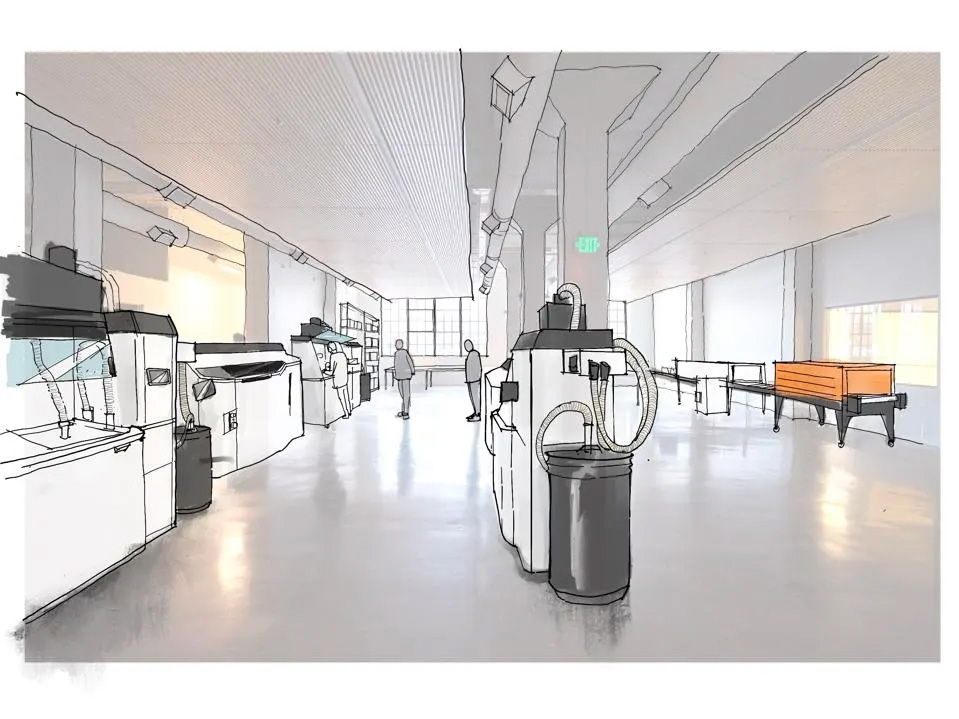
An illustration of Made in Old Town’s 3D printing hub. Image courtesy of SERA Architects.
Jobs are central to the plan. An early study projected nearly 400 positions created in Phase 1, in a neighborhood that doesn’t have many major employers.
Workforce development is built into the project. MiOT is partnering with City Team, a local social service provider that supports individuals in recovery, to offer training and certification in footwear and apparel roles, ranging from equipment technicians to future entrepreneurs.
“Residents will have the opportunity to gain on-the-job training and eventually certification that allows them to build a career in footwear and apparel,” indicated Claudel.
Partnerships with SneakerWeek, the Technology Association of Oregon, and local universities, like the University of Oregon, will also make the campus a place to learn and connect.

The Made in Old Town Campus. Image courtesy of MiOT.
Claudel calls MiOT “a magnet for the footwear and apparel industry’s changemakers,” from entrepreneurs to executives to researchers.
What’s happening in Old Town is much more than shoes and apparel. It’s about whether a city can take empty spaces and turn them into something that creates jobs and ideas, and brings people back downtown.
Subscribe to Our Email Newsletter
Stay up-to-date on all the latest news from the 3D printing industry and receive information and offers from third party vendors.
Print Services
Upload your 3D Models and get them printed quickly and efficiently.













You May Also Like
The Money Behind AM: What to Watch at AM Investment Strategies 2026
For years, simply being a 3D printing company could attract attention from investors. New machines, new materials, faster speeds, and the promise of mass production were often enough to get...
AmeraLabs Offers New Dental 3D Printing Resins
Lithuania-based AmeraLabs is putting new dental 3D printing resins on the market. Its new Made in Europe resins will include one material for impression trays, one for surgical guides, and...
3D Printing News Briefs, June 10, 2026: Grand Opening, Photoresins, Footwear, & More
We’re starting with some exciting news in today’s 3D Printing News Briefs: Stratasys just celebrated the opening of its new North American headquarters in Minnesota. Moving on, Nanoscribe is scaling...
3D Printing News Briefs, April 22, 2026: DINOs, Post-Processing, AM for Aerostructures, & More
We’ll start with event news in today’s 3D Printing News Briefs, as AMUG presented its DINO Award to six members at this year’s conference, and Axtra3D celebrated its five-year anniversary...