A 3D Printed Chilled Water Pump Cooling Rotor: The U.S. Navy Keeps Using AM to Cut Costs

One of the surest ways for the additive manufacturing (AM) industry to illustrate that AM is a differentiator is by creating use cases that deliver quantifiable lead time and/or cost savings in situations that routinely arise in industrial settings. In this regard, the U.S. Navy has emerged as an especially capable AM user, building up a diverse catalog of applications that prove how enterprises can use 3D printed parts to achieve substantial efficiency gains.
In June, for instance, Naval Air Systems Command (NAVAIR) Fleet Readiness Center East (FRCE) revealed how the maintenance, repair, and operations (MRO) hub had leveraged the Stratasys Origin One to reduce lead time from six months to less than two weeks for 2,000 O-ring installation tools, used for the F-35. And the Southeast Regional Maintenance Center (SERMC), located in the northeast Florida town of Mayport, just announced that sailors at the facility recently designed a 3D printed cooling rotor for a destroyer’s chilled water pump system.
The military’s enhancement of its ability to manufacture its own parts is noteworthy regardless of the context. Still, it’s a particularly big deal in a case like this one, where the part itself isn’t available for purchase from standard Navy supply channels. Under normal circumstances, if the cooling rotor breaks, the entire motor — which costs just over $300,000 — has to be replaced.
Alternatively, the blade prototype was printed for approximately $18, and the final 3D printed part, delivered by the Fleet Readiness Center Southeast (FRCSE) Detachment Mayport, cost $131.21. The part was also certified in-house, demonstrating how 3D printing enables organizations to take control over entire manufacturing processes from start to finish.

A cooling rotor for a destroyer’s chilled water pump system.
In a press release about SERMC’s cost savings of over $300,000 by 3D printing a chilled water pump cooling rotor, SERMC’s commanding officer, Captain Kiah Rahming, said, “Sailors at SERMC are always looking for new applications for 3D printing to expand our capabilities and save time, resources, and money. This effort is a testament to the ingenuity and drive of our team.”
Chief Machinist’s Mate Nicholas Heinrich, the AM coordinator at SERMC, said, “We started by reverse engineering the original aluminum piece to create a prototype using a low-cost polymer. The original part fits very snugly to the shaft, so after a satisfactory fitment check we coordinated with FRCSE Detachment Mayport to identify the best material for the final part.”
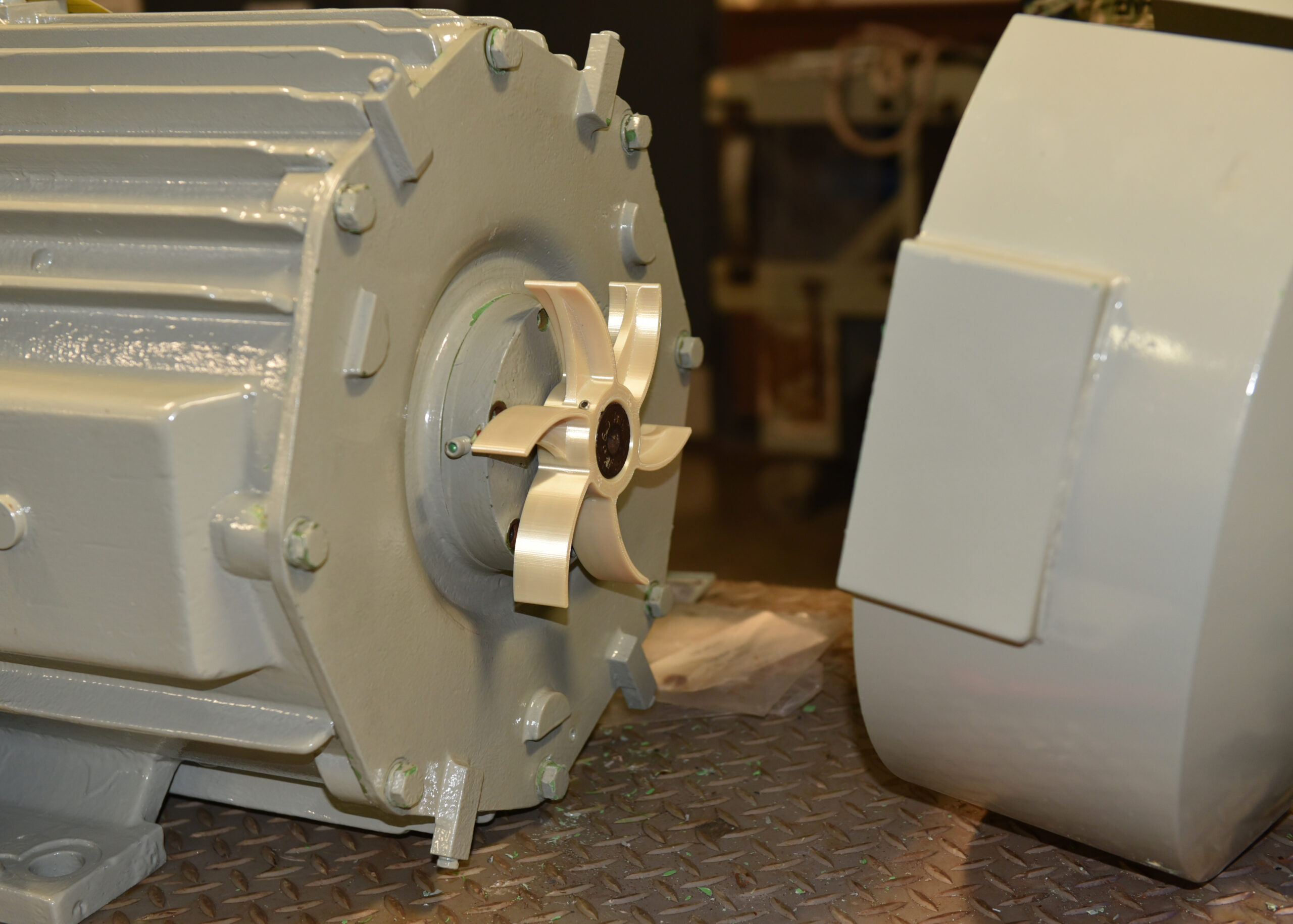
A cooling rotor placed in a destroyer’s chilled water pump system.
SERMC was also responsible for one of my favorite AM military use-cases, in which Heinrich and a civilian technician worked together to invent a new tool for replacing motors on the MK 15 Phalanx Close-in Weapons System. Both applications demonstrate the potential for 3D printing to drastically shorten the time and distance between demand and supply.
In terms of the 3D printed rotor blade, specifically, it’s striking how the application encompasses so many different AM advantages in one component: replacing one material with another, production at the point of need, saving costs by replacing one part in a scenario where you’d otherwise most likely have to replace an entire system. Above all, the application reinforces how the U.S. military is already quite advanced at using 3D printing to establish distributed manufacturing networks.
By designing a part “on location”, then having the final part printed off-site, SERMC has developed an ideal process for testing components, as well as the infrastructure required to produce them. If SERMC ultimately decides that it would make sense to acquire the same 3D printer that FRCSE Detachment Mayport used to print the final rotor, SERMC can produce the parts on-demand, directly at the point-of-need.
It’s only a matter of time before someone estimates the yearly cost savings that would be achievable by implementing across the Department of Defense (DoD) all the already-proven use cases fitting this profile: presumably, something like this is already in the works. That’s when the U.S. military’s real use of AM at scale will have begun in earnest.
Images courtesy of Scott Curtis/SERMC
Subscribe to Our Email Newsletter
Stay up-to-date on all the latest news from the 3D printing industry and receive information and offers from third party vendors.
Print Services
Upload your 3D Models and get them printed quickly and efficiently.













You May Also Like
EOS Joins the MAT‑H2 Consortium
EOS is joining the MAT‑H2 consortium. MAT is an EU-funded group that aims to do research into a hydrogen-led economy. The thinking is that hydrogen will be a clean energy...
Where the Money is Going, Part Two: Why All Roads Lead to AI
In Part One of this article, Vanesa Listek expertly described the major themes driving infrastructure investment so far this decade, illustrating how the same concerns are driving both public and...
DTU 3D Prints New Fuel Cell Design With 5x Power Boost
Technical University of Denmark (DTU) researchers have used Lithoz ceramics 3D printing to make more efficient hydrogen fuel cells. With a part made from Lithoz Yttria Fully Stabilized Zirconia (8YSZ),...
Fraunhofer ILT Tests 3D Printed Titanium Reactors to Generate Hydrogen Onboard Heavy Vehicles
The Aachen-based Fraunhofer Institute for Laser Technology (Fraunhofer ILT) is to research titanium aluminide hydrogen reactors and heat exchangers. The hope is that lightweight, better-performing 3D printed components will make...