Protolabs Installs Second Axtra3D Lumia X1 to Meet Growing Demand for Photopolymers

Digital manufacturing leader Protolabs offers many services, including injection molding, CNC machining, and 3D printing, which makes it versatile enough to serve a wide range of customer needs. While the revenue from its 3D printing division has been dipping, the technology remains a popular option for customers, and Protolabs continues to grow its AM capabilities while it works to expand further into production manufacturing. As such, the company has successfully installed a second Lumia X1 3D printer from Axtra3D, in order to meet the continually growing demand for advanced photopolymer applications.
“From the outset, the Lumia X1 has exceeded expectations in both performance and reliability, making it an excellent choice for scaling,” said Protolabs Director of 3D Printing Operations Kenny Capps. “Its ability to consistently deliver high-quality parts with minimal post-processing has allowed us to expand production without compromising on speed or precision. The addition of a second unit enables us to meet the growing customer demand for HPS parts.”
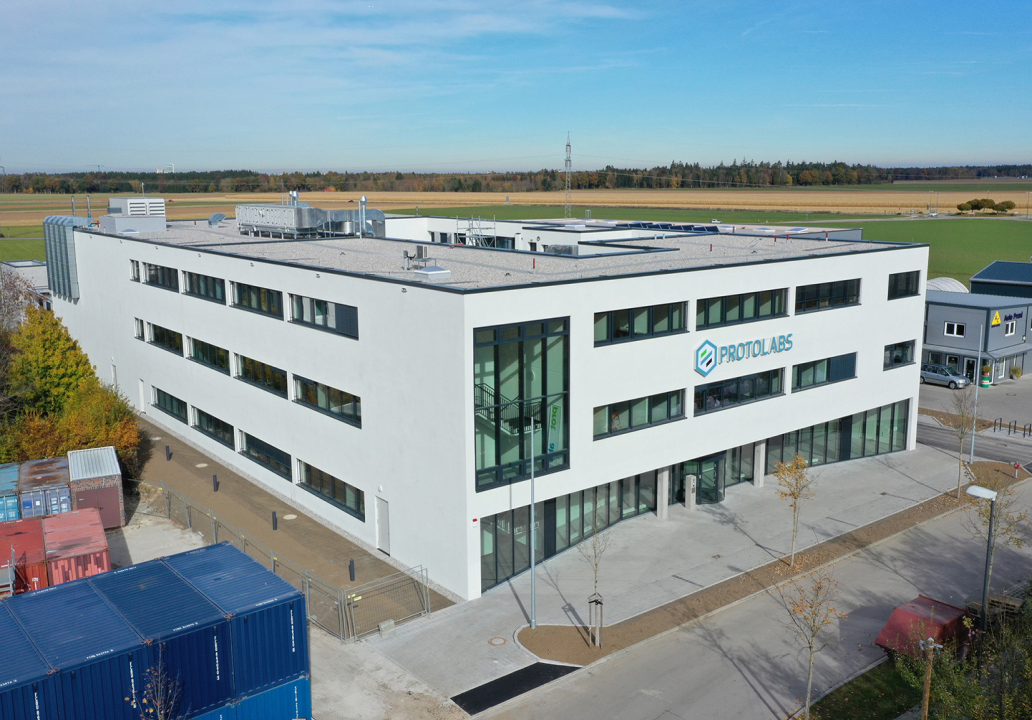
Protolabs’ Putzbrunn-facility. Image courtesy of Protolabs.
This addition comes within just nine months of Protolabs installing the first high-throughput Lumia X1 at its Raleigh, North Carolina location, so the manufacturing company is serious about quickly and strategically scaling its photopolymer capabilities. This also shows how successful the first Lumia X1 deployment was, and how much confidence Protolabs has in the platform.
Rajeev Kulkarni, Chief Strategy Officer at Axtra3D, said, “Protolabs’ decision to install a second Lumia X1, driven by expanding application use, reinforces the value of our Hi-Speed SLA. The fact that we moved from PO to full installation in just three days is a testament not only to the strength of our partnership, but also to the operational alignment and commitment on both sides.”
Protolabs uses Axtra3D’s patented Hybrid Photosynthesis (HPS) technology for applications like production-grade end-use parts, fire-retardant components, and ceramic mold inserts. HPS is essentially vat polymerization that uses both digital light processing (DLP) and stereolithography (SLA) technology, and is said to offer high speed, precision, dimensional accuracy, surface quality, and throughput. The Lumia X1 Hi-Speed SLA printer is Axtra3D’s flagship system, and combines HPS with its TruLayer technology, which rapidly detaches the active print layer and moves to the next one to ensure seamless layer transitions; Axtra3D says this results in a 20X throughput improvement, while maintaining fidelity and accuracy of the printed parts.

“Protolabs is known for identifying and scaling transformative technologies quickly, and their continued investment in the Lumia X1 highlights the platform’s unmatched combination of speed, precision, and material capability,” Kulkarni continued. “We’re excited to support Protolabs’ growth and innovation.”
According to the Q1 2025 3DP/AM Market Data and Forecast by Additive Manufacturing Research, the polymer AM market totaled $2.06 billion in the first quarter of 2025, while the metal AM market was $1.52 billion for the same time period. So Protolabs made what will likely be a very lucrative decision by investing in a second Axtra3D Lumia X1.
On Thursday, July 31st, at 2 pm EST, Protolabs and Axtra3D will take part in an exclusive ASME webinar on “Advanced Photopolymers: Accelerating Product Development.” Eric Utley, 3DP Applications Engineering Manager for Protolabs, and Axtra3D’s Kulkarni will discuss why Protolabs chose Hi-Speed SLA technology for its business, share recent success stories, and talk about the main outcomes and capabilities that are driving impact.
Subscribe to Our Email Newsletter
Stay up-to-date on all the latest news from the 3D printing industry and receive information and offers from third party vendors.
Print Services
Upload your 3D Models and get them printed quickly and efficiently.













You May Also Like
HG Laser & The Overlooked Sources of China’s Advanced Manufacturing Strength
Chinese state-owned enterprise (SOE) HGTech (Huagong Tech) just reported that it achieved record revenue in H1 2026, amounting to just over $1 billion. The company credited the results to success...
3D Printing Financials: $28M in China, U.S. Deals and a Metal AM Comeback
Money continues to go into additive manufacturing (AM). From a $30 million raise for a Chinese metal 3D printing company to new funding for naval AM and a European company...
AMAsia Pulse: AM Investment Picks Up Across Asia-Pacific
The first half of September brought fresh investment and expansion activity across Asia-Pacific’s additive manufacturing sector. China’s Xinjinghe secured funding for an aerospace AM hub, South Korea’s Lincsolution outlined plans...
3D Printing Market Hits $4.48B After Six Straight Quarters of Growth
The additive manufacturing market continued to grow in the second quarter of 2026, adding another quarter to what is becoming a much more consistent expansion for the industry. Worldwide revenue...