
Hyperion Robotics, UK National Grid to Use 3D Printing for Low-Carbon Substation Foundations

Hyperion Robotics, a Finnish provider of additive construction (AC) solutions specializing in low-carbon infrastructure projects, has partnered with UK utilities giant National Grid to test the use of 3D printed concrete substation foundations. Hyperion Robotics will design and build the foundations in Finland before shipping them to the University of Sheffield for testing, with the company already having delivered the first batch to the academic institution.
Subsequently, National Grid will conduct further tests on the foundations at the company’s Deeside Centre for Innovation, in North Wales. According to National Grid, the research hub is the first such facility in Europe “where assets associated with electricity networks can be tested off-grid, 24 hours, seven days a week”.
Hyperion Robotics claims that, over the course of a decade, the substation foundations could save over 700 tons of concrete and reduce carbon emissions by over 300 tons, while still costing slightly less than conventional construction methods. Funding for the project was provided by the Network Innovation Allowance (NIA), managed by the UK Government’s Office of Gas and Electricity Markets (Ofgem).

In a press release about the partnership between Hyperion Robotics and National Grid to 3D print low-carbon concrete substations for the UK power grid, Fernando De los Rios, the CEO and founder of Hyperion Robotics, said, “Collaborating with National Grid, one of the world’s largest utility companies, marks a pivotal moment for Hyperion Robotics as we advance our mission to help the industry build smarter and greener. This partnership accelerates our efforts to decarbonize the construction sector through cutting-edge engineering and low carbon 3D-printed concrete structures. Through this collaboration, National Grid is setting an inspiring global benchmark for innovation and sustainability in the energy sector.”
Dr. Muhammad Shaban, National Grid Electricity Transmission’s Lead Innovation Engineer, said, “Our collaboration with Hyperion Robotics is a real step forward in achieving more innovative construction practices which align with our bold and ambitious commitments on sustainability. This trial of low-carbon 3D printed alternatives to concrete for substation foundations is the first of its kind in the UK, and has the potential to transform construction activities across the industry.”
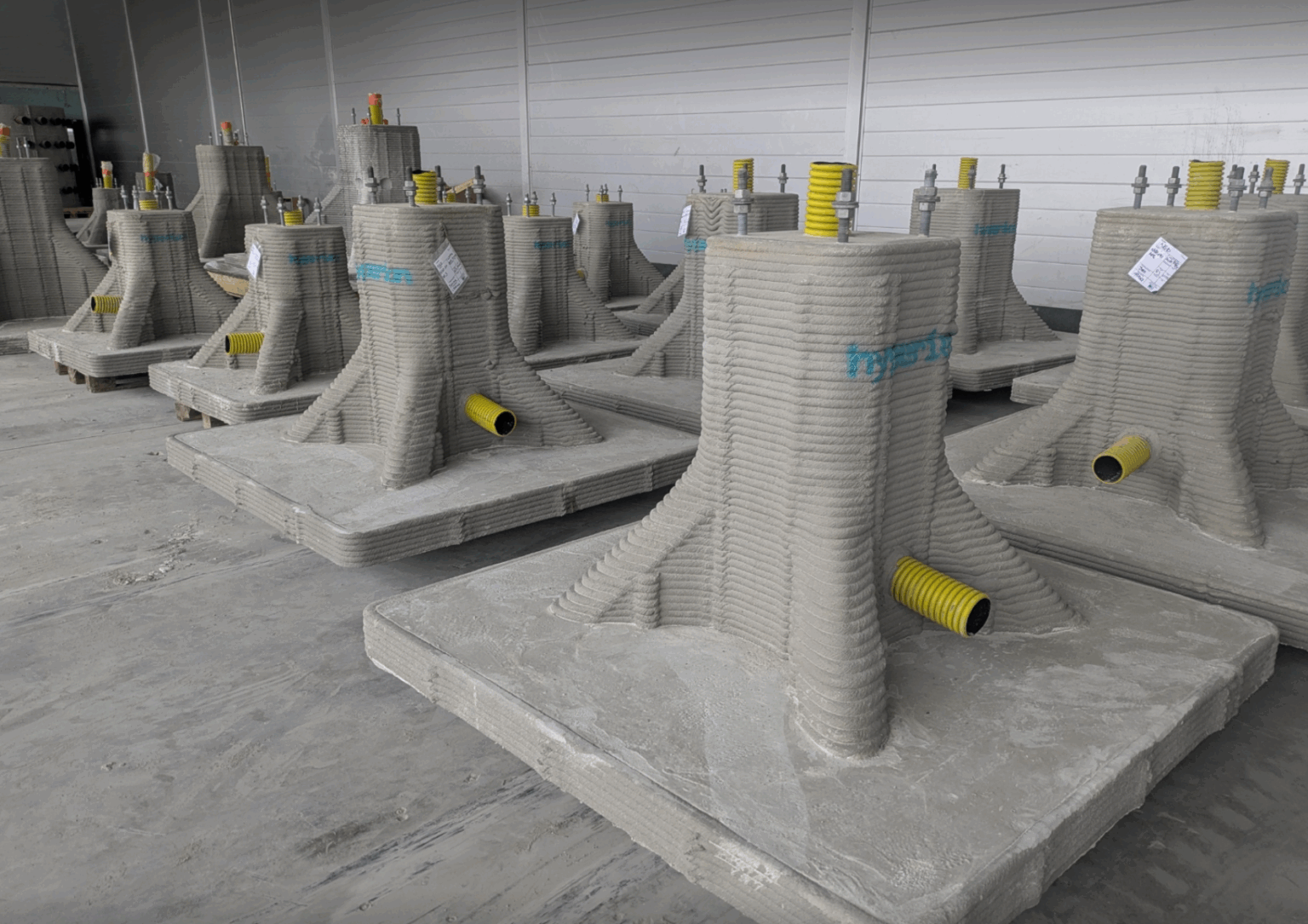
This is one of the most logical uses of AC I’ve encountered, and there could hardly be a better choice for the foundations’ deployment than the UK. As evidenced rather dramatically by the National Grid substation fires that shutdown Heathrow Airport back in March, the UK power grid needs major work, as is the case in just about every Western nation.
The UK government is very aware of that state-of-affairs: around the same time as the Heathrow shutdown, Ofgem fast-tracked over $5 billion in funding to help update the UK power grid in alignment with the UK’s decarbonization goals. Thus, the timing would suggest that, if the initial project that National Grid and Hyperion Robotics are collaborating on proves successful, there will be strong momentum behind attempts to scale the project in the near future.
For Hyperion Robotics, success with the project could potentially give the company both the incentive and the means to expand its operations into the UK. If that turns out to be the case, a scaled-up version of the project based on more localized construction capacity could lead to even greater rates of carbon emission reductions.
Images courtesy of Hyperion Robotics
Subscribe to Our Email Newsletter
Stay up-to-date on all the latest news from the 3D printing industry and receive information and offers from third party vendors.
Print Services
Upload your 3D Models and get them printed quickly and efficiently.













You May Also Like
Why the AM Industry Should Pay Attention to Schneider Electric’s $22.6B PTC Acquisition
By late 2024, there was already enough signaling of the additive manufacturing (AM) industry opportunity in the data center infrastructure market for AM Research to write a report on the...
How Does Nike’s 3D Printing Approach Fit Into Its Restructuring Plan?
Shares of Nike stock hit all-time highs in late 2021 but have cratered in the years following, with the company losing nearly 80 percent of its market cap since peaking....
3D Printing News Briefs, October 1, 2026: Defense, Enclosures, & More
In today’s 3D Printing News Briefs, we’re starting with defense news, first from Massivit and then from AML3D. Then we’ll move on to U.S. manufacturing of a new large-format LPBF...
South Korea’s Lincsolution Lands Hanwha Defense Deal as Hanwha Invests Billions in US
I recently wrote about how the South Korean additive manufacturing (AM) firm Lincsolution is building an aerospace and defense hub, part of the company’s construction of “the largest AM facility in...
























































