Ingersoll Machine Tools Makes Deployable 3D Printer for U.S. Army

Amidst the U.S. military’s years-long additive manufacturing (AM) ramp-up, the U.S. Army has frequently turned to Rockford, Illinois’ Ingersoll Machine Tools to help produce custom hardware: most notably, components for the additive friction stir deposition (AFSD) system at Rock Island Arsenal (also in Illinois), often referred to as “the world’s largest metal 3D printer.” Now, in Ingersoll Machine Tools’ latest work for the military, the company has delivered a factory-in-a-box system to the U.S. Army Corps of Engineers.
While not much is known about the system, Ingersoll’s VP, Jason Melcher, did tell WIFR, Rockford’s local TV news station, that “it will be deployed in Illinois.” Additionally, the WIFR report noted that Ingersoll bid in order to win the contract about two years ago, and that, according to the company, the fact that it’s based in America was a key reason its bid was successful.
From Melcher’s description of the factory-in-a-box — which includes both a 3D printer and a CNC milling machine, housed in a shipping container — it sounds like it may be a smaller version of the MasterPrint 3X, a hybrid, large-format composite printer. Assuming that’s the case, the U.S. Army appears to be seriously exploring how to make relatively large thermoplastic parts from the front lines.
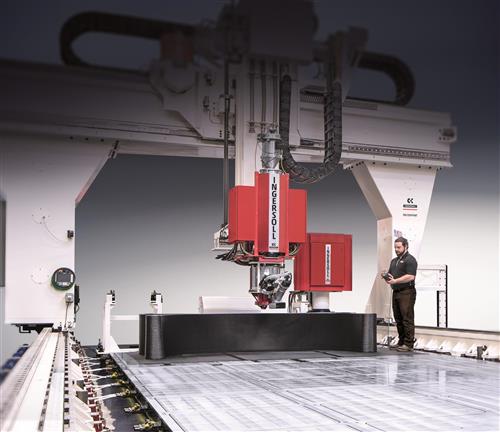
Master Print 3X. Image courtesy of Ingersoll Machine Tools.
Melcher told WTVO News, another local Rockford TV news outlet, “We took a large 3D printer, a large CNC milling machine, and made small versions…[They] may be the smallest versions Ingersoll ever made, but [we] creatively fit them in with full function, full CNC, full materials management, full tools, full probing, you name it. Everything that a big machine can do, these machines can do.”
Ingersoll Machine Tools applications engineer, Nerek Gasparyan, told WIFR, “The more you can cut the logistic out …[and] come up with the solutions on the ground, the faster you are going to be able to react to all kinds of scenarios that warfare would present.”
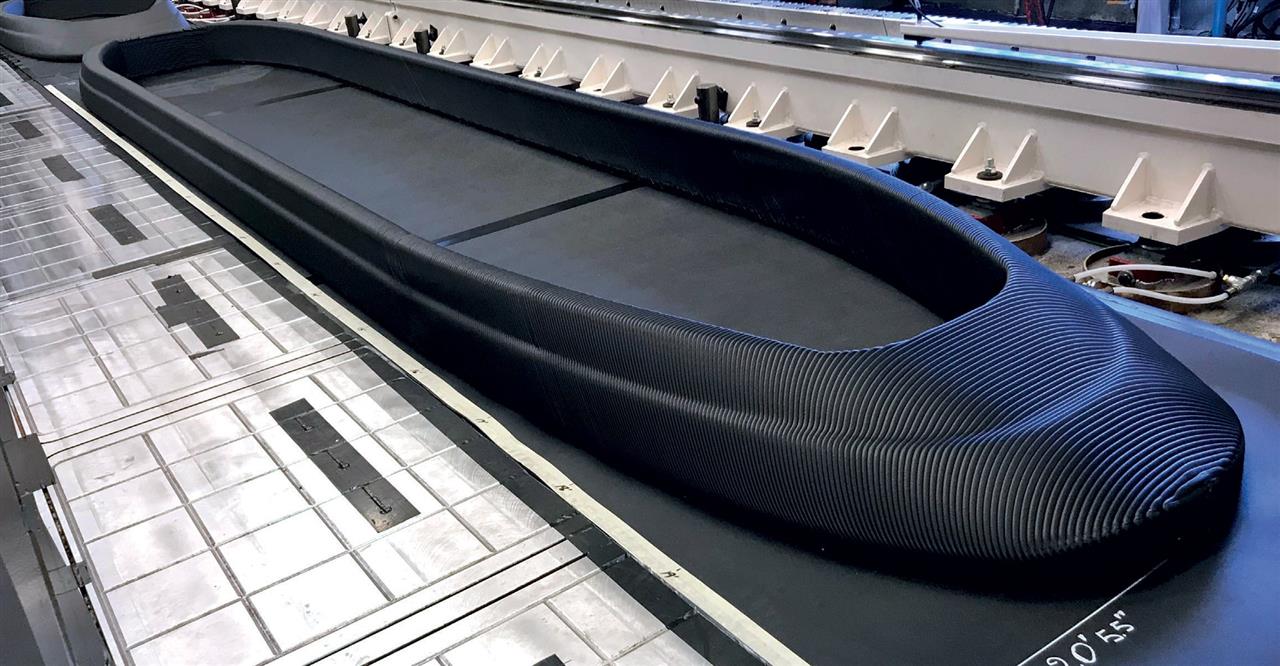
3D printed boat hull mold or prototype. Image courtesy of Ingersoll Machine Tools.
The U.S. military seems to have gotten serious about sourcing advanced manufacturing equipment domestically over the last couple of years, a development that has only become publicly apparent as the relevant projects have been completed. Aside from this story about Ingersoll, there is also the Chicago Additive AMOS printer, manufactured in the U.S. thanks to co-licensing of a NAVWAR patent, which was announced a couple of weeks ago.
Further, both the AMOS and the Ingersoll factory-in-a-box are designed for deployability, suggesting what applications the DoD may be most interested in using the machines for, most immediately. While the AMOS printer seems perfectly suited for drones, it is a bit harder to guess what the Ingersoll system is specifically intended for.
However, the fact that the product was delivered to the Army Corps of Engineers, in particular, combined with its capacity for large composite parts, may indicate that the factory-in-a-box will foremost be used for construction. In this vein, given that the machine will be deployed in Illinois, it is noteworthy that the Army Corps of Engineers funds the Construction for Autonomous Manufacturing in Scale (CACMS) at the University of Illinois.
Subscribe to Our Email Newsletter
Stay up-to-date on all the latest news from the 3D printing industry and receive information and offers from third party vendors.
Print Services
Upload your 3D Models and get them printed quickly and efficiently.













You May Also Like
10 Years of Multi Jet Fusion: Onsite at HP’s Vancouver, Washington Facility
At this year’s RAPID event in Boston, HP Additive Manufacturing Solutions celebrated ten years in the additive manufacturing (AM) market. The company ushered in the milestone with several innovations, including...
These 3D Printed Lattices Can Sense Damage Before Failure
A new paper, “Full-Field Damage Monitoring in Architected Lattices Using In situ Electrical Impedance Tomography,” points to lattices being able to detect damage. This could really help composites in critical...
3D Printing News Briefs, October 3, 2026: Hypersonics, Hotends, & More
We’re starting off with defense in this weekend’s 3D Printing News Briefs, as Titomic was awarded a $5 million U.S. defense contract, and VulcanForms announced a partnership with Specter Aerospace...
3D Printing News Briefs, October 1, 2026: Defense, Enclosures, & More
In today’s 3D Printing News Briefs, we’re starting with defense news, first from Massivit and then from AML3D. Then we’ll move on to U.S. manufacturing of a new large-format LPBF...