GKN Aerospace Adds Interspectral’s AM Explorer Software to its 3D Printing Workflow

GKN Aerospace, the UK-based leading manufacturer of aircraft components, has adopted AM Explorer, a platform made by Swedish software firm Interspectral, at its Centre of Excellence for Engine Systems in Sweden. GKN will incorporate the software into its additive manufacturing (AM) workflow, including its use with the Nikon SLM Solutions NXG XII 600.
AM Explorer combines AI and 3D visualization capabilities to help prevent print defects before they occur. According to Interspectral, GKN’s initial use of AM Explorer started in early 2024, which is around the same time that GKN announced it would be investing over $60 million to enhance its AM capabilities at the Swedish facility.
Last fall, Interspectral announced that the company had secured new venture funding to improve its product offerings and expand its operations. At the time, it also revealed plans to upgrade AM Explorer as part of its strategy for the capital influx.
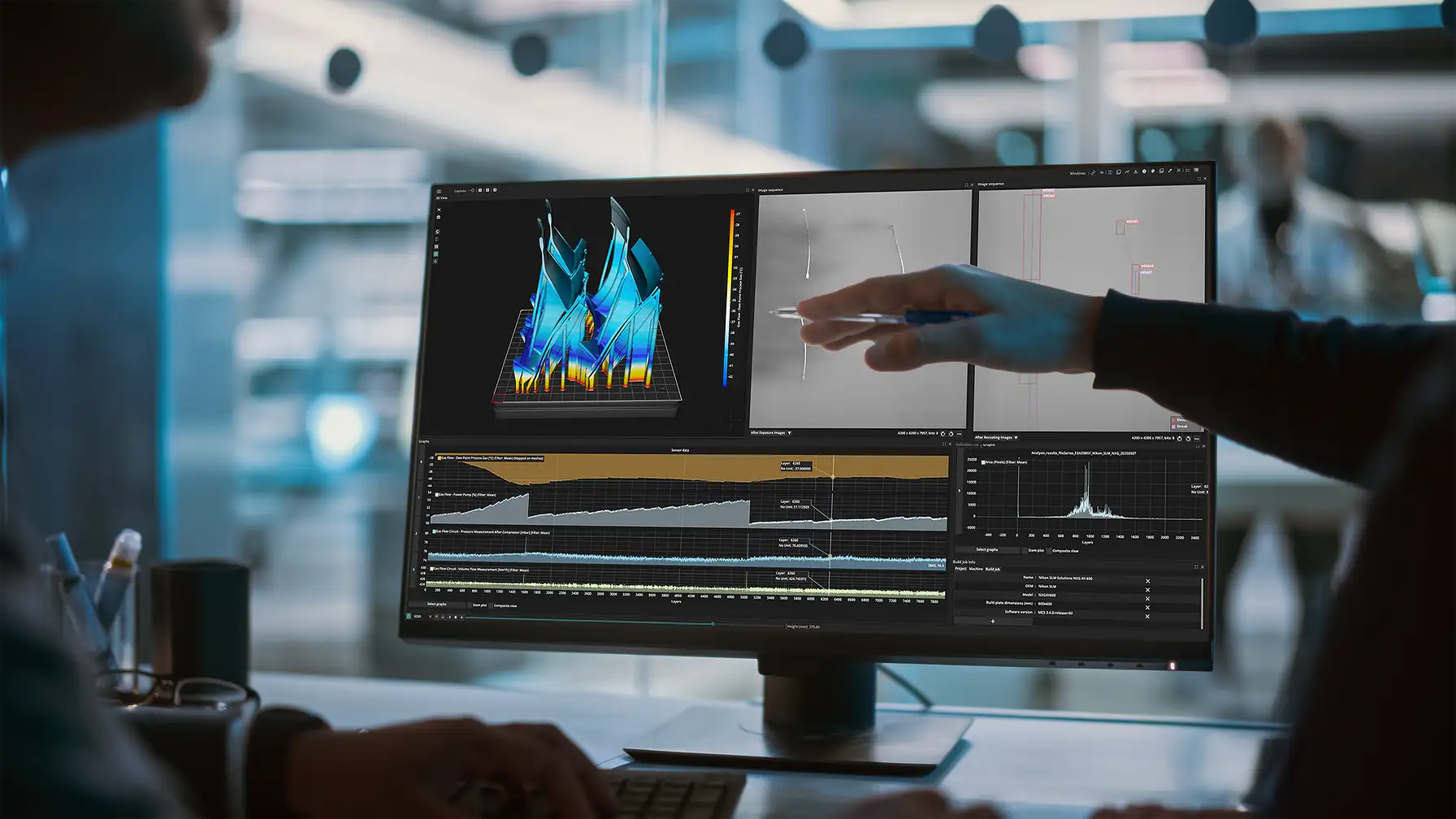
GKN Aerospace Adopts AM Explorer. Image courtesy of Interspectral.
In a press release about GKN Aerospace’s adoption of the AM Explorer at its Swedish Centre of Excellence, Martin Thordén, VP of GKN Aerospace Engines, said, “Currently, aircraft engine components rely on large castings and forgings, with up to 80% of the material machined away before reaching the final form. By employing additive technology…GKN Aerospace can minimize raw material waste, and energy within production. This significantly cuts emissions, costs and lead time.”
Similarly, Interspectral Product Manager Thomas Rydell said, “We’re proud to support GKN Aerospace on their journey to industrialize [AM] and contribute to a more sustainable aviation industry. Through close collaboration with the team in Trollhättan, we’re tackling real-world industry challenges — driving greater efficiency, automation, and cost savings.”

Nikon SLM NXG XII machine. Image courtesy of Nikon SLM Solutions.
Throughout the general AI boom of the last several years, the specificity of planned use cases in adopting industries has been one of the biggest prevailing uncertainties for forecasters of the long-term growth potential in AI-associated sectors. In other words, we all know that there are plenty of promising AI applications out there; we just don’t know how quickly and effectively the new adopters can incorporate the technology into their operations.
In this regard, the manufacturing sector has presented as much uncertainty as any other area of the economy. On the other hand, in recent months, announcements of AI use-cases across the AM industry, taken as a whole, increasingly suggest that AM users know what they want to use AI for most immediately: quality control. MIT’s recently announced Initiative for New Manufacturing (INM), for instance, has its sights set on making this class of use cases the focus of one of its first funding opportunities.
With that in mind, if companies like GKN Aerospace can demonstrate that they not only have detailed AI integration strategies that they’re implementing, but also — soon enough — that they’re seeing substantial return on investment (ROI) from such implementation, it will bring all the more clarity to the question of what role AI is best-suited to play, most immediately, in manufacturing supply chains. The fleshing out of a trend like that is precisely the sort of thing that’s needed to sustain the AI boom long-term.
Subscribe to Our Email Newsletter
Stay up-to-date on all the latest news from the 3D printing industry and receive information and offers from third party vendors.
Print Services
Upload your 3D Models and get them printed quickly and efficiently.













You May Also Like
The Money Behind AM: What to Watch at AM Investment Strategies 2026
For years, simply being a 3D printing company could attract attention from investors. New machines, new materials, faster speeds, and the promise of mass production were often enough to get...
Metal AM in a Multipolar World: Resilience, Regional Production and a Changing Market
Technology develops in response to forces driving change. That was the starting point for a keynote I presented with Mikael Schuisky at AM Meetup 2026, held in Karlstad, Sweden, on...
EOS Bets on Mexico’s AM Market with Axiomatek Sales Channel Deal
Mexico is one of the biggest beneficiaries of the push to diversify manufacturing out of China. This development is perhaps inevitable given the current global trade environment, but even with...
3D Printing Market Hits $4.48B After Six Straight Quarters of Growth
The additive manufacturing market continued to grow in the second quarter of 2026, adding another quarter to what is becoming a much more consistent expansion for the industry. Worldwide revenue...