Oqton’s 3D Printing Software Wins ASTRO-InSPIRE’s 2nd Annual Tech Challenge


Rejoice, ye process engineers! Your raised concerns do not go in vain. Additive manufacturing (AM) materials qualification is genuinely becoming the central focal point for commercialization efforts in the industry’s metals market segment.
Of course, depending on whose perspective one takes into account, it could be argued that, already for years, materials qualification has been the central focal point for commercialization of metal AM. However, the seemingly infinite additional obstacles also standing in the way of commercialization may have prevented the broader market from giving materials qualification the attention needed to spur sufficient momentum. Metal AM OEMs may have needed to first earn the right, essentially, to focus primarily on qualification.
In other words, this isn’t an overnight development (qualification never is), as proven, for instance, by the countless project calls related to qualification that America Makes has issued over the last decade. ASTRO America, the nonprofit that has been running point for the US defense sector’s somewhat mysterious AM Forward initiative, is another good example, illustrated most recently by its announcement of the winners of its second annual ASTRO-InSPIRE Tech Challenge, which was won by AM software provider Oqton.
Oqton beat out a bunch of heavy hitters, including Ansys and Autodesk, in a competition to deliver the best solution related to distortion prediction and compensation in PBF processes. Part distortion happens due to residual stress, the internal force built up by the range of thermal changes occurring in layers produced at different stages of the build process. Early metal AM scalers, chief among them the defense sector, have long considered this one of the key remaining technical barriers to adoption. Meanwhile, AM process specialists in the software world (like Oqton) offer simulation functions and geometry compensation tools to enable users to address potential distortion issues in the print preparation phase.
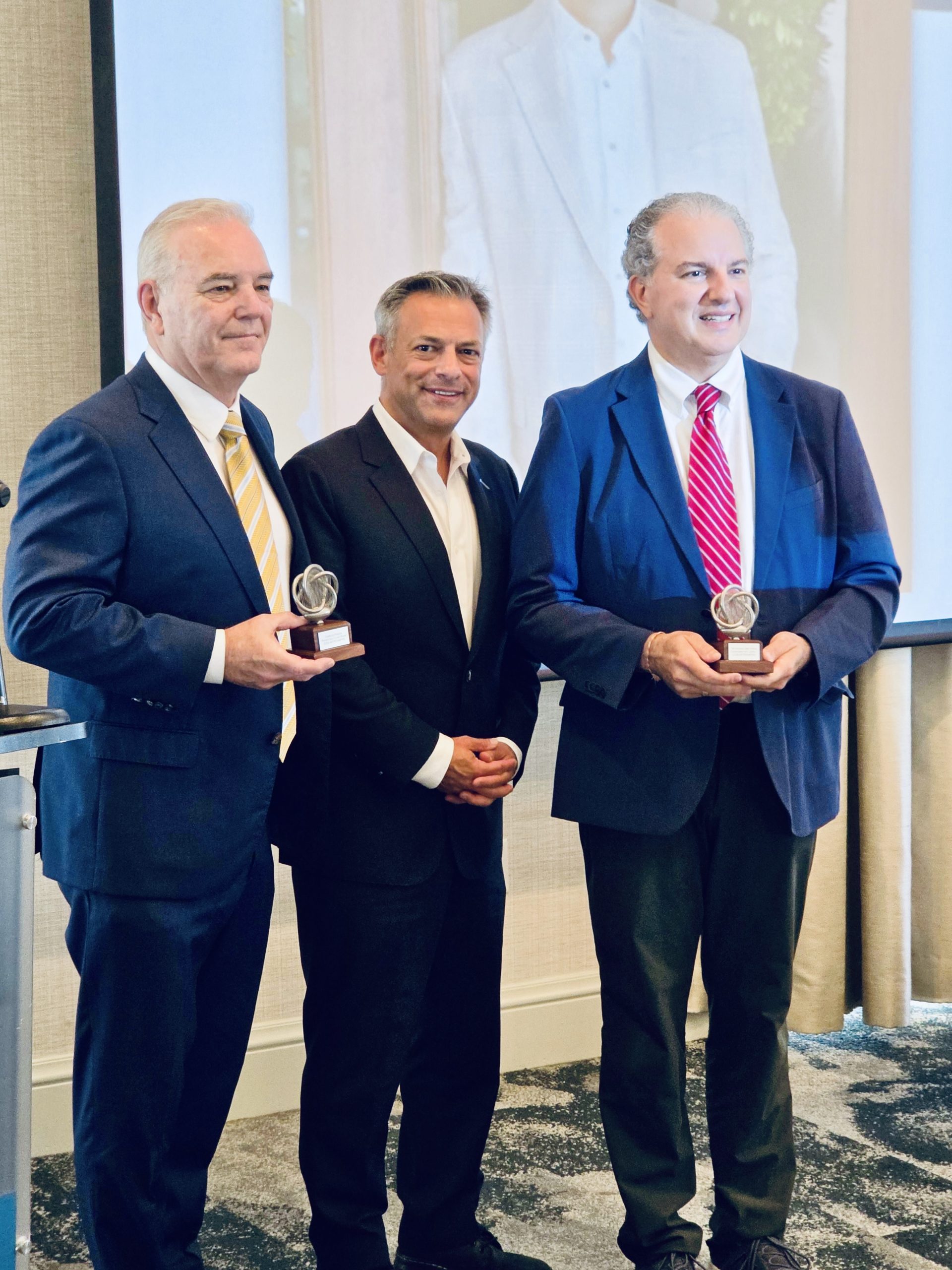
From left to right: Charles W. Rigdon, Chair of Triumph Gulf Coast, Neal Orringer, President of ASTRO America, and Rep. Jimmy Patronis (R-Fla.)
Zooming out somewhat, despite this being just the second year of the competition, there is a clear continuity of themes in ASTRO’s InSPIRE challenge, a contest the organization runs with its partner, Florida State University’s (FSU’s) Institute for Strategic Partnerships, Innovation, Research, and Education (InSPIRE). Last year, ADDIGURU and Additive Assurance, respectively a software platform and a hardware manufacturer for in-situ monitoring (ISM), won the first annual technical challenge, related to “Actionable In-Situ Awareness”. Since tracking metrics related to causing part distortion is a primary objective for ISM hardware, ASTRO looks to be helping build a comprehensive solution set that could help metal AM users maximize their ability to prevent distortion before it happens.
Ultimately, all of this contributes to making materials qualification less expensive by working towards a standard set of tools that will ideally eliminate the need for the vast majority of physical trial-and-error, which accounts for so much of the resource burden in qualification efforts. This seems like a valid area for interfirm cooperation (the AM Forward angle), while I also like that ASTRO is forcing the relevant companies to compete for the AM Forward members’ business.
Interestingly, then, the competitive stakes in the metal AM market seem to be organizing around qualification aptitude, evidenced not just by this but by many other recent announcements, including The Barnes Global Advisors’ (TBGA) contract from BPMI. The industry did not have an easy time getting to this point, yet it is nonetheless the right one to have reached.
The industry no longer has to be forced to care about materials qualification because the catalysts that have driven AM companies in this direction are now self-explanatory: whatever part of the industry you represent, if you want to compete at scale, you have to demonstrate that you’re up to the challenge of participating in the industry-wide task of consistently producing qualified parts. Next, I’d like to see all of this combined with workforce development efforts. The race to win metal AM will be determined by whoever figures out how to make a combination of materials qualification and workforce development evolve toward lower costs per part.
Featured image: the Oqton team with leadership from ASTRO. All other images courtesy of ASTRO America
Subscribe to Our Email Newsletter
Stay up-to-date on all the latest news from the 3D printing industry and receive information and offers from third party vendors.
Print Services
Upload your 3D Models and get them printed quickly and efficiently.













You May Also Like
Advanced Manufacturing at IMTS 2026: 3D Printing and AI and Drones, Oh My!
Last week’s International Manufacturing Technology Snow (IMTS) in Chicago welcomed over 90,000 attendees to the jungle that is McCormick Place. With over 1.17 million square feet of exhibit space, and...
Caracol to Build Large-Format 3D Printing Hub in Milan With Designtech & LAMÁQUINA
In the 1990 classic in economic strategy, The Competitive Advantage of Nations, business theorist Michael Porter wrote, “Most commentators on the Italian economy have persistently underestimated Italy, because they have...
ETH Students 3D Print Experimental Rocket Engine
Students at the Swiss University ETH have built a Rotating Detonation Rocket Engine (RDRE). An RDRE burns propellant in a ring-shaped combustion chamber where a continuous supersonic wave detonation is...
Printing Money Episode 35: Notable VC and M&A Deals, with Arno Held and Alex Kingsbury
Welcome to Printing Money Episode 35 and let us be the last to wish you a happy new year. For this episode Danny is joined by Arno Held (Managing Partner,...