TissueLabs Launches Advanced TissuePro Bioprinter for Labs Ready to Scale Up


Swiss biotech company TissueLabs has launched its most advanced bioprinter yet, the TissuePro. Built for tissue engineering and regenerative medicine, the new machine features precise multi-material printing, more automation, and greater flexibility compared to the company’s earlier models.
TissuePro builds on the success of TissueStart, the company’s entry-level bioprinter used in over 300 labs across more than 30 countries. While TissueStart opened the door for researchers entering the bioprinting field, TissuePro is meant for labs ready to scale up and tackle complex tissue models, organ-on-a-chip systems, vascularized constructs, and other advanced applications.
“TissuePro is everything we’ve learned, reinvented, and reimagined,” said Dr. Gabriel Liguori, Founder and CEO of TissueLabs. “If you loved TissueStart, get ready. You’re about to fall in love all over again.”
Precision Printing, Reinvented
At the heart of TissuePro is TissueLabs’ proprietary Mixtrusor technology, which lets the machine mix and print several bioinks at the same time. It uses five separate piston-based extruders to give researchers very precise control (down to just 0.1 microliters). This is a big improvement over pressure-based systems, which typically require constant adjustment.
According to the company, this setup lets researchers print complex, detailed tissues with different layers and materials. It also supports advanced printing methods, such as coaxial and triaxial printing (techniques that allow multiple bioinks to be printed in layers within a single strand), making it easier to recreate complex tissue structures similar to those in the human body. With this setup, users can create highly detailed, heterogeneous tissues with layered structures and compositional gradients.

TissueLabs’ TissuePro bioprinter. Image courtesy of TissueLabs.
To make it even more versatile, TissuePro comes with a light-curing system that uses five different wavelengths, allowing it to work with many types of materials. Both the printheads and the print bed can be heated or cooled (from 4°C to 60°C), so the machine works with everything from lab-made materials to natural ones. The system also includes automated multi-head printing, which cuts down on manual work and helps labs get more consistent, repeatable results.
TissuePro was developed with a wide range of applications in mind. While its core strength lies in regenerative medicine, the system is also geared toward drug development, cancer research, organ-on-a-chip models, cultured meat production, and soft robotics: fields that need precision, repeatability, and material flexibility. The system is now available for pre-order, with shipments expected to begin in August 2025.
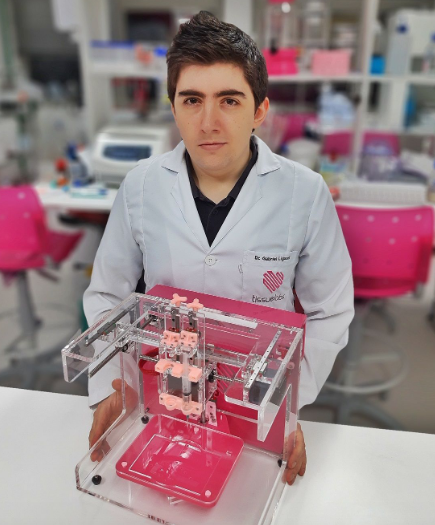
TissueLabs Founder and CEO Gabriel Liguori, with the TissueStart bioprinter. Image courtesy of TissueLabs.
From Brazil to Switzerland
The launch of TissuePro also shows how much the company has grown. Originally founded in Brazil, TissueLabs moved its headquarters to Switzerland to be closer to Europe’s biotech and innovation hubs.
Under the leadership of Liguori, a surgeon-turned-entrepreneur, TissueLabs has expanded its product lineup, which now includes extrusion and light-based bioprinters, biomaterials, and software tools. With TissuePro, TissueLabs is doubling down on its mission: to speed up the path to lab-grown tissues and organs, and put advanced bioprinting tools into the hands of more researchers around the world.

TissueLabs’ TissuePro bioprinter. Image courtesy of TissueLabs.
Subscribe to Our Email Newsletter
Stay up-to-date on all the latest news from the 3D printing industry and receive information and offers from third party vendors.
Print Services
Upload your 3D Models and get them printed quickly and efficiently.













You May Also Like
Polish Electronics 3D Printing OEM XTPL Sells 10 More Printhead Modules to First Chinese Customer
Smartphones, laptops, and all other such devices are only getting more expensive. As evidenced by Apple’s cautioning of higher prices for this year’s new iPhone line, the problem is largely...
Lyten’s Graphene Filaments Power Modovolo’s US-Made 3D Printing Platform
Drone manufacturer Modovolo has selected Lyten as the primary filament supplier for its industrial 3D printing platform, a move the companies say will strengthen U.S.-based manufacturing for aerospace, defense, and...
AM Research Data Shows 3D Printing Markets Increased from $4.29B in Q4 2025 to $4.35B in Q1 2026
Leading industry analyst firm Additive Manufacturing Research (AM Research or AMR) has been providing market reports for the 3D printing/AM sector since 2013. It recently published the “Q1 2026 3DP/AM...
3YOURMIND Demonstrates that Distributed 3D Printing is Ready at AM Village 2026
Given that additive manufacturing (AM) is so closely adhering to the classic industrialization blueprint whereby military adoption pushes a new technology to commercialization, I’ve thought for a long time that...