
Deployable Construction 3D Printer in the Works from Air Force and X-Hab 3D

“Impactful innovations require impactful organizational change,” Major Brian Vickers told Department of Defense (DoD) outlet DVIDS. Maj. Vickers, the Deputy Base Civil Engineer at Maryland’s Martin State Air National Guard Base (ANGB), was referring to a project that the US Air Force’s (USAF’s) 175th Civil Engineer Squadron (CES) has embarked upon with Pennsylvania additive construction (AC) firm X-Hab 3D to develop a construction printer that could be deployed to quickly rebuild infrastructure in contested logistics environments.
Vickers is the head of the project, called simply the Expeditionary 3D Concrete Printer, which has been funded in part by USAF’s AFWERX Refinery, one of the branch’s many innovation accelerators. The 175th CES worked with X-Hab to modify the private company’s existing commercial model — the Mobile Expeditionary 3D Printer (MX3DP) — a “ruggedized robotic-arm style 3D printer on a continuous track mobile platform.”
According to DVIDS, the modifications involved “reinforcing components, automating processes, and simplifying controls” in order to optimize the MX3DP for use in active combat zones. The 175th CES has worked with the Massachusetts National Guard and the National Security Innovation Network, another DoD technology accelerator that’s part of the Defense Innovation Unit (DIU), to develop 3D printed wall designs that maximize blast resistance.
In April 2024, before bringing the modified MX3DP to Martin State ANGB, the Expeditionary 3D Concrete Printer team trained on the machine with X-Hab at Penn State University’s Additive Construction Lab, with that initial training process taking only four days, according to Vickers. X-Hab 3D, a spin-off founded by Penn State faculty, maintains close ties to the lab and uses it as a hub for testing and training on its large-scale 3D printing systems. By the next month, the 175th CES, “the first operational Air Force unit” with a construction printer, had finished its first solo on-base print.
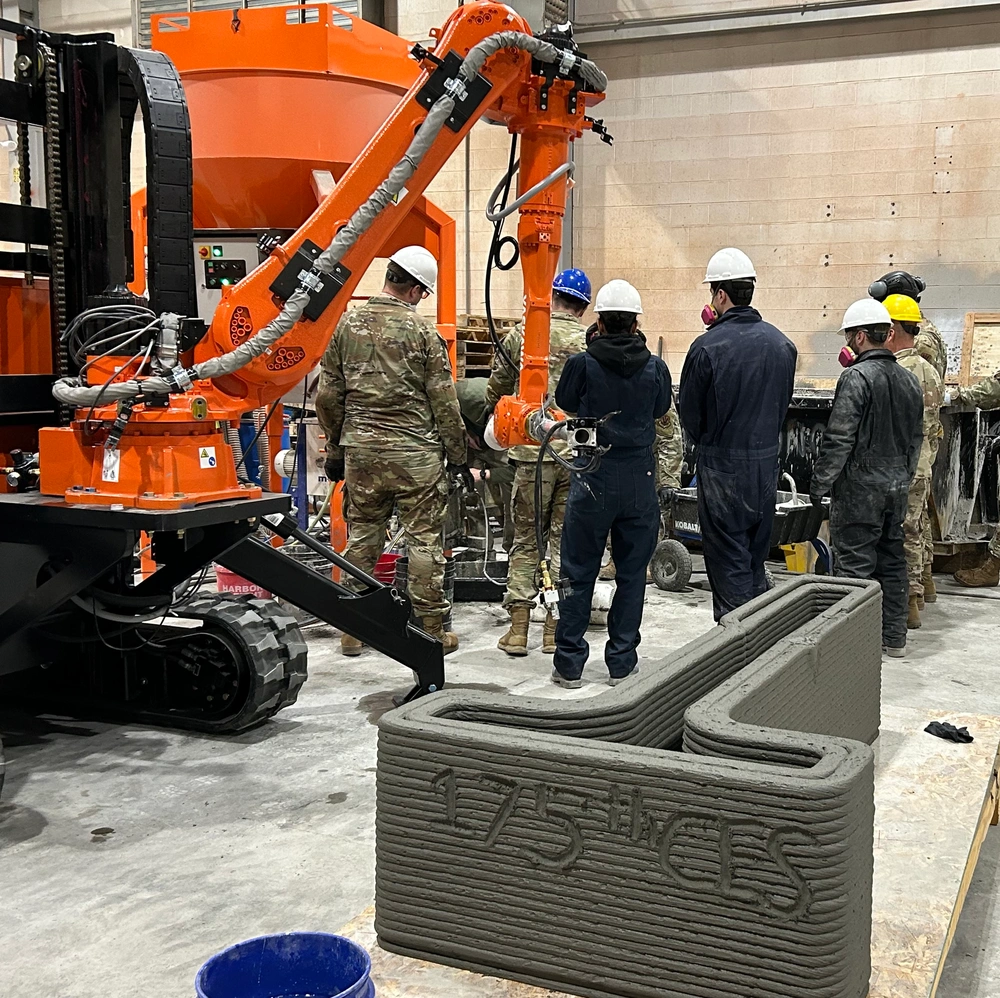
Expeditionary 3D Concrete Printer at Martin State Air National Guard Base in Maryland.
“The idea [for the Expeditionary 3D Concrete Printer project] came from carefully considering the role of Air Force Civil Engineers in future conflicts,” Vickers told DVIDS. “The Air Force Civil Engineer enterprise has been largely focused on base maintenance and sustainment for over a decade, and our ability to rapidly construct and repair austere airfields and infrastructure on a large scale will likely be strained in future conflicts. By building with concrete, occupants of these buildings are far more protected from blasts, fragmentations, and small-arms fire.”
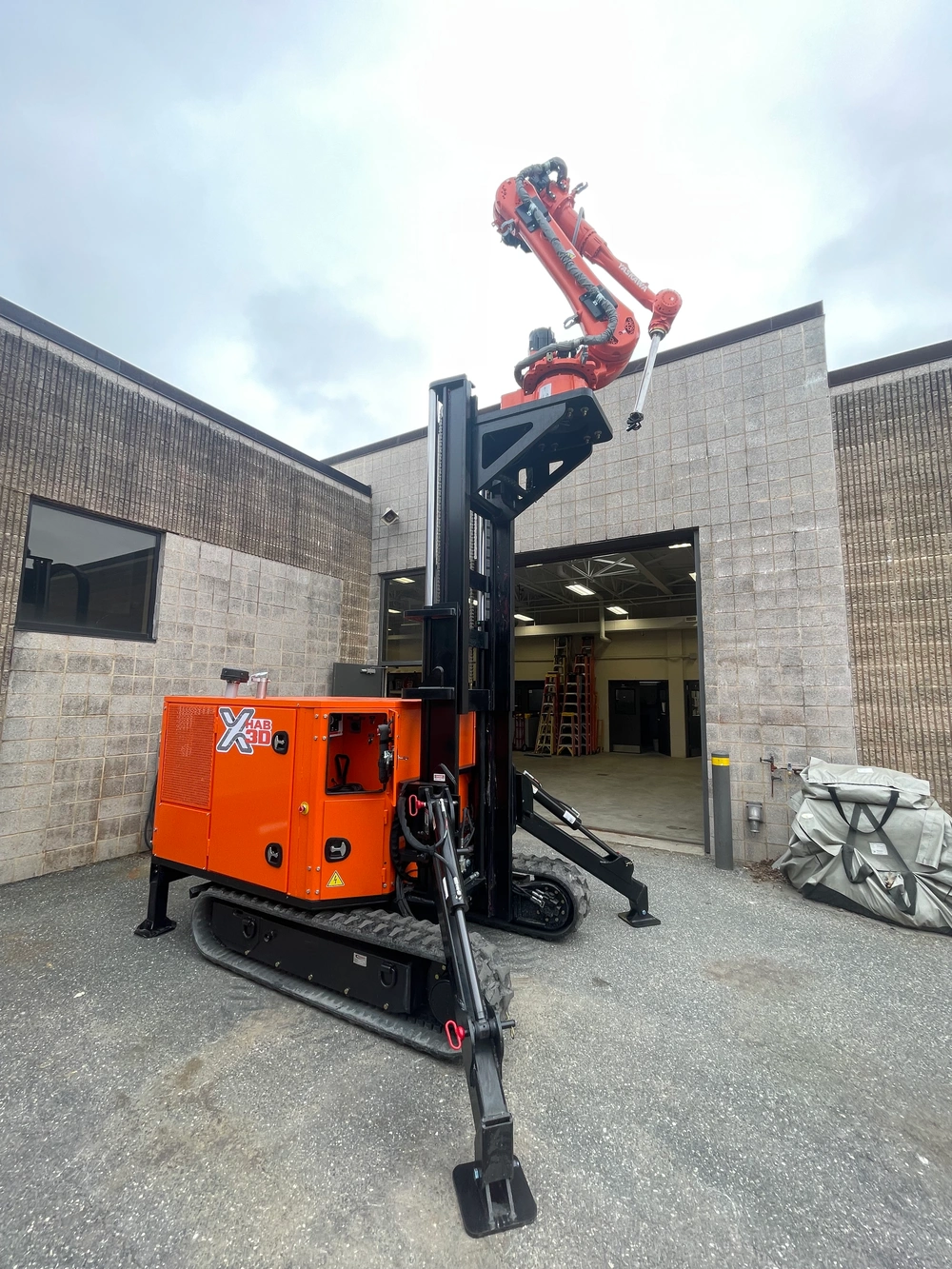
Expeditionary 3D Concrete Printer at the 175th CES at Martin State Air National Guard Base, Maryland.
Up next for the 175th CES will be a print of a structure that can house the modified MX3DP, with Vickers noting that such a build could serve as “a model for a concrete replacement of the Small Shelter System (SSS) Tent that has been a DoD standard for several decades.” Used as temporary housing, workspaces, or storage on deployed bases, the SSS Tent is known for being quick to assemble but offers only short-term protection.
Interest from the defense community in the development of a rapidly deployable concrete printer was inevitable, given all of the focus by the DoD and its allies on deploying additive manufacturing (AM) in contested logistics environments (a term that the US military is still in the process of formally defining). As I’ve noted before in this context, on a planet facing a proliferation of major infrastructure risks of all kinds — not just those embodied by active military threats — it makes sense to expand as greatly as possible our notion of what constitutes a “contested” logistics environment.
That is, even outside active combat zones, there are countless obstacles standing in the way of rebuilding critical infrastructure, from labor shortages to NIMBY mentality to now tariffs. Along those lines, everyone whose business it is to complete infrastructure projects would do well to adopt the same kind of mentality that gives life to initiatives like the Expeditionary Concrete 3D Printer.
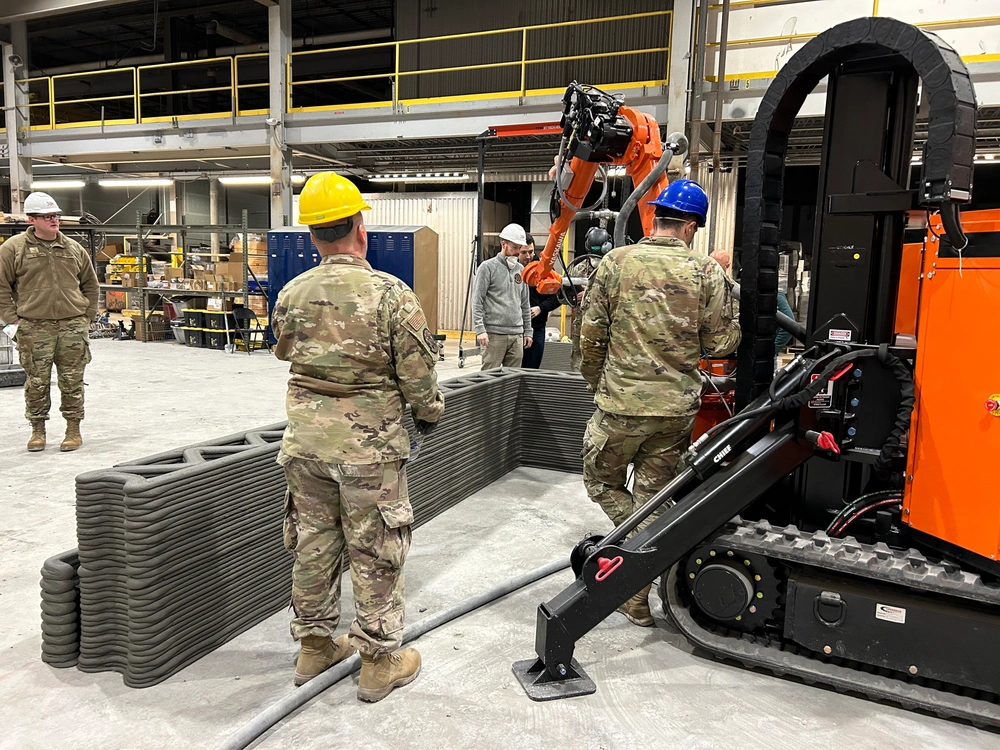
Expeditionary 3D Concrete Printer at Martin State Air National Guard Base in Maryland.
Indeed, this mindset is perhaps most appropriate in the realm of construction, considering the centrality of building structures to every other area of the economy. You only have to think about a single catastrophe like the Francis Scott Key Bridge collapse that occurred last year in Baltimore, its human and economic impact, and the difficulty that lies in rebuilding the bridge, to grasp how society at-large could benefit from taking an approach to construction (and other industrial challenges) that echoes what militaries around the world are doing.
Images courtesy of Turner Dilley/DVIDS.
Subscribe to Our Email Newsletter
Stay up-to-date on all the latest news from the 3D printing industry and receive information and offers from third party vendors.
Print Services
Upload your 3D Models and get them printed quickly and efficiently.













You May Also Like
3D Printing News Briefs, August 22, 2026: Polymers for CubeSats, Animal Mobility Devices, & More
We’re starting with defense news in this weekend’s 3D Printing News Briefs, before moving on to polymers for CubeSats and 3D printed prosthetics. We’ll end with a story about engineering...
Pusan National University & ORNL Develop Elastomeric Liquid Crystal Actuators
Researchers from Korea’s Pusan National University and Oak Ridge National Laboratory (ORNL) have developed 3D printed elastomeric actuators. In a paper published in Nature, the team used elastomeric liquid crystal...
Scientists Use BMF to 3D Print Seal Whiskers That Track Prey Long After It’s Gone
Seals use their whiskers to hunt. Not Navy Seals, although they may in some way also, but this article is about lowercase seals. Not Seal the musician either; as far...
Harvard’s Jennifer Lewis Lab Is 3D Printing Artificial Muscles That Twist and Bend on Demand
Researchers at Harvard John A. Paulson School of Engineering and Applied Sciences (SEAS) have developed a new way to 3D print materials that can move on their own, bending, twisting,...























































