Pratt & Whitney Taps DED 3D Printing to Speed Jet Engine Repairs

Pratt & Whitney, a subsidiary of aerospace/defense giant RTX, has developed a new method leveraging directed energy deposition (DED) additive manufacturing (AM) to repair critical components on its geared turbofan (GTF) engines. Pratt & Whitney claims that the DED maintenance, repair, and operations (MRO) approach reduces repair time by over 60 percent, compared to existing methods.
Based in Connecticut, Pratt & Whitney developed the MRO process at its North American Technology Accelerator (NATA) in Jupiter, Florida, in collaboration with the non-profit Connecticut Center for Advanced Technology (CCAT) and the RTX Research Center. Pratt & Whitney announced the opening of the NATA, its second technology accelerator — following the opening of the Singapore Technology Accelerator in 2022 — exactly a year ago.
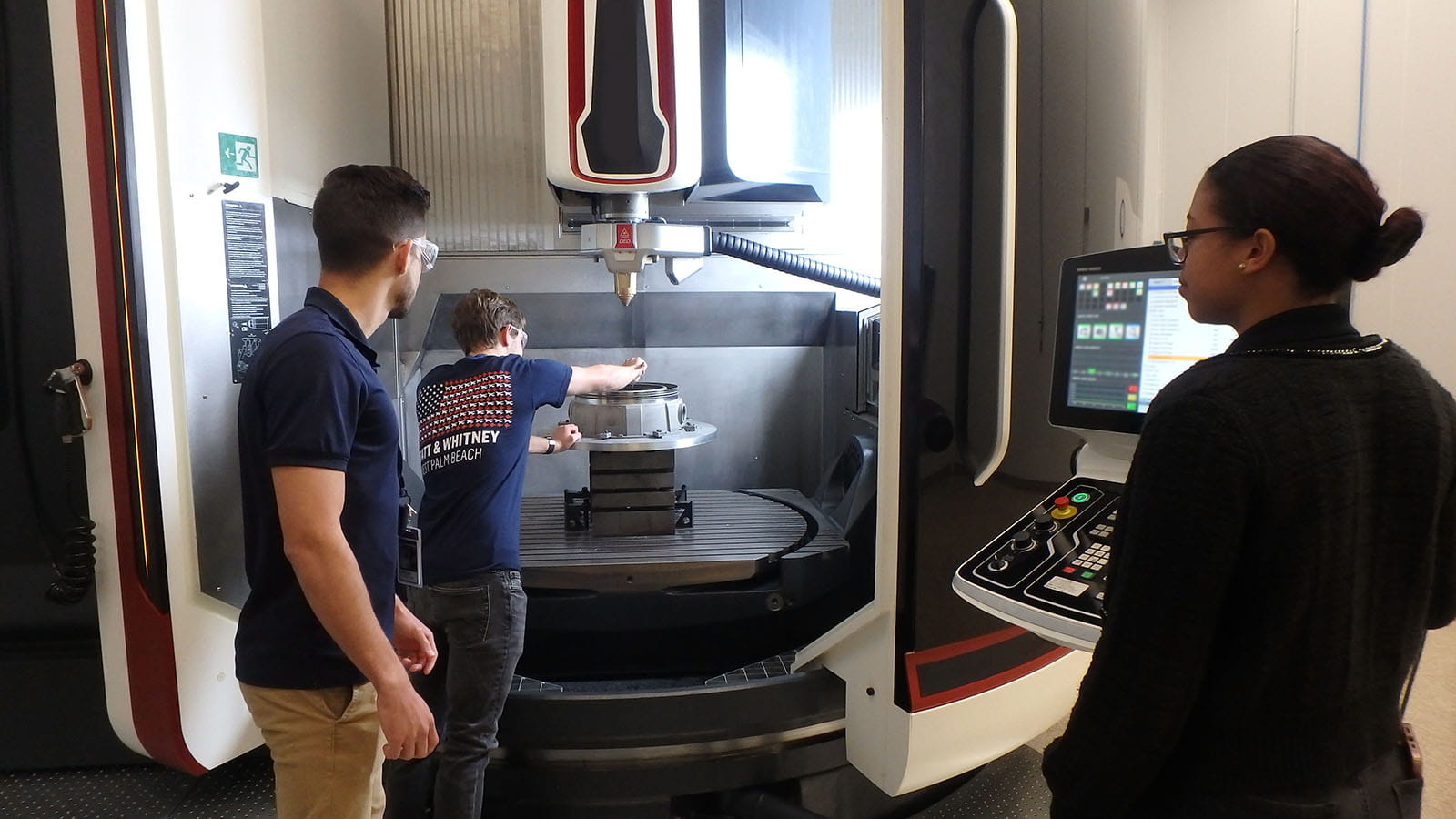
Pratt & Whitney engineers work on a metal part.
In that original announcement, Pratt & Whitney referenced the project focused on AM repair for GTF engines as a central focus of the new facility without specifying that DED was the method in question. The company is now planning on industrializing the process in order to scale it across its global MRO network for the GTF engine, anticipating that it will enable the recovery of $100 million worth of parts over the next five years.
In the press release from April, 2024, about the opening of the NATA in Florida, the VP of Aftermarket Operations at Pratt & Whitney, Kevin Kirkpatrick, said, “NATA combines data science with people know-how and state-of-the-art automation to help address customer pain points such as inventory management and part availability, while accelerating our improved repair capabilities and efficiency to better serve our customers.”
Meanwhile, in a press release about the initial success of the DED project for GTF MRO, Kirkpatrick said, “[A more agile, additive repair process] reduces our dependency on current material supply constraints. Additive technology has the potential to support a range of critical GTF part repairs and we’re actively working to explore additional opportunities for implementation.”

Airbus SAS.
As I just wrote about Axtra3D’s launch of its TrueSilX50 material and expansion of its reseller network, newcomers in the AM industry may end up being the biggest winners of any acceleration to US reshoring that results from the mounting uncertainty yielded by the Trump administration’s trade war policies. This goes for processes and technologies just as much as it does for products and companies, and DED — a relative newcomer compared to more established processes like SLA, FFF, and PBF — is perfectly poised to reap the benefits of accelerated reshoring.
Beyond the symbolism of announcing the success of the DED project exactly a year after the NATA was announced, it is noteworthy that both the project and the mission of the NATA are working as planned, insofar as that trajectory bodes well for Pratt & Whitney’s long-term plans to scale up the DED process and branch out into other AM applications. That is exactly the sort of trajectory the AM industry needs to instill the necessary confidence that a scale-up of additive technologies is a viable strategy as a supplement and, eventually, an alternative to existing supply chains.
If the project continues to work out as planned, there is significant potential to build on it, given that the cost savings yielded would presumably be re-invested into further R&D. Thus, Pratt & Whitney has not only developed a new method for engine MRO but is establishing a model for bringing the economics of AM into a new phase of maturity.
Images courtesy of Pratt & Whitney
Subscribe to Our Email Newsletter
Stay up-to-date on all the latest news from the 3D printing industry and receive information and offers from third party vendors.
Print Services
Upload your 3D Models and get them printed quickly and efficiently.













You May Also Like
Creality K3 Opens for Pre-Order at $849, Advancing Multi-Color 3D Printing
Creality has officially opened pre-orders for the Creality K3, its latest flagship K Series 3D printer, starting at $849 in the United States. Recognized as an IFA Innovation Awards 2026...
Beyond the Printer: HP and DyeMansion Tackle the Future of Prosthetics
Making a custom orthotic or prosthetic device involves much more than producing the final part. Patients need to be measured, devices must be designed to fit their bodies, and finished...
3D Printing News Briefs, October 14, 2026: Bolus, Aerospace Tooling, Water Filter, & More
In today’s 3D Printing News Briefs, we’re starting with medical news, as Myrava has received FDA 510(k) clearance for its 3D printed bolus. Moving on to aerospace and metals, AML3D...
Can India’s AM Push Help Make it a Viable Supplement to China?
Diversifying manufacturing supply chains to locales outside of China has nothing to do with actually cultivating “substitutes” to the Chinese economy. The real stakes are these: China is an irreplaceable...