SUNLU Releases New 3D Printing Filament Dryer with Annealing


Filament dryers have long been needed in material extrusion. Both industrial and home users benefit from conditioned filament with reduced moisture and uniform temperatures closer to extrusion levels. Whether integrated into the machine or as separate units, filament dryers enhance consistency, improve repeatability, and reduce print errors, especially with materials like PLA and PA.
Hygroscopic filaments absorb moisture from the air, leading to filament breakage, stringing, and extruder blockages. ABS, PC, PETG, TPU, and many other filaments suffer from these issues. However, even non-hygroscopic materials like PP benefit from consistent temperature control.
I find it a bit disappointing that many people overlook factors like room humidity, airflow, and the starting temperature of filament. Still, it’s encouraging to see more attention being given to moisture reduction—it’s a good start.
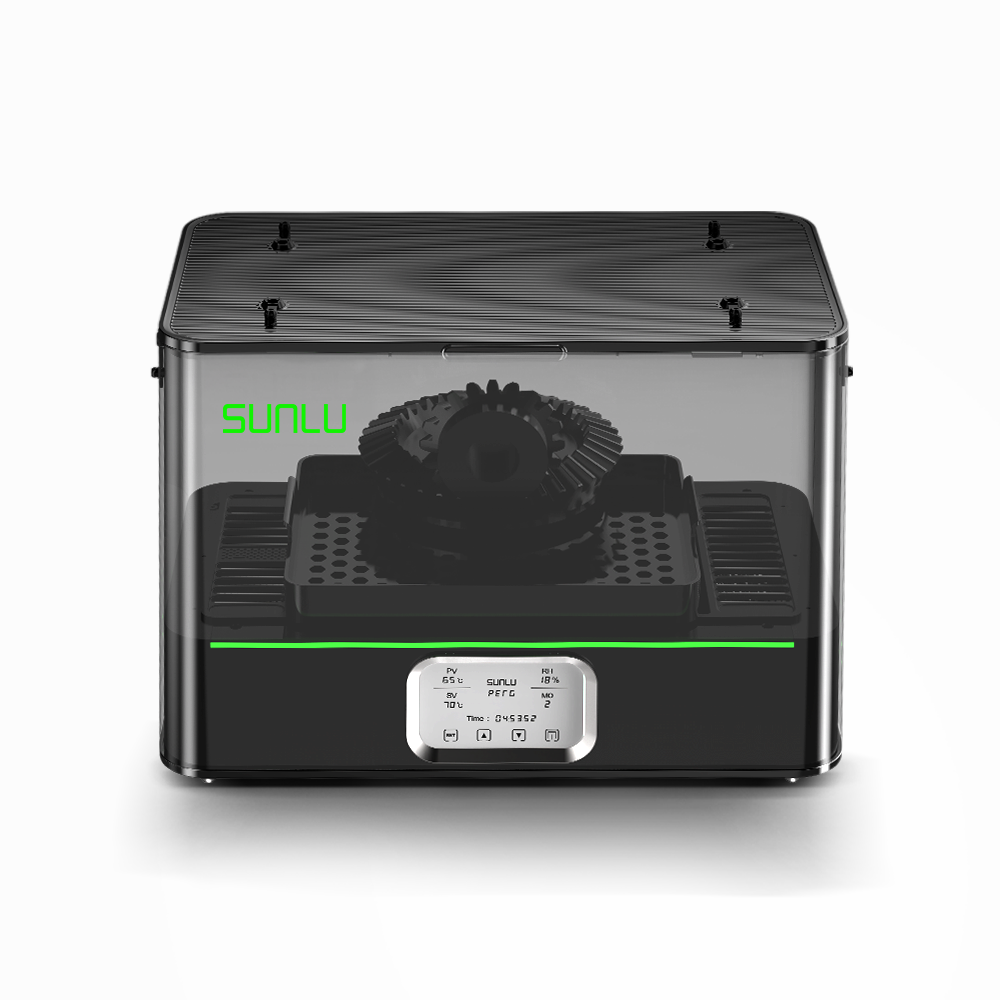
Whereas we’ve had both improvised and high-end filament dryers for years, none have sold in high numbers. Chinese filament manufacturer SUNLU aims to change this with the FilaDryer E2. This new unit can reach temperatures of up to 110°C, making it more suitable for PA (polyamide, nylon), PC, and high-performance materials such as PEI.
The unit maintains a temperature of up to 70°C with ±3°C accuracy in an environment of 25°C (±5°C). Between 70°C and 110°C, it offers ±5°C accuracy based on measurements taken at four different points, ensuring consistent drying for professional-grade results. The chamber measures 372mm × 192mm × 186mm and can accommodate two 1-kilo spools or a 2- or 3-kilo spool.
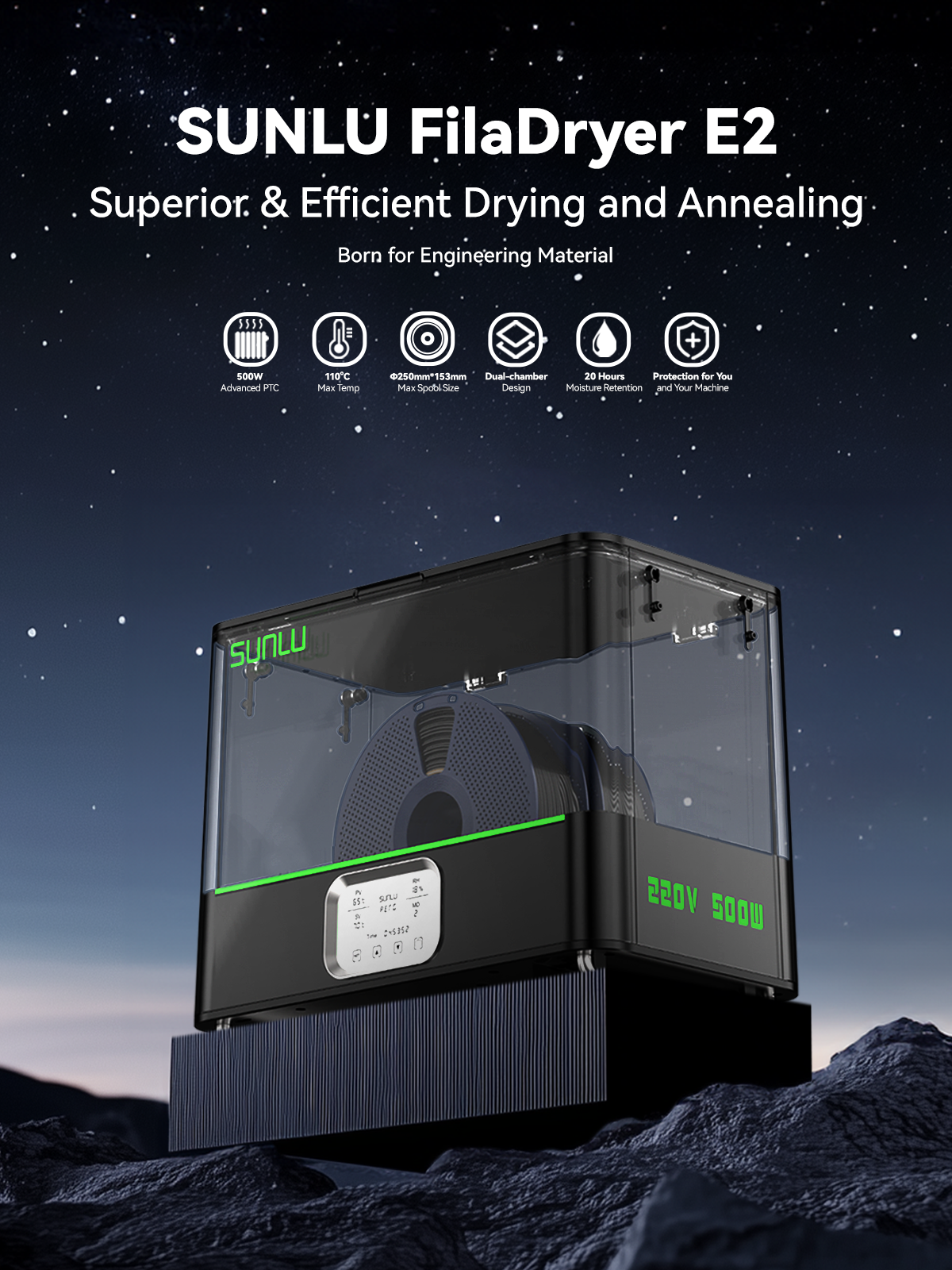
The chamber is sealed with silicone plugs, allowing up to eight filaments to be run through in 1.75mm, 2.85mm, or 3mm diameters. It features a touchscreen interface, enabling users to create custom drying cycles or select from preset options. The unit is UL, CE, FCC, UKCA, and ROHS certified.
The dryer costs $400, which is significantly more than the $100 Creality Plus Space Pi and Creality’s own $130 FilaDryer S4 model. The S4 can hold four rolls and will likely suffice for most home users. SUNLU also offers dry box-style units like the S1 and S2, priced at $40 and $50, respectively. PrintDry has a four-spool unit available for $199, while EIBOS offers a rolling unit for $140. Compared to these options, the SUNLU appears expensive. However, the real test will be in its performance—if it can maintain a uniform temperature across the build chamber, it will outperform these alternatives. A higher temperature range will also expand material compatibility.
But SUNLU has one more trick up its sleeve. For years, users have relied on convection and lab ovens to anneal parts, a process that enhances uniformity and strengthens prints. By heating parts to their glass transition temperature, annealing can improve tensile strength and heat deflection, making the material more crystalline. However, the process requires precise control—without it, parts may deform or warp. While some materials and geometries benefit from annealing, others can suffer reduced performance or excessive distortion.
PETG, for instance, is an excellent candidate for annealing at around 90–110°C, where relatively simple parts can gain increased impact resistance. SUNLU’s new annealing mode could make this process more accessible for both home and industrial users. Even PLA parts could see strength improvements.
I’m not sure how many people will take advantage of this feature, but for some users, it will be a fantastic solution. If you produce end-use PETG and PLA parts, this machine is worth considering, as it could significantly enhance material properties.
I truly hope to see more advanced filament dryers in the market. As desktop material extrusion machines are increasingly used for end-use parts, filament dryers will become more common. These machines could play a crucial role in improving the economics of 3D-printed parts, and I look forward to seeing further advancements in this space.
Subscribe to Our Email Newsletter
Stay up-to-date on all the latest news from the 3D printing industry and receive information and offers from third party vendors.
Print Services
Upload your 3D Models and get them printed quickly and efficiently.












You May Also Like
Kratos Buys an AMCM M 8K to Increase Its AM Capacity in Indiana
As is true concerning the growth of any market, increasing AM adoption happens primarily through industrial clusters, hubs of economic activity which harness and accelerate innovation. While Indiana may not...
3D Printing News Briefs, October 29, 2026: 3D Printed Satellite Parts, Mandrel, Car Accessories, & More
We’re starting with metallized polymer micro-AM components for satellites in today’s 3D Printing News Briefs, and then moving to a new facility, an award-winning gas storage manufacturing project, and Snapmaker...
With 45% Revenue Growth & a New 3D Printer, BigRep Returns to Private Ownership
BigRep GmbH has been on a bit of a roller coaster recently, but with this latest news, I’m hoping that means the ride has stopped. Reporting approximately 45% revenue growth...
China’s Additive Manufacturing Market is About to Get Even More Competitive
Last month I wrote about the Chinese laser brand HG Laser and how its increasing focus on metal additive manufacturing (AM) demonstrates that Chinese AM companies benefit from having to...