
Nano Dimension Expands Micro-Manufacturing with Exa 250vx 3D Printer

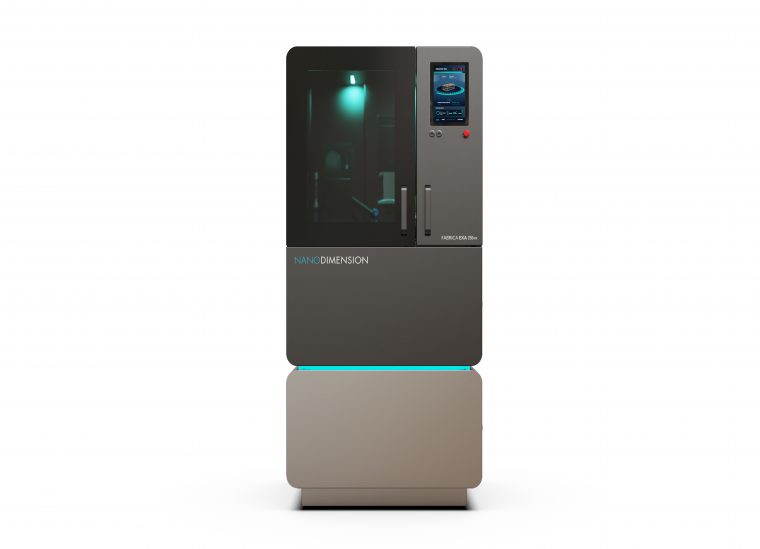
As it continues to push for the acquisitions of Desktop Metal and Markforged, Nano Dimension has introduced a new micro-3D printing system at Formnext. Adding to the Fabrica Tera and Giga 3D printers is the Exa 250vx digital light processing (DLP) system, tailored specifically for micro applications.
With a build volume of 100mm x 100mm x 70mm and capable of layer thicknesses of just 10 microns, the Exa 250vx is meant to combine high resolution with enhanced production throughput. This positions it as a tool for service bureaus and original equipment manufacturers (OEMs) engaged in large batch production of small, intricate parts.

Potential applications span a wide range, from connectors in electronics and micro needles and filters for medical devices to jewelry. As showcased by micro 3D printing specialist Horizon Microtechnologies, these types of parts can be coated for functionality, enabling the production of such complex devices as antennas.
“Manufacturers producing micro parts are facing a trade-off between precision and productivity,” says Nir Sade, Senior Vice President of Additive Manufacturing at Nano Dimension. “As part of Exa’s development, we worked closely with customers to address a host of needs such as high-volume parts production with micro level detail for parts larger than the 50mm build limit we currently have on the Tera. The result is a system that provides the perfect balance of quality, productivity and cost, making it a game changer for the industry.”
The news comes as Nano attempts to acquire the two metal binder jetting companies with the largest market share, Desktop Metal and Markforged. In a note distributed earlier this month, Cantor Fitzgerald analyst Troy Jensen said, regarding Desktop Metal, “DM’s results were consistent with our survey results. Revenues of $36.4M were about 10% below expectations and decreased 15% and 7% on a y/y and q/q basis, respectively. Net income in the quarter was ($15.7)M, or a loss of $0.47 per share. DM exited Q3 with $30.8M in cash on the balance sheet, burnt $15.4M in the quarter and has $113M in debt. They really need the Nano acquisition to close and recent activist activity at Nano raises some concerns about the timing of this transaction closing.”
The activist activity Jensen is referring to are the protests by Nano investor Murchinson Ltd., whom we’ve covered in the past. The latest claim from the firm is that Nano leadership is linked to Russian oligarchs and should, therefore, undergo closer scrutiny by the Committee on Foreign Investment in the United States. To counteract Murchinson’s protests, Nano leadership has been actively encouraging its shareholders to approve the merger votes, specifically the Desktop Metal merger to be voted on December 1.
Subscribe to Our Email Newsletter
Stay up-to-date on all the latest news from the 3D printing industry and receive information and offers from third party vendors.
Print Services
Upload your 3D Models and get them printed quickly and efficiently.













You May Also Like
Solid Rocket Motors: the First Big Scaling Test for AM in the US Defense Sector
The additive manufacturing (AM) industry has become obsessed with the opportunity for drones, and there’s certainly good reason for that. But before drones, the big focal point in AM for...
Why the AM Industry Should Pay Attention to Schneider Electric’s $22.6B PTC Acquisition
By late 2024, there was already enough signaling of the additive manufacturing (AM) industry opportunity in the data center infrastructure market for AM Research to write a report on the...
AM Demand Signals: Reshoring the Robotics Supply Chain
The Federal Communications Commission (FCC) recently banned the sale in the US of “almost all” new mobile robots sourced from foreign countries. IEEE Spectrum (the link in the first sentence)...
3D Printing Financials: $28M in China, U.S. Deals and a Metal AM Comeback
Money continues to go into additive manufacturing (AM). From a $30 million raise for a Chinese metal 3D printing company to new funding for naval AM and a European company...

























































