Axtra3D Unveils New 3D Printing Materials and Partnerships at Formnext 2024


Axtra3D has a novel approach to vat polymerization by combining digital light processing with laser stereolithography, allowing it to produce exceptionally well-defined edges and details. This combination of high detail, superior surface finish, and high throughput is helping the company establish a strong reputation in the vat polymerization space. Axtra’s capabilities are especially appealing for applications like molds and casting.
At Formnext 2024, the firm showcased several updates, including the addition of six new materials to its portfolio, the expansion of its reseller network, and further machine sales to an existing client—evidence of growing traction in the market.
New Resins
“These six resins have been carefully engineered to optimize performance with Axtra3D’s Lumia X1 Hi-Speed SLA platform, empowering users to achieve high precision, durability, and functional properties. This underscores Axtra3D’s commitment to providing adaptable, high-performance solutions for industries ranging from automotive and industrial manufacturing to consumer goods and healthcare. We continue to improve our Hi-Speed SLA offerings by staying true to our foundational value proposition of no tradeoffs in precision, accuracy, surface finish, and print throughput when developing new materials and solutions. With these latest additions, Axtra3D further strengthens its core business model by building a robust ecosystem of top-tier material partners in the additive manufacturing industry. We are excited to welcome Arkema and Spectroplast to our expanding material partner ecosystem and deepen our collaborations with Forward AM and Loctite,” stated Axtra3D CSO Rajeev Kulkarni.
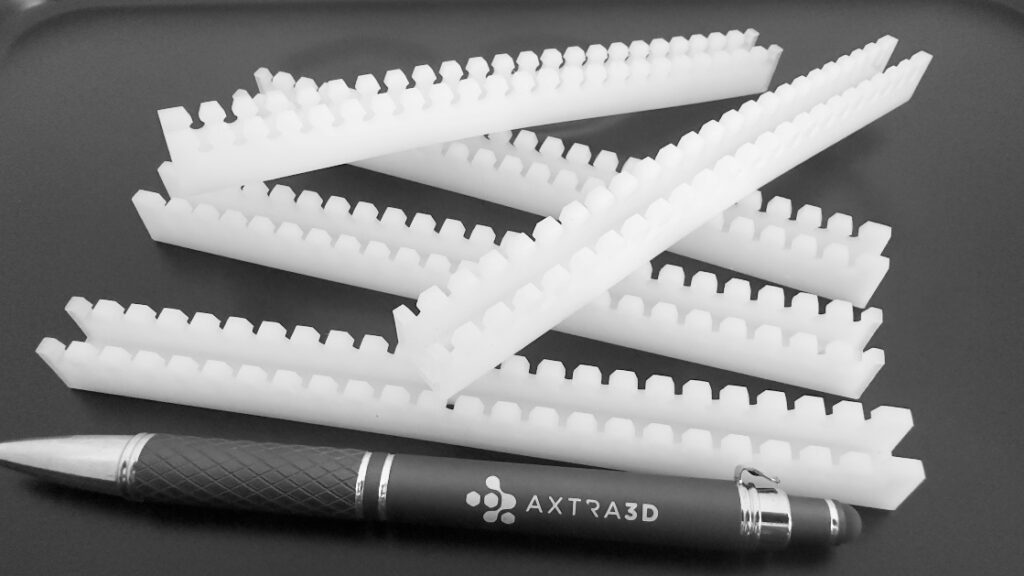
Parts 3D printed with TruSil-X50.
The new materials come from Spectroplast, Henkel, Arkema, and Forward AM. Spectroplast’s involvement is particularly notable, as the company has primarily focused on its own machines and services until now. This shift suggests a strategic move by Spectroplast to make its materials available to a broader ecosystem.
One standout material is Spectroplast’s TruSil-X50, a silicone that could be used in industrial applications as well as skin-safe medical uses, such as hearing aids. The potential for 3D-printed silicone is enormous, with applications that could far exceed the current scope of the 3D printing market. Imagine customized hearing aids, more comfortable hearing protection, bespoke headphones, tailored mouthguards, and beyond. This material could drive entirely new markets while enhancing existing ones.
Another notable material is N3D-FR512 from Arkema, a flame-retardant material with a UL-94 V-0 rating at 0.8 mm and a heat deflection temperature of 170°C. It is specifically designed for electrical connectors, a growing application in 3D printing.
While 3D printing has been used to produce connectors at scale for over a decade, the application is now rapidly expanding. MRI plugs, military connectors, aviation components, and more are increasingly being manufactured using additive technologies. This application is particularly well-suited to Axtra3D, as the precision and sharpness of its component edges align perfectly with the demanding requirements of connector manufacturing.
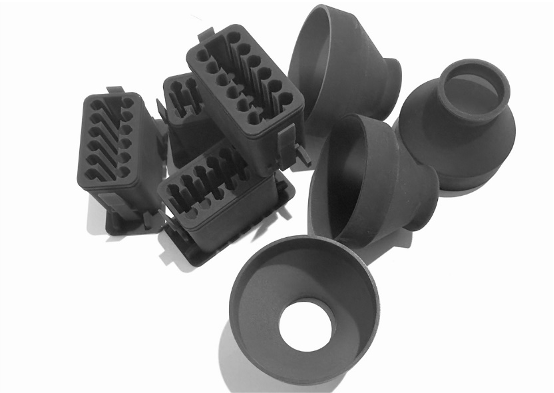
N3D-FR512
Another material is Loctite IND 249 from Henkel, a relatively durable and stiff material designed for complex and large assemblies due to its robustness before curing. The company suggests it is suitable for mold tooling and fixtures. Meanwhile, Loctite IND 3380 is a stiff ESD material intended for tooling and jigs in the electronics industry.
Another material is Ultracur ST 45 B from Forward AM. This reactive urethane chemistry is commonly used for silicone molding and casting. The company claims it is easy to demold and cast while offering high thermal stability. This resin aligns well with Axtra’s strengths, as silicone molding is another expanding area in 3D printing, particularly for medical applications and gaskets.
Another material from Forward AM is Ultracur RG 1100, designed for low-pressure molding applications. Low-pressure molding uses PA or other materials to encapsulate components, typically connectors or PCBs. This is also a growing area in additive manufacturing, driven by the electronics industry’s current influx of capital and increasing demand for short-run production. Often overlooked, low-pressure molding has the potential to become a significant application for additive manufacturing.
Additionally, the company has signed Hartwig Inc. as a reseller. Hartwig, a distributor of CNC consumables and machines, already works with EOS and Sodick. It also sells machines from well-regarded brands such as Okuma (lathes and machining centers), Tsugami (turning and Swiss lathes), and Okamoto (grinders). It is notable that a distributor with a CNC-focused client base is turning to polymer 3D printing, as there is typically a stark separation between metal-focused shops and those specializing in polymers.
Service bureau LPE has also purchased two Axtra systems. LPE provides CAD services, consulting, finishing, and production. The company operates 20 machines of various types and employs a staff of 40.
We can see Axtra3D steadily building its capacity over time. Securing new resins from major suppliers indicates the company’s growing relevance within the industry and increasing production volume. The new capabilities Axtra brings to the industry are particularly promising. In molds and casting, the combination of its technology with newly developed resins has the potential to unlock various large-scale applications.
Subscribe to Our Email Newsletter
Stay up-to-date on all the latest news from the 3D printing industry and receive information and offers from third party vendors.
Print Services
Upload your 3D Models and get them printed quickly and efficiently.













You May Also Like
3D Printing News Briefs, September 12, 2026: Rebranding, Cybersecurity, Project Call, & More
We’ve got a lot of business news from ATLIX to start off this weekend’s 3D Printing News Briefs, with a new identify for its additive manufacturing (AM) portfolio and some...
Apple’s 3D Printed Hinge Cover & the Inauguration of the Ternus Era
Marc Andreessen notwithstanding, it turns out that hardware is, in fact, eating the world. Perhaps after being starved for so long, the hardware side of tech innovation is now overcompensating,...
3D Printing News Briefs, September 10, 2026: Tax Credits, Polymer Research, Microneedles, & More
We’re starting off this week’s 3D Printing News Briefs with a little business from Axtra3D and Beehive Industries, before moving on to a scientific collaboration agreement between Roboze and a...
IperionX Gets $11.5M Army Boost to Make Titanium Fasteners in the U.S.
IperionX is going to get another $11.5 million, potentially up to $25.4 million, of an existing SBIR Phase III with the Army (Task Order W911QX26FA097). The award covers low-cost titanium...