Novineer Partners with Contract Manufacturer AM Craft on AI-Backed Reverse Engineering for CAD Models


The need for replacement parts that are in limited production—or out of production altogether—will always be a demand catalyst for additive manufacturing (AM). Unless the entire global economy at some point shifts to using equipment designed to be serviced exclusively with parts produced on-demand, we will forever depend on systems whose replacement parts are more or less eliminated from mass production long before those systems themselves are out of use.
This is of course a key piece of the explanation behind the interest that aerospace suppliers have in AM, with aircraft frequently staying in service well beyond the timeline anticipated upon their initial procurement. The biggest obstacle to leveraging AM in this context lies in the fact that the blueprints for replacement parts so frequently lack a digital paper trail. This in turn this drives demand for reverse-engineering capabilities that can quickly transform photographs into CAD models. That’s the basis for a new partnership between generative design software enterprise Novineer and contract manufacturer AM Craft.
It’s certainly not impossible, without access to a dedicated software tool, to reverse engineer the blueprint for a component that only exists as a physical part. However, it typically requires hours of work by an engineer specifically trained for the task.
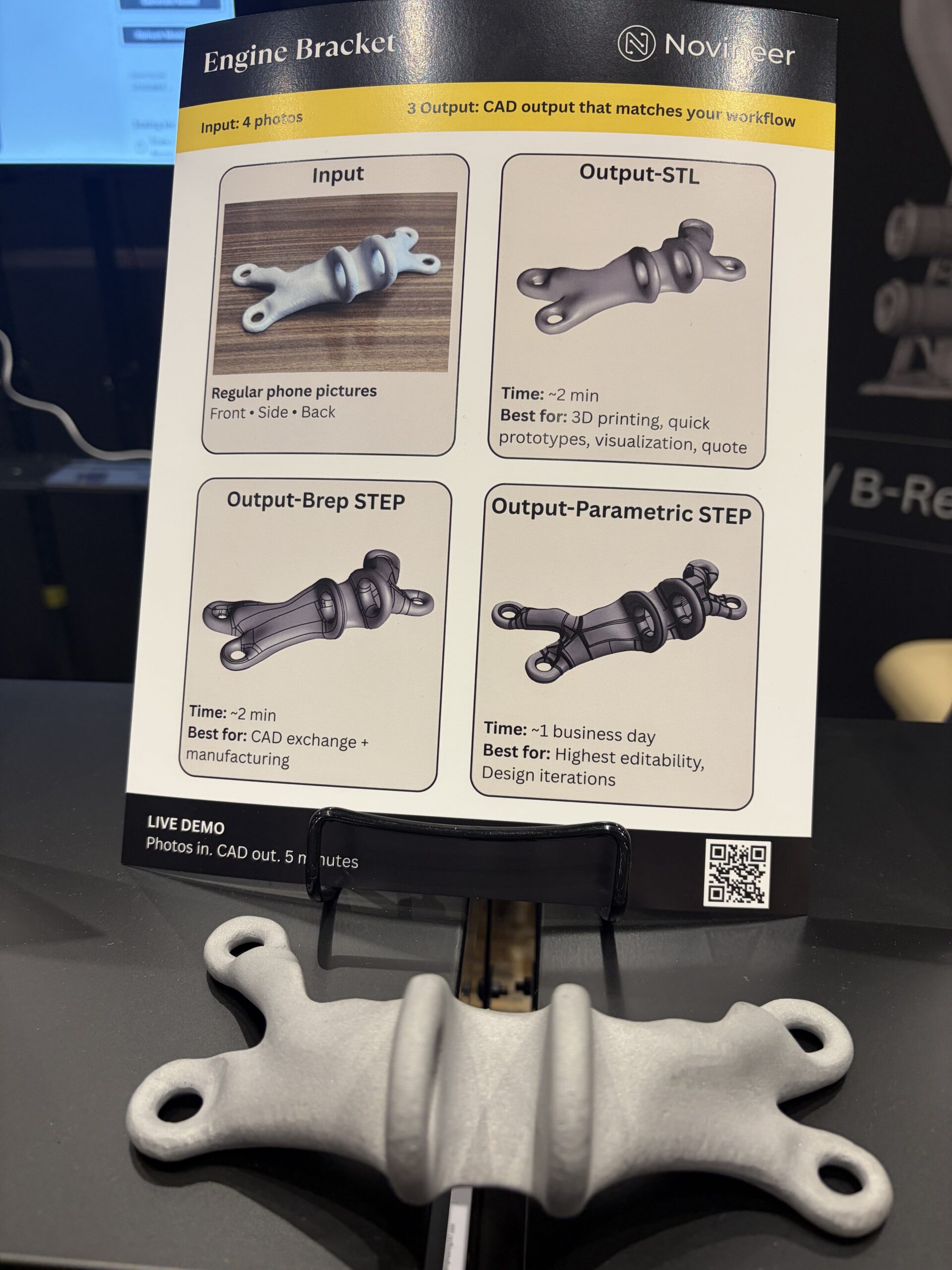
NoviVision example at AMUG 2026. Image courtesy of Sarah Saunders.
On the other hand, the solution that Novineer has made available to AM Craft, called NoviVision, relies solely on photographs taken with a smartphone, by workers who don’t need any additional training to perform the job. According to Novineer, the conversion of the images to editable CAD models takes about two minutes. For a company like AM Craft, which has produced over 35,000 flight-certified parts, all that time saved per part adds up.
In a press release about Novineer’s partnership with AM Craft on AI-backed reverse engineering capabilities, Didzis Dejus, CEO of AM Craft, said, “Part availability is one of the most persistent operational challenges facing airlines and MROs today. AM Craft was built to solve it — combining EASA-certified [AM] with the kind of speed and flexibility the traditional supply chain cannot offer. Our partnership with Novineer takes that capability further. By integrating NoviVision into our workflow, we can move from a physical part to a certified replacement faster than has previously been possible, and we can do so from almost anywhere in the world. That matters enormously to the engineers and procurement teams we work with daily.”
Beyond the specific benefit of broadening access to reverse-engineering software for design, one thing to like about this partnership is that Stratasys is a partner of and strategic investor in AM Craft. At the end of last year, Novineer announced its own partnership with Stratasys, centered around integrating Novineer’s NoviPath simulation function with Stratasys’ GrabCAD Print Pro software.

Cupholders printed by AM Craft on Stratasys machines. Image courtesy of Stratasys.
Thus, a user like AM Craft can now reverse engineer a part file on their phone, then upload that file into GrabCAD and use the simulation function to help guide the editing process. As Novineer’s CEO and co-founder, Dr. Ali Tamijani, told me in an interview about the Stratasys partnership, one of the big holes in the market that Novineer aimed to address with NoviPath was the lack of simulation software explicitly tailored to FDM printing.
In the same way that the success of AI-for-manufacturing solutions requires that the specific needs of manufacturers be taken into account, AM users need software tools that go beyond a one-size-fits-all mentality applied to a field with as many internal subdivisions as manufacturing. This suggests that over the next few years, it will be especially important for AM companies to establish their own partnerships with software enterprises that specialize in addressing the precise set of challenges most relevant to the AM industry.
That opens up opportunities for the software providers and the OEMs and contract manufacturers alike, but it also means that AM companies will likely have to go back to the drawing board for a few more years in order to genuinely capitalize on incorporating AI into their ecosystems. The capital expenditure associated with that kind of endeavor should further accentuate the relative positioning of the companies that are experienced at forming partnerships and attracting government funding.
Featured image courtesy of Novineer
Subscribe to Our Email Newsletter
Stay up-to-date on all the latest news from the 3D printing industry and receive information and offers from third party vendors.
Print Services
Upload your 3D Models and get them printed quickly and efficiently.













You May Also Like
AM Investment Strategies 2026 Sets the Stage for AMS 2027
AM Investment Strategies 2026 Nov. 5 · 12 p.m. ET · Free online event RESERVE YOUR SPOT ↗ A one-hour online discussion featuring some of the biggest names in 3D...
With Its Latest $200M Round, ICON May Be Running Away With the 3D Printed Construction Market
I used to view ICON, the Austin-based additive construction (AC) firm, as one of a handful of companies that could realistically consider itself the leader of the 3D printed construction...
How Should Businesses Build New Business? Dirk Simon Weighs In — Part 1
Dirk Simon had deep experience in materials and chemistry before joining the 3D printing industry. Instrumental in BASF and Farsoon’s market introduction, Dirk has spent a lot of time thinking...
3D Printing Services Near $2.5B as AM Market Shifts Beyond Hardware
The additive manufacturing market may be growing again, but one of the more interesting numbers behind that recovery has little to do with selling 3D printers. AM services generated nearly...