3D Systems Expands Product Line ahead of Formnext 2024

At Formnext 2024, 3D Systems (NYSE: DDD) will be introducing a suite of new technologies and materials aimed at advancing production capabilities across additive manufacturing (AM) sectors. Showcasing developments in stereolithography (SLA), selective laser sintering (SLS), and MultiJet Printing (MJP), 3D Systems has expanded its portfolio to support applications demanding high resolution, efficiency, and repeatability in end-use parts.
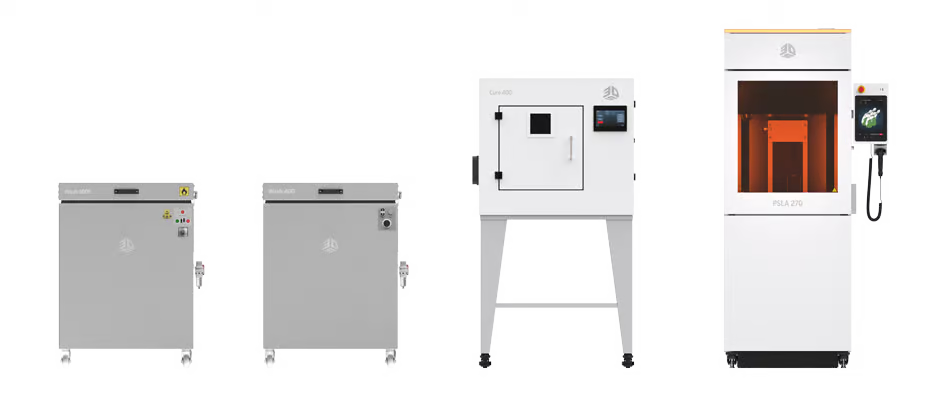
Key introductions include the PSLA 270 platform—a mid-frame SLA solution—combined with the new Wash 400, Wash 400F, and Cure 400 systems. This configuration addresses common production challenges by offering streamlined, scalable post-processing. With dual-detergent capabilities for safer part cleaning and consistent UV curing, the setup optimizes workflows for medium-frame 3D printers in professional settings.
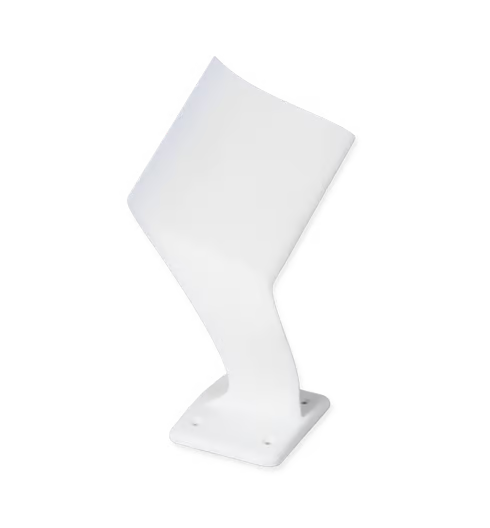
Additionally, 3D Systems will be presenting two new rigid composite materials, Figure 4 Rigid Composite White and Accura AMX Rigid Composite White, both designed for parts requiring high stiffness and minimal maintenance. Available initially in Europe, these materials are expected to support applications from automotive tooling to small-scale fixtures.
On the SLS front, the SLS 380 platform, combined with new DuraForm materials, brings advanced thermal management and repeatability features to production environments. This system enhances consistency and supports high-performance materials, which can be critical for high-yield production across regulated sectors.
Complementing these hardware and material advancements is the Delfin INVAC3D, a powder management system for 3D Systems’ DMP Flex 200. Designed specifically for metal powder handling, the INVAC3D enables closed-loop powder recovery, which is particularly beneficial for dental laboratories utilizing metal additive manufacturing.
“Our customers’ ingenuity fuels our innovation,” explained Marty Johnson, vice president of product and technical fellow, 3D Systems. “By collaborating closely with their engineering teams, we’re pushing the boundaries of additive manufacturing. To keep pace with their evolving needs, we’re constantly expanding our solution portfolio. Our latest additions — new accessories and materials — are prime examples of how customer-centric innovation can deliver a competitive edge.”
3D Systems has prioritized an ecosystem approach to its product line, focusing on integrating its proprietary post-processing systems directly into its broader portfolio. Rather than relying on external, standalone post-processing providers, 3D Systems designs its wash, cure, and finishing solutions—like the Wash 400, Wash 400F, and Cure 400—to work seamlessly with its own 3D printers. This approach not only offers customers cohesive, turnkey workflows but also ensures tight compatibility and control over the full production process. Such integration reduces dependency on third-party post-processing, an area often fragmented across the AM sector and dominated by a mix of independent companies specializing in various finishing technologies.
Subscribe to Our Email Newsletter
Stay up-to-date on all the latest news from the 3D printing industry and receive information and offers from third party vendors.
Print Services
Upload your 3D Models and get them printed quickly and efficiently.











You May Also Like
Scaling AM Suppressor Production: Oerlikon AM & ATLIX Rise to the Challenge
End-of-barrel suppressors, oftentimes referred to as silencers, function by capturing and redirecting high-pressure propellant gases through carefully engineered internal structures and channels. By disrupting the gas flow before it exits...
Unlocking Big Part Manufacturing for the Energy Sector: How EPRI’s Convergent Approach Proves the Potential of Large-Area DED 3D Printing
The U.S. hydropower fleet, more than 2,200 plants averaging 65 years of age, relies on large, bespoke components that are increasingly difficult to source. Long lead times, disappearing suppliers, and...
In-Situ Automated Toolpath Generation and Auto-Alignment for Performance-Driven Directed Energy Deposition (DED)
The evolution of Directed Energy Deposition (DED) systems has increasingly focused on improving process adaptability, geometric fidelity, and integration into automated manufacturing environments. FormAlloy has advanced this progression through the...
From Material Maturity to Fleet Execution: What Comes Next for Additive Manufacturing in the U.S. Navy
Additive manufacturing is steadily moving from experimental use toward routine application in U.S. Navy shipbuilding, sustainment, and much more. In recent years, the Navy, working through its Maritime Industrial Base...