
Chromatic 3D Materials Raises $6M to Drive 3D Printing of Flexible Materials

Amid much doom and gloom, we are seeing a notable amount of funding for the 3D printing market, with 3DEO, Mantle, Orbex, Q5D, CORE Industrial Partners, Replique, Inkbit, and others receiving support. Now it’s Chromatic 3D Materials‘ turn to announce that it has raised $6 million. The company plans to use the funds to build more factories, get parts qualified, and develop better materials.

Anouk Wipprecht’s 3D printed dress at Formnext 2023 uses Chromatic 3D materials. Courtesy of 3DPrint.com.
“Chromatic delivers the material performance and technology required to make manufacturing more responsive and sustainable. With this financing, we’ll be driving implementation of our technology across several markets and continuing to expand our market reach,” said Chromatic CEO Cora Leibig.
“From our first investment, I was convinced that Chromatic was delivering a truly novel and necessary technology to the additive manufacturing space. The applications in the pipeline, particularly in aerospace, are transformative, and I’m excited to support the company through implementation and commercialization,” said Jordan Noone of Embedded Ventures.
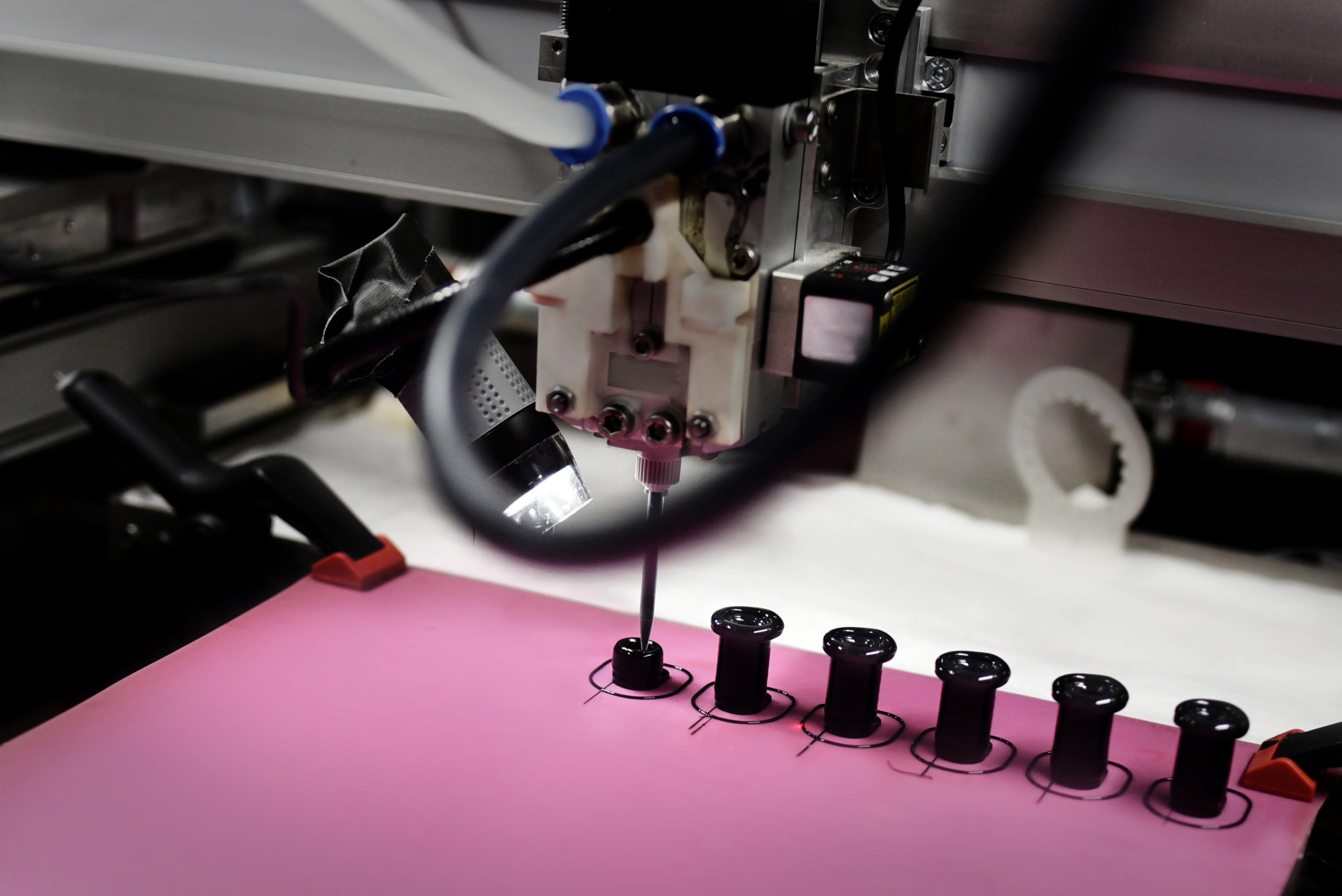
Chromatic’s RX-AM materials and printer making grommets.
Chromatic has now raised over $15 million and manufactures its resins in the U.S. and printers in Germany. Its RX-Flow printers use durable urethane materials through reactive chemistry. This approach allows for tough materials to be printed onto substrates such as glass or fabric. It’s an intriguing method that could enable the creation of integrated window assemblies or, for example, the addition of 3D-printed pads to bike pants. The company also focuses on more utilitarian but high-volume products like bellows, bladders, and cable grommets. These items can be produced in build volumes ranging from 348 x 543 x 194 mm to 80 x 1040 x 194 mm. Chromatic now offers 12 materials, including some that can withstand temperatures up to 140°C, possess improved tensile strength, or exhibit oil resistance.
Chromatic has significant opportunities in automotive and aviation, as well as in often overlooked industrial markets. Small components that dampen, soften impacts, or reduce movement are abundant, and some are both expensive and critical. While cable grommets may not be the most exciting products, they are essential. In short-run production, bridge manufacturing, new geometries, and supply chain resilience, there is considerable potential. Traditionally, we’ve struggled with making durable elastomeric parts. If Chromatic builds its niche in air-holding, robust products, the company could tap into substantial volumes across various markets.
Additionally, their ability to print on textiles and other materials could lead to novel applications. Imagine custom yoga pants with added support in specific areas, or enhanced kinesiology tape (KT tape) with conformal parts designed to reduce pain in targeted areas. There are numerous possibilities with Chromatic’s technology and urethane chemistry in general. As the company uses its funding to develop new materials, its market reach will grow.
Currently, the company sells materials, machines, and provides a service. This means you could order a few parts for a proof of concept or experiment quickly, then scale up with their service or implement your own system. This model helps de-risk customers and allows them to scale without needing significant capital expenditures upfront, benefiting both careers and budgets.
Chromatic doesn’t need to dominate the floor at Formnext or outshine 3D Systems. It simply needs to find the right application fit for its machines and materials. There are tens of millions of valuable elastomeric parts that could be optimized with 3D printing, given the right cost and volume. If Chromatic improves yields and lowers costs, the company could have several winning applications.
Subscribe to Our Email Newsletter
Stay up-to-date on all the latest news from the 3D printing industry and receive information and offers from third party vendors.
Print Services
Upload your 3D Models and get them printed quickly and efficiently.













You May Also Like
South Korea’s Lincsolution Lands Hanwha Defense Deal as Hanwha Invests Billions in US
I recently wrote about how the South Korean additive manufacturing (AM) firm Lincsolution is building an aerospace and defense hub, part of the company’s construction of “the largest AM facility in...
Bambu Lab and SUSAN FANG 3D Print for London Fashion Week
At London Fashion Week, some of the more unusual pieces on the runway came from 3D printers. Chinese fashion designer SUSAN FANG presented her Spring/Summer 2027 Air-Illusion collection at the...
Why Cross-Border 3D Printing Is Closing the Speed Gap with Local Manufacturing
The fastest 3D printing supplier in your shortlist may no longer be the one closest to your office. That sounds unlikely to many engineers. For years, overseas 3D printing carried...
Arridex Expands 3D Printing Network to Ghana
Nigeria-based Arridex has deep experience in oil and gas additive manufacturing. Previously known as RusselSmith, the firm has in-house metal and polymer additive technology. The company is making 3D printed...























































