
Munich’s Dcubed Raises €4.4M to 3D Print Solar Arrays Directly in Space

A surge of investor interest drives space hardware developer Dcubed into its next growth phase. The Munich-based company has just closed an oversubscribed €4.4 million Series A funding round, securing the capital needed to expand its operations.
Led by French-based Expansion Ventures and Germany’s BayBG Venture Capital, the investment round also included participation from other investors, including European venture capital firms HTGF, Ventis, and Rymdkapital, U.S.-based Aurelia Foundry, and the venture development group Decisive Point Europe. This new wave of investment will quadruple the production of its satellite actuators–a critical component used to securely hold and then release satellite parts in space.

U.S. Managing Director Andria Fortier and Dcubed founder Thomas Sinn. Image courtesy of Dcubed.
This expansion comes at a pivotal time as the space industry anticipates a sharp increase in satellite launches. Projections estimate the deployment of over 100,000 satellites in the coming years, up from the current 10,000. To meet this demand, Dcubed hopes to standardize its products and make them more accessible by launching an online store, a first in the space industry, where customers can order space components as easily as they would from any major online retailer.
Beyond scaling its existing operations, Dcubed also plans to use the new funds to fuel its ambitious plans to lead the field of in-space manufacturing. By manufacturing directly in space, Dcubed aims to create designs optimized for the space environment rather than for the Earth-based conditions they must endure during launch. This approach not only saves time and costs but also opens the door to a new era of space capabilities, including high-power communication satellites, space solar power stations, and even lunar bases.
Dcubed is set to make history with its 2025 mission, where it will 3D print a satellite solar array directly in space—something that has never been done before. This project, which has received €9.5 million from the European Innovation Council, will show how solar panels can be built in space, rather than on Earth, making them more efficient for space use. The European Space Agency (ESA) is also backing this mission, which will involve creating a solar array capable of generating over 100 watts of power. This mission is part of Dcubed’s broader plan to develop more powerful solar arrays in the future, which will help power small satellites and space vehicles.
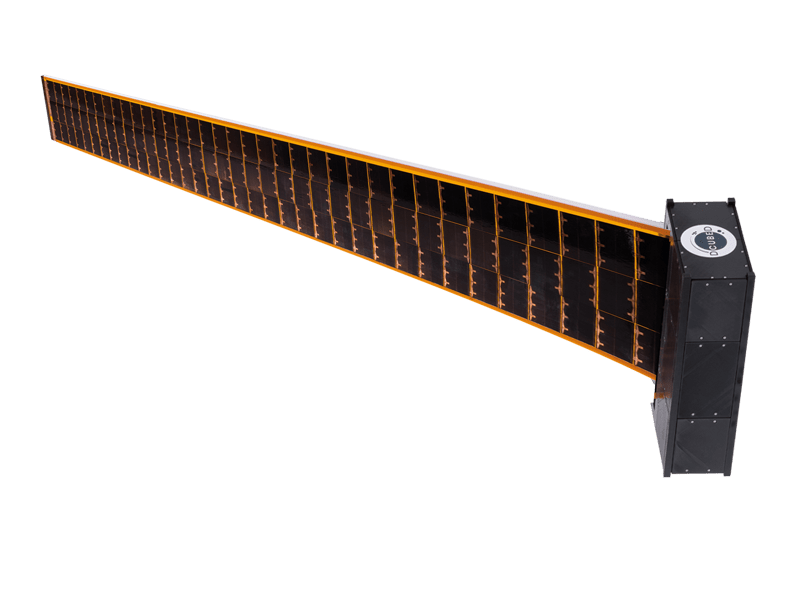
Rendering of Dcubed’s in-space manufactured solar array. Image courtesy of Dcubed.
As part of its strategic growth, Dcubed is also expanding its footprint to the U.S. The company has opened a new office in Westminster, Colorado, a hub for space companies. This U.S. expansion is key for Dcubed, as more than half of its customer base is already located in the country. The new office, led by Andria Fortier, will allow Dcubed to build stronger relationships with American clients and partners while tapping into the rich talent pool of the U.S. aerospace industry.
Fortier, who brings nearly a decade of experience in the aerospace and defense sectors, will oversee the growth of Dcubed’s U.S. operations, including the expansion of its team and its strategic partnerships.

Origami solar arrays. Image courtesy of Dcubed.
“Despite a tight global finance environment, investors notably oversubscribed our Series A round,” indicates Thomas Sinn, CEO of Dcubed. “This funding round proves high market trust in our capabilities. Together with our global investors, we now have a solid foundation to boost future growth in the booming space market.”
Dcubed’s success in raising funds is impressive, especially given the current economic climate, where securing venture capital has become increasingly challenging. Despite these setbacks, the space industry is holding strong, and investors still see a lot of promise. Recent reports show that investments in space startups are bouncing back, with $4 billion invested just in the second quarter of 2024. This comeback comes after a tough two years and shows that investors are regaining confidence in the space sector, especially in areas like infrastructure and new technologies.
Ted Elvhage, General Partner at Expansion Ventures, highlighted the rapid growth of the space market, which is expected to quadruple to $2 trillion over the next decade. He emphasized that Dcubed can capitalize on this growth by combining high-quality German engineering with a solid global business strategy.

Double blanket solar array. Image courtesy of Dcubed.
Similarly, Alois Ganter of BayBG Venture Capital, which made its first NewSpace investment with Dcubed, pointed out how important space technologies are for progress in areas like communication and security on Earth. He also noted that Dcubed’s ability to fund its growth through customer orders rather than just relying on investments has made investors even more confident in the company.
As Dcubed moves forward with its plans to scale production, pioneer in-space manufacturing, and expand into the U.S. market, it cements its position as a critical player in the evolving space industry.
Subscribe to Our Email Newsletter
Stay up-to-date on all the latest news from the 3D printing industry and receive information and offers from third party vendors.
Print Services
Upload your 3D Models and get them printed quickly and efficiently.













You May Also Like
Stratasys vs. Bambu Lab: What’s Really Behind the $27.6M Patent Verdict?
Editor’s note: This is Part 1 of a two-part series by Xu Fanglei examining the technology and patent issues behind the Stratasys-Bambu Lab dispute. Part 1 looks at the U.S....
Bambu Lab and SUSAN FANG 3D Print for London Fashion Week
At London Fashion Week, some of the more unusual pieces on the runway came from 3D printers. Chinese fashion designer SUSAN FANG presented her Spring/Summer 2027 Air-Illusion collection at the...
3D Printing News Briefs, September 26, 2026: Bioceramic Implants, 3D Concrete Printing, & More
In this weekend’s 3D Printing News Briefs, we’ll start with an integration between PanOptimization and AMCM, before moving on to healthcare news from KLS Martin and Lithoz, and then UltiMaker...
Bambu Lab Moves Beyond 3D Printing with R1 Laser Cutter
Bambu Lab has gone from one X1 printer, which did very well, to entry-level A1 systems, mid-market P2S systems, and larger H3Ds and more. They’ve also made systems that couple...























































