Materialise Empowers 3D Printing with New Innovations and Alliances at RAPID+TCT 2024

Materialise (Nasdaq: MTLS) kicked off RAPID + TCT 2024 in Los Angeles by unveiling upgrades to its flagship preparation software, Magics, and announcing new partnerships with Ansys, nTop, and EOS. These advances promise to tackle 3D printing’s biggest challenges, including handling complex designs, manufacturing large parts, improving quality control, and cutting down costs.
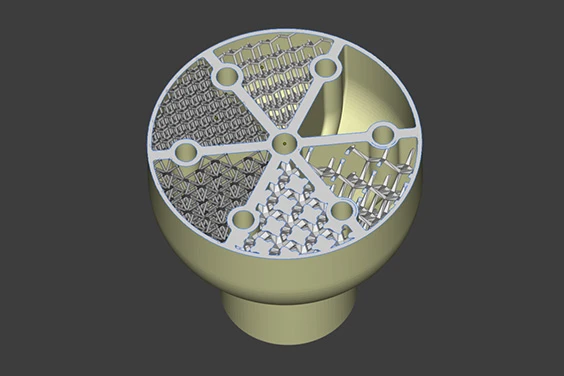
Users can use various lattices on their parts with Magics Lattice module. Image courtesy of Materialise.
At the heart of Materialise’s announcements is Magics 28, an upgraded version of its well-known software for data and build preparation in 3D printing. This version introduces several boosts to improve functionality and user experience.
One of the key highlights is the new Lattice Module, which handles complex beam lattices. This feature speeds up and improves file processing, making it easier to integrate intricate designs into 3D printing. Additionally, Materialise says the Nester Module now allows users to automatically arrange multiple parts on a build platform, which, once printed, helps reduce material waste. The user interface has also been revamped with a dark theme to reduce eye strain for those working long hours.
“With this new version of Magics, we are empowering users with faster file preparation for complex designs and enabling more efficient printing of multiple parts in a single build,” said Egwin Bovyn, Magics Product Line Manager at Materialise.
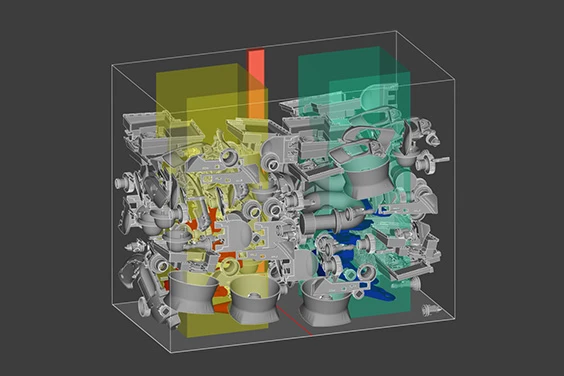
Materialise Nester is a module for Magics. Image courtesy of Materialise.
Alongside these software upgrades, Materialise is also focusing on strategic collaborations to improve the 3D printing process by addressing potential issues early. The brand is partnering with Ansys to identify design flaws before printing and with EOS to detect anomalies during the build process.
The partnership with Ansys integrates its simulation technology, which predicts potential weak spots in designs, into Materialise’s 3D printing process for laser powder bed fusion (LPBF) metal parts. This collaboration provides an end-to-end digital solution that detects weak spots in designs before printing begins, improving build success rates and reducing waste.
Meanwhile, Materialise’s ongoing collaboration with EOS targets cutting inspection costs for metal 3D-printed parts, particularly in the aviation and medical industries. By combining data from various EOS systems with Materialise’s Quality & Process Control (QPC) system, they can detect anomalies during the build process. This proactive approach eliminates the need for extensive quality checks after manufacturing, reducing costs and ensuring higher-quality parts.
The QPC system aggregates data from sources like optical tomography and powder bed cameras, speeding up quality assurance. This initiative is part of Materialise’s broader CO-AM Software Platform, which provides tools for managing the entire 3D printing process, from planning to post-processing and quality inspection.
“Our optical tomography camera is state-of-the-art and a reliable sensor for monitoring the process stability,” noted Bernd Biechele, Director of Software Development at EOS. “Thanks to these interfaces, the Materialise QPC system will be able to aggregate this data in combination with other images and sensor data to significantly accelerate quality assurance in additive manufacturing.”

Integration of Magics with Ansys’ leading simulation software. Image courtesy of Materialise.
In another significant move, Materialise has teamed up with nTop to speed up the design-to-manufacturing process. By integrating nTop Core’s modeling technology with Materialise’s Magics software, they simplify file transfers and reduce system crashes, allowing the production of complex parts that were previously unprintable due to data size and complexity.
This alliance removes the need for meshing, a process that converts models into meshes for 3D printing and other intermediate steps. It streamlines file exchanges between design and manufacturing teams and boosts the reliability of design-to-manufacture workflows, unlocking new levels of innovation in 3D printing.
RAPID + TCT 2024 attendees can witness firsthand how the new Magics software and strategic partnerships are set to boost the capabilities and efficiency of 3D printing at Materialise’s booth (#2821).
Like other companies that have been in the space for decades, Materialise’s announcements are a staple at the RAPID event. In previous years, they have unveiled new technologies such as the Materialise Magics 3D Print Suite launched at RAPID+TCT 2016 and collaborations with industry leaders like HP, Nikon, and Essentium (now part of Nexa3D) announced at RAPID+TCT 2019. This tradition continues as Materialise fosters new partnerships to advance the technology, a tradition dating back to the early 1990s when it pioneeringly debuted the Magics software, which has since become one of the most widely used platforms for data preparation and build optimization in 3D printing.
Subscribe to Our Email Newsletter
Stay up-to-date on all the latest news from the 3D printing industry and receive information and offers from third party vendors.
Print Services
Upload your 3D Models and get them printed quickly and efficiently.













You May Also Like
Metal 3D Printers for the Desktop Are Finally Starting to Feel Like Desktop Products
FDM 3D printing is becoming increasingly accessible, yet metal 3D printers designed for everyday desktop use remain rare on an ordinary workbench. The real challenge is not making a metal...
3D Printing Financials: 6K Additive Sales Rise as Aerospace and Defense Demand Grows
6K Additive (ASX: 6KA) grew rapidly in the first half of 2026 as demand for its metal powders increased, particularly from aerospace and defense customers. The newly public company also...
When Data Becomes the Differentiator: Qualified Material Data is Changing the Future of Structural Additive Manufacturing
For years, additive manufacturing has promised engineers greater design freedom. The challenge wasn’t printing the part—it was proving the part belonged on an aircraft. Designing a lightweight bracket or consolidating...
Amaero Builds U.S. Metal Powder Capacity for Additive Manufacturing
For metal additive manufacturing (AM) to grow in the United States, companies need more than printers. They also need a reliable supply of the powders that go into those machines....