Unveiling Dyze Design’s Zephyr High Flow Extruder: Revolutionizing High-Speed 3D Printing

Dyze Design, the Canadian expert in high-performance extrusion systems, introduces its latest innovation, the Zephyr™ High Flow Extruder for 1.75mm filament. This state-of-the-art extruder leverages Dyze Design’s MeltCore™ technology, delivering an impressive flow rate of 685 grams per hour (154 mm³/s). This positions the Zephyr™ as one of the fastest printheads available for 1.75mm filament.
Superior Performance and Speed
“The Zephyr™ extruder is designed to achieve high-speed printing without sacrificing the quality of the printed parts,” says Simon Duchaine, Dyze’s Chief Commercial Officer. Ideal for both rapid prototyping and small series production, Zephyr™ addresses the critical need for speed and precision in modern industrial 3D printing.

Equipped with two 70W heaters and two PT100 temperature sensors, the extruder operates up to 500°C, making it suitable for advanced materials like PEEK and PEI. These high-temperature capabilities are perfect for demanding industries such as aerospace, automotive, and medical fields. The dual independent heaters ensure optimal temperature for each material, enhancing print quality and productivity.
Industrial-Grade Engineering
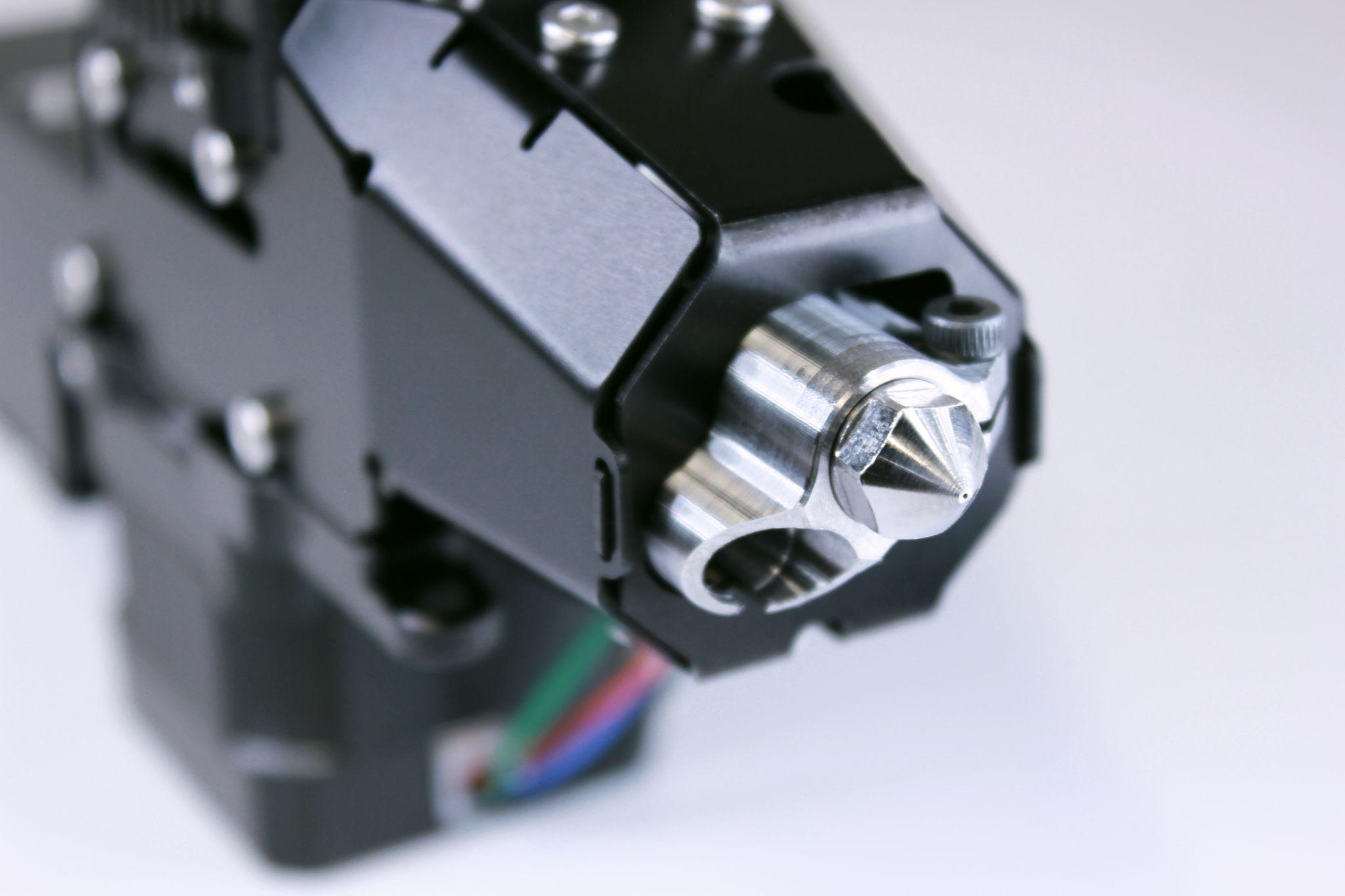
Zephyr™ embodies a decade of expertise in developing industrial and large-format printheads for robotics additive manufacturing and traditional 3d printing. “We’ve integrated the best elements from our previous designs into the Zephyr™, creating a solution that bridges desktop additive manufacturing with large-scale industrial applications,” notes Duchaine. The robust construction, including hardened alloy steel gears, ensures durability and consistent performance, reducing the need for frequent maintenance.
Enhanced Filament Handling

The gear ratio of 3.1:1 strikes a perfect balance between speed and torque. Zephyr™ features a double grip mechanism with two idlers on a cam-locked slider, minimizing slippage and ensuring efficient filament feeding. The extruder’s nine tension settings accommodate a wide range of filaments, from flexible to slightly oversized, making it a versatile choice for various printing projects.
“The filament tension adjustment feature ensures optimal extrusion for each material type, enhancing print consistency. Whether using standard PLA or more challenging and softer materials like TPU or TPE, Zephyr™ offers the necessary adjustments for precise and reliable prints,” adds Duchaine. This adaptability simplifies the printing process, reducing the need for multiple extruders.
Compact and Versatile

Weighing under 700 grams with dimensions of 47mm x 108mm x 155mm, Zephyr™ is compact and easy to integrate into different 3D printer setups. This versatility allows it to be used in both desktop printers and large industrial machines, including robotic arms.
MeltCore™ nozzle assemblies are available in diameters from 0.4mm to 1.8mm, catering to various printing needs in terms of speed and precision.
Dyze Design is now accepting orders for the Zephyr™ High Flow Extruder, with order fulfillment starting in July. For more details or to secure this advanced extruder, visit Dyze Design’s website: https://dyzedesign.com/zephyr-high-flow-extruder/ or contact their sales team at sales@dyzedesign.com.
About Dyze Design Inc.
Founded in 2015 and based in Montréal, Dyze Design specializes in high-performance, innovative extrusion systems and 3D printer components for professional and industrial use. Their product lineup includes the Typhoon® high-flow extruder, Pulsar® and Pulsar® Atom pellet extruders, DyzeXtruder Pro extruders, Sentinel® and Orthus® filament detectors, and Tungsten Carbide Nozzles. Renowned brands like Roboze, Sharebot, Blackbelt, PodoPrinter, AON3D, Trideo, 3DPlatform, Filament Innovations, and robotic arm brand, Kuka, have integrated Dyze Design’s printheads, hotends, extruders, or nozzles as OEM parts for their high-end 3D printers.
Subscribe to Our Email Newsletter
Stay up-to-date on all the latest news from the 3D printing industry and receive information and offers from third party vendors.
Print Services
Upload your 3D Models and get them printed quickly and efficiently.













You May Also Like
10 Years of Multi Jet Fusion: Onsite at HP’s Vancouver, Washington Facility
At this year’s RAPID event in Boston, HP Additive Manufacturing Solutions celebrated ten years in the additive manufacturing (AM) market. The company ushered in the milestone with several innovations, including...
These 3D Printed Lattices Can Sense Damage Before Failure
A new paper, “Full-Field Damage Monitoring in Architected Lattices Using In situ Electrical Impedance Tomography,” points to lattices being able to detect damage. This could really help composites in critical...
3D Printing News Briefs, October 3, 2026: Hypersonics, Hotends, & More
We’re starting off with defense in this weekend’s 3D Printing News Briefs, as Titomic was awarded a $5 million U.S. defense contract, and VulcanForms announced a partnership with Specter Aerospace...
3D Printing News Briefs, October 1, 2026: Defense, Enclosures, & More
In today’s 3D Printing News Briefs, we’re starting with defense news, first from Massivit and then from AML3D. Then we’ll move on to U.S. manufacturing of a new large-format LPBF...