3D Printing Financials: How T&R BioFab is Balancing Innovation and Revenue Challenges


South Korean bioprinting pioneer T&R Biofab (Kosdaq: 246710) has been busy in recent months with new initiatives in regenerative medicine, collaborations, and product development. However, the company faces significant challenges regarding its financial health. Despite their innovative strides, T&R Biofab’s path to profitability remains uncertain. While their technological advances are impressive, the ongoing financial difficulties pose a significant challenge to securing a stable future.
A Glimpse at Recent Developments
Established in 2013 and listed on the Korean stock exchange Kosdaq in 2018, T&R Biofab has made significant strides in regenerative medicine. The company has roughly 100 employees and has been involved in several promising projects. One outstanding achievement is a recent deal with Lambda Biologics. This collaboration looks into commercializing 3D organoids for medical research and drug testing. Organoids are considered a powerful potential alternative to animal testing, offering more ethical and accurate testing methods, and are heralded as one of the keys to faster medical progress.
Building on this momentum, T&R Biofab has also ventured into the booming cosmetics industry. The company recently announced the acquisition of Blisspack, a Korean specialist in cosmetics and packaging, for KRW 16.7 billion ($12.3 million). Expected to be completed in the first half of 2024, this strategic move will “create synergies” by combining T&R Biofab’s tissue regeneration technologies with Blisspack’s cosmetic expertise.
Korean cosmetics are experiencing unprecedented global growth, projected to reach $28 billion by 2032. Exports have already reached over $7 billion in 2022, and there is strong demand in markets like the United States, China, and Europe. Through this collaboration, the duo plans to develop innovative medical cosmetics that promote tissue regeneration, which could unlock new revenue streams.
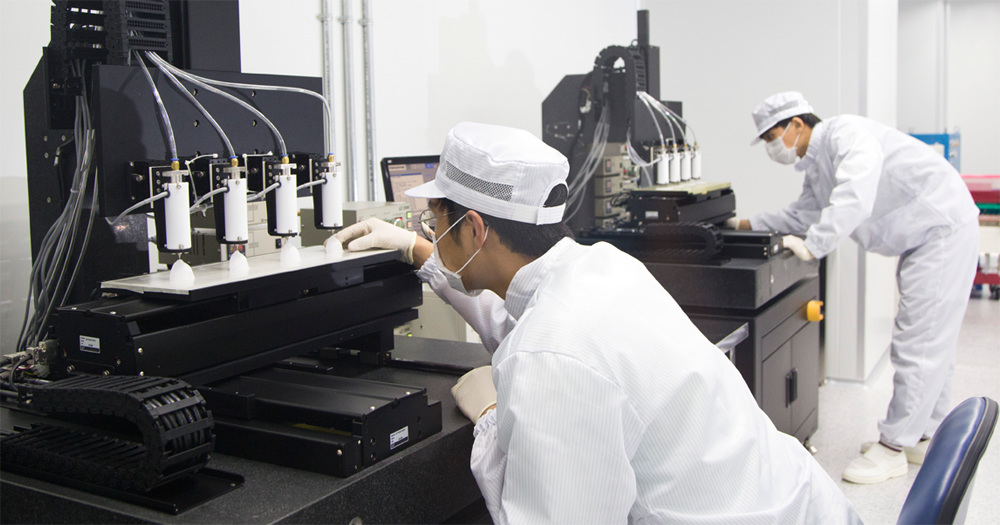
T&R Biofab engineers work on bioprinted products and medical implants. Image courtesy of T&R Biofab.
Financial Hurdles
Despite these promising developments, T&R Biofab’s financial situation remains precarious. The company has been grappling with significant losses. By the end of the third quarter of 2023, T&R BioFab reported revenue of KRW 952.9 million ($697,236) and a net loss of KRW 5.39 billion ($3.94 million). In the fourth quarter, revenue increased to KRW 1.44 billion ($1.1 million), but the company still faced a net loss of KRW 271.34 million ($198,535).
For the full year of 2023, T&R BioFab’s total revenue was KRW 5.2 billion ($3.8 million). This is a decline from previous years, where revenue figures were KRW 1.3 billion ($954,276) in 2019, KRW 6.8 billion ($4.9 million) in 2020, KRW 3.2 billion ($2.3 million) in 2021, and KRW 5.8 billion ($4.3 million) in 2022.
Also, the company’s total capital at the end of the third quarter of 2023 was KRW 27.1 billion ($19.8 million), with a significant accumulated loss of KRW 13.1 billion ($9.6 million), resulting in a loss ratio of 48.34%. This ratio is essential because if it exceeds 50% for two consecutive years, T&R Biofab risks being designated as a “managed stock,” indicating that the company is under heightened regulatory scrutiny due to its financial distress. The company had previously raised KRW 2 billion ($1.5 million) by issuing new shares, but this did little to ease the financial losses. Local industry experts anticipate that the legal loss ratio could surpass the 50% threshold, leading to more regulatory scrutiny and additional compliance requirements.
Although being designated as a managed stock does not automatically result in delisting, it places the company under stringent regulatory oversight, increasing the risk of delisting if the financial situation does not improve. Furthermore, T&R Biofab’s grace period for statutory loss requirements ended in 2021. Since then, the company has struggled to keep its losses under control, highlighting the ongoing challenge of maintaining financial stability without the cushion provided by the grace period.
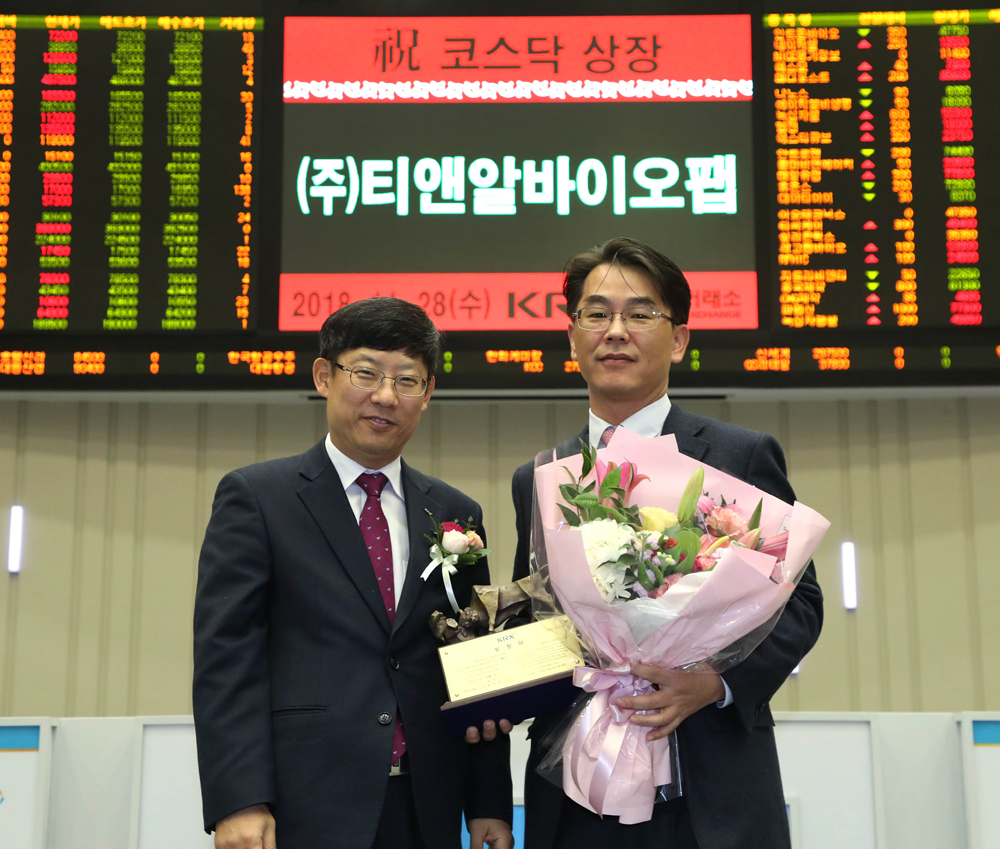
T&R Biofab CEO Wonsoo Yun in 2018 during the IPO of the company. Image courtesy of T&R Biofab.
Striking a Balance
T&R Biofab is navigating the challenge of balancing its innovative projects with the need for financial stability. The company’s progress in regenerative medicine and 3D bioprinting are crucial for long-term growth. However, turning these innovations into significant revenue to cover its financial losses is still challenging.
Like most companies, one of their key strategies is to increase sales through new products. To that end, T&R Biofab is entering Japan’s largest home shopping market, QVC, in the second quarter of 2024 with its Melting HA Film, a soluble hyaluronic acid film. Developed through over 20 years of research, this ultra-thin film dissolves on contact with the skin, disappearing immediately and delivering high concentrations of active ingredients for lifting, wrinkle improvement, skin soothing, whitening, and moisturizing effects.
Another one of its flagship products is a wound dressing, which received approval from the Korean Ministry of Food and Drug Safety (MFDS) in 2022. Wound dressings protect an affected area and help recover skin damaged due to a burn or a wound. T&R Biofab has its eyes set on the domestic wound dressing market worth KRW 230 billion ($168,9 million), which is expected to grow due to an increase in surgical and cosmetic procedures (like mole removals or laser treatments), rising elderly population, and changes in wound care awareness.
Over the last ten years, the firm has also focused on the R&D of artificial skin models using 3D bioprinting. It has developed an advanced artificial skin model that mimics the layers and structure of real skin. This model is designed to test cosmetics without relying on animals. It also helps in research focused on preventing skin aging, a growing concern among consumers.
Innovative strides in regenerative medicine and bioprinting place T&R Biofab at an important moment. With advances in developing organoids and medical cosmetics, along with the strategic acquisition of Blisspack, the company is pushing the boundaries of medical technology. However, turning these innovations into financial success remains a challenge, so T&R Biofab focuses on expanding sales and targeting overseas markets to strengthen its financial position.
Subscribe to Our Email Newsletter
Stay up-to-date on all the latest news from the 3D printing industry and receive information and offers from third party vendors.
Print Services
Upload your 3D Models and get them printed quickly and efficiently.













You May Also Like
Divergent Declares that German 3D Printers are Superior, And Plans Massive LPBF Expansion
Divergent has announced a new version of its Laser Powder Bed Fusion (LPBF) printer and a new site. The company aims to do nothing short of “further accelerating its mission...
Inside Haddy: Jay Rogers Wants 3D Printing to Build Real Products, Not Just Prototypes
A warehouse from the outside, but step inside Haddy and it shifts quickly: finished pieces up front, clean and minimal, furniture you can touch and sit on. Walking through the...
SpaceX IPO Puts a Major 3D Printing Powerhouse on Wall Street
SpaceX officially began trading on the Nasdaq today under the ticker symbol SPCX, marking one of the most anticipated and largest public offerings in Wall Street history. The company priced...
DEEP Manufacturing Collaborating with Fortius Metals to Demonstrate WAAM at Scale
DEEP Manufacturing is trying to build pressure vessels and marine habitats at scale with DED technology. Using commercial robot arms and wire arc additive manufacturing (WAAM), the company is hoping...