CADchat Introduces Digital Workspaces, Video Conferencing for CAD

Graham Bredemeyer, the founder of innovative additive manufacturing (AM) firm Collider, is back on the startup scene, this time with a platform for CAD-related video conferencing called CADchat. The company proposes CADchat as a tool that comprises all of the disparate features of Zoom, Slack, and Dropbox combined with CAD viewing and annotating. From the looks of it, CADchat could actually be a game-changer for collaborative product development.
Though the COVID-19 pandemic drove countless office workers to use virtual conferencing programs like Zoom and Microsoft Teams, those of us who have relied on such tools know that they are significantly lacking, particularly when it comes to 2D and 3D design. Outside of the typically buggy interfaces, file sharing and collaboration are essentially limited to screensharing. If you’ve got some document you want to present to a coworker, it means sharing your screen and scrolling around to get them up to speed.
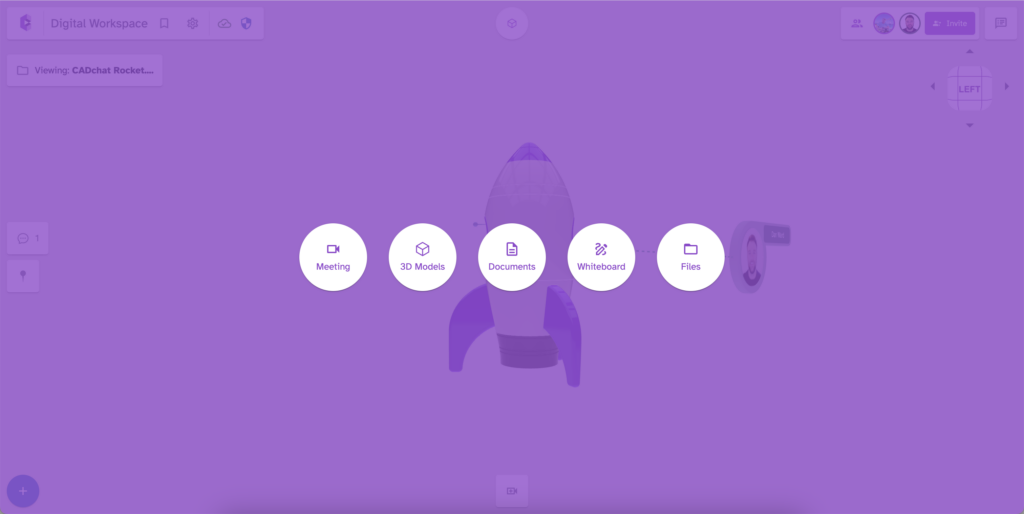
CADchat seems to build significantly on this capability, and it does so with 3D modeling features. Rather than simply share a screen, a user is able to share a 3D model interface where anyone can annotate, chat, and share files. The model around which everyone pow-wows can be rotated and commented upon by anyone in the virtual meeting. Because the CAD file is hosted in the cloud, there doesn’t appear to be any lag when manipulating the model virtually.
On top of the capabilities related to 3D modeling, users can also share and collaborate on 2D files, such as 2D CAD drawings or even Excel spreadsheets, or bounce ideas off of one another using a virtual whiteboard. The platform also acts as a file sharing hub so that a project can have a single source of truth for all of the necessary documents.
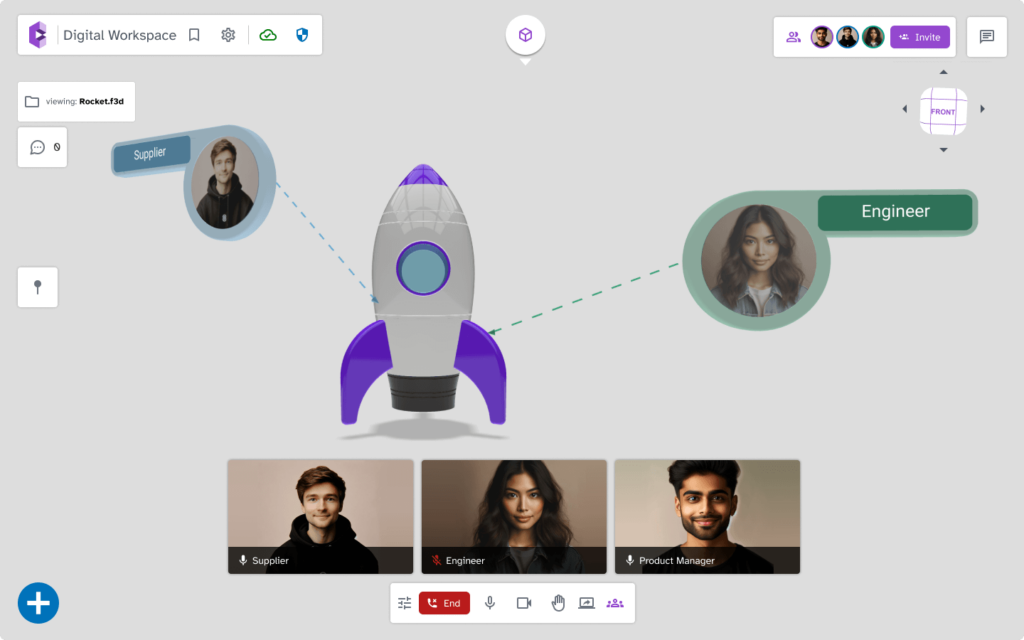
Perhaps most important of all is that all of this activity persists even after a meeting has ended, including model annotations, the messenger box, the whiteboard, and the files. In this way, not only does CADchat combine Zoom, Slack, Dropbox, and a 3D model viewer, but it also doesn’t go away once the call is over. You can go back to the meeting and revisit your colleague’s notes and doodles even when everyone is offline.
“Product development doesn’t end when the meeting does, and neither should the tools we use. With CADchat, we are thrilled to offer a platform that not only supports real-time collaboration but also enriches the continuity of teamwork. Our digital workspaces ensure that everything from 3D models to critical feedback remains accessible and interactive long after the calls have ended,” said Graham Bredemeyer, CEO of CADchat. “Our goal is to redefine collaboration by maintaining the integrity and continuity of every meeting. Think of it as a permanent, virtual conference room, where all of your project-related discussions, decisions, and documents are just a click away.”
All of the features, even without the CAD aspect, seem powerful enough for virtual meetings, but because it includes the ability to share 3D models, the platform seems like a missing piece of the puzzle for engineers and designers. Nearly every CAD company has been attempting to create a unified platform to connect their disparate apps, but none seems to have fully succeeded. The aesthetic of the platform mirrors the simplicity and streamlined nature of Autodesk tools, so one wonders if an integration with Fusion may be in the works. However, CADchat looks like it would be equally at home in the 3DEXPERIENCE from Dassault.
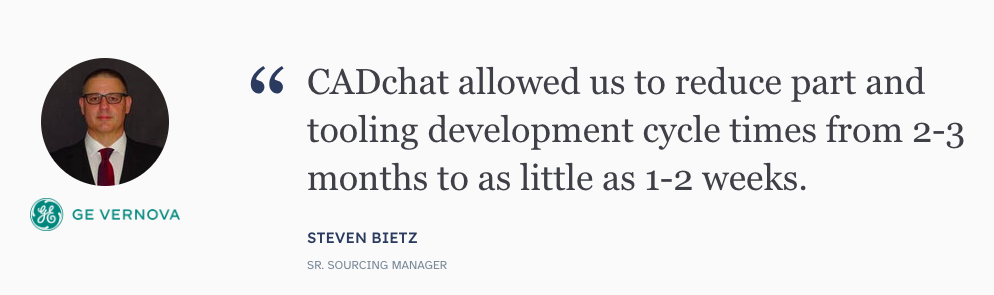
Such an integration does not seem unlikely, given the caliber of clients the company has so far. CADchat has already listed GE Vernova as a customer. The energy-focused spin-off of the manufacturing giant is already poised to impact the transition to sustainable fuel sources. In this case, however, GE claims to have “reduce[d] part and tooling development cycle times from two to three months to as little as one to two weeks.” This improvement of over 90% in efficiency was achieved without any new hardware.
It’s interesting to note how this product development efficiency parallels the sorts of improvements made possible by 3D printing multiple design iterations. Perhaps, the parallel emerges from Bredemeyer’s history in AM, in which he developed a unique method for 3D printing sacrificial tooling that was filled with injection molding plastic all in one production process. Another interesting element to the story is that, after creating such a novel hardware for AM, Bredemeyer is now working on software. Perhaps the lower overhead of running a software startup will help aid in CADchat’s success moving forward.
Those interested in the digital workspace platform can sign up for a free trial here.
Subscribe to Our Email Newsletter
Stay up-to-date on all the latest news from the 3D printing industry and receive information and offers from third party vendors.
Print Services
Upload your 3D Models and get them printed quickly and efficiently.













You May Also Like
UniFormation S10 Heads to Kickstarter with an Integrated Resin Printing and Post-Processing System
UniFormation will launch its S10 desktop resin 3D printer on Kickstarter on October 22, 2026, with pledges starting at $999. The S10 integrates printing, washing, and drying, allowing a print...
Creality Goes Pro with Sermoon P1S 3D Scanner
From making millions of value-engineered Prusa clones, Creality really has aggressively pivoted to more complex machines. The company has made strides forward in software, and the Ender’s of yore is...
Stratasys Showcases 3D Printed Automotive Applications & New Printer at IMTS 2026
Just ahead of last week’s International Manufacturing Technology Show (IMTS) in Chicago, Stratasys launched the F870, a new large-format, production-grade FDM 3D printing platform designed to drive industrial manufacturing at...
Creality Launches SPARKX i8 on Indiegogo, Bringing Fastest, No-Purge-Waste Printing
Creality announces the launch of the multi-color 3D printer SPARKX i8 on Indiegogo, at an early-bird price of $309 (MSRP $399) starting from Sept. 21. Designed for ultimate user experience,...