Rising Patents Signal U.S. and Europe as 3D Printing Powerhouses


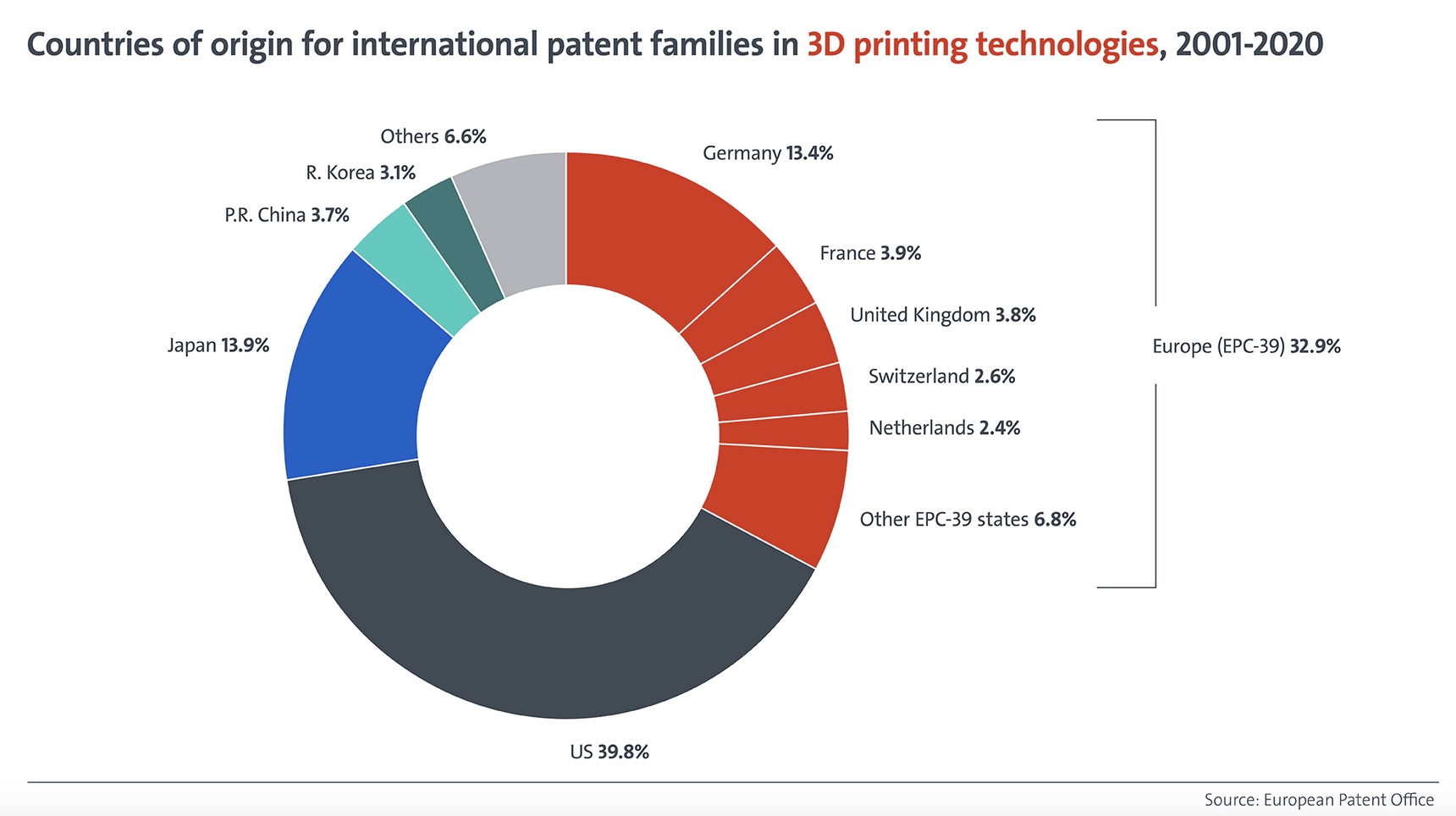
In a landscape where innovation is the name of the game, 3D printing is stealing the spotlight. Once a niche technology, 3D printing is breaking traditional production barriers, cutting waste, and supporting mass customization across various industry sectors. A new report from the European Patent Office (EPO) strengthens this observation. Accounting for 40% of global patenting activity in additive manufacturing (AM), U.S. researchers and inventors are playing a significant role. Considering that 3D printing technology originated in the U.S. nearly four decades ago, it’s not surprising to see the country continuing to lead in this transformative field.
Titled “Innovation trends in additive manufacturing: Patents in 3D printing technologies,” the study takes a deep dive into international patent data, offering a comprehensive global snapshot of the current state of 3D printing. According to the report, the U.S. and Europe are at the forefront of innovation in this area. Together, they account for nearly three-quarters of all 3D printing inventions worldwide, with the U.S. leading at 40% and Europe following closely at 33%.
Sector leaders
Furthermore, the study reveals that innovation in AM has surged in the past decade. Between 2013 and 2020, international patent families (IPFs)—essential inventions patented in two or more countries—grew at an average annual rate of 26.3%. This is nearly eight times faster than the average growth rate for all technology fields combined during the same period, which was 3.3%. In this context, U.S. inventors and researchers filed a total of 19,941 IPFs from 2013 to 2020, experiencing a more than five-fold increase from 542 in 2013 to 3,024 in 2020.
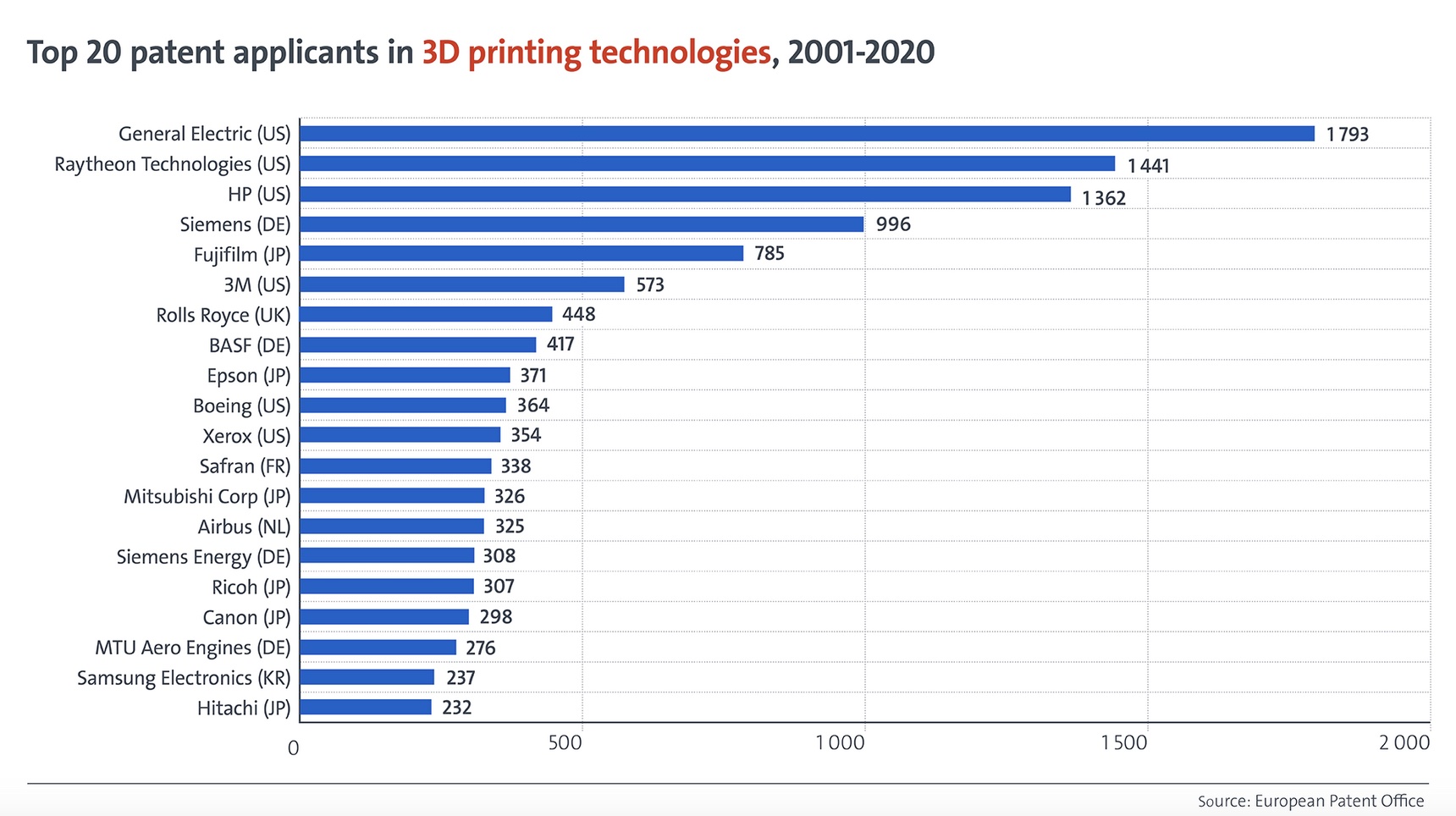
U.S. companies General Electric, Raytheon Technologies, and HP are the top three applicants for IPFs in 3D printing. In contrast, three other U.S. companies (3M, Boeing, and Xerox) also appear in the top 20. Overall, the U.S. and Europe dominate the ranking, with six U.S. and seven European companies among the leading 20 applicants; Japan has a further six companies. In addition, Johnson & Johnson is the top applicant globally for 3D printing inventions related to medical equipment, and Ford leads in vehicle applications. Meanwhile, smaller companies and startups contribute significantly to the field, including Divergent 3D, Continuous Composites, and Evolve Additive Solutions.
Remarkably, 12% of global 3D printing IPFs stem from universities or public research organizations, nearly double their typical share. Among the top 10, five are MIT, the University of California, Harvard University, the University of Texas System, and the University of Michigan. In the realm of artificial organs and tissue, six of the top seven applicants are U.S. universities.
“With this study, we’re taking a global perspective on the 3D printing revolution using international patent data to report on the scope and implications of this technology trend,” says EPO President António Campinos. “Europe secured four of the top ten spots for research institutions in additive manufacturing innovation. This bodes well for the future since technical progress in this field often stems from the cutting-edge research in these institutions.”
Patent surge
One of the most compelling advantages of 3D printing is its ability to remove the traditional technical restrictions that have long plagued the industrial production process. Old-fashioned methods and tools no longer limit AM, completely changing how we think about and make products. This new freedom has encouraged renewed ideas and promotes sustainability.
Although the healthcare and transportation sectors have led the charge in 3D printing patent applications since 2010, the technology is by no means limited to these areas. Its adaptability to various materials, like plastics, metals, ceramics, and even organic cells, has opened doors to rapid growth in multiple sectors. Thanks to AM, tooling, energy, fashion, electronics, construction, and even the food industry are experiencing transformative changes.
When it comes to the worldwide landscape of 3D printing innovation, U.S. companies have established a strong presence, particularly in fields like aerospace, pharmaceuticals, naval engineering, sports equipment, medical equipment, and energy. American innovators are behind more than half of all international patent families in 3D printing, emphasizing the country’s leading role in shaping the future of this disruptive field.
Building on this momentum, the latest report by Additive Manufacturing Research (formerly SmarTech Analysis) brings more good news. The study projects the market for metal 3D printing alone will reach $5.4 billion by 2023, and the company projects the market could balloon to over $25 billion by 2025. This optimistic outlook is supported by the industry’s performance during the Covid-19 pandemic, when 3D printing played a pivotal role in the switch to local production, thereby reducing dependence on international supply chains. The experience underscored the adaptability and crisis-management value of 3D printing technology, further indicating a future full of opportunities.
So, what does all this mean for 3D printing? It’s changing how industries work and making them more sustainable. It’s growing fast and has a lot of different uses, so its future looks promising. Not only are the numbers impressive, but the real-life changes it’s making in various fields show it’s a technology worth keeping an eye on.
Subscribe to Our Email Newsletter
Stay up-to-date on all the latest news from the 3D printing industry and receive information and offers from third party vendors.
Print Services
Upload your 3D Models and get them printed quickly and efficiently.













You May Also Like
AM Pulse Asia: Consumer Metal AM, Nuclear Parts and Rockets Push New Ground
The second half of August produced financing milestones, facility openings, and qualification results across Asia-Pacific additive manufacturing. Rongsu Technology closed a CNY 100 million Series A+ and launched a consumer...
HeyGears G1 Passes $14M on Kickstarter with Full-Color 3D Printing
HeyGears was started in 2015 and has been making value-driven Vat Polymerization systems for dental and home use. The company is marketing savvy and very driven. Now the firm has...
One Machine, Three Worlds of Creation: Inside the HeyGears G1 Series
Turning a digital idea into a finished full-color physical product often requires several machines, multiple software tools, manual coloring, repeated positioning, and outsourced production. For creators and small businesses, this...
AMPulse Asia: India’s Orbital Launch Headlines a Busy Second Half of July
The second half of July brought major developments across Asia’s additive manufacturing sector. Highlights included India’s first private orbital launch powered by 3D printed engines, a billion-yuan ownership change at...