Lockheed Orders Titanium Plate from 3D Printing Materials Company IperionX


IperionX, a Charlotte, NC-based metals supplier specializing in titanium powders for additive manufacturing (AM), announced that the company has received an order for titanium plate components from defense giant Lockheed Martin. IperionX will use its patented Hydrogen Sintering and Phase Transformation (HSPT) process in the production of the plates, which the company claims provides strength and corrosion-resistance properties comparable to wrought titanium, but with reduced carbon emissions.
The order comes two days after IperionX announced that it was granted two permits crucial to the development of the company’s Titan Project in west Tennessee, “the largest JORC-compliant resource of titanium and rare earth rich mineral sands in the US”. Originated in Australia and New Zealand, the Joint Ore Reserve Committee (JORC) Code is one of the most influential set of reporting standards globally for the mining sector.
IperionX expects all remaining regulatory requirements for the Titan Project to be completed by the end of 2023. As the company notes in the press release about its receipt of the two latest permits, the significance of the operation lies in the fact that the US sources over 80 percent of its titanium from foreign markets, combined with the growing demand for the metal to feed the US’s burgeoning supply chains for products like EV batteries. This has relevance to the Lockheed order as well, given the accelerated push by the Biden administration to reshore US defense supply chains: the potential for a fully domestic titanium supply chain is clearly a quite attractive prospect for a US defense contractor, in particular.
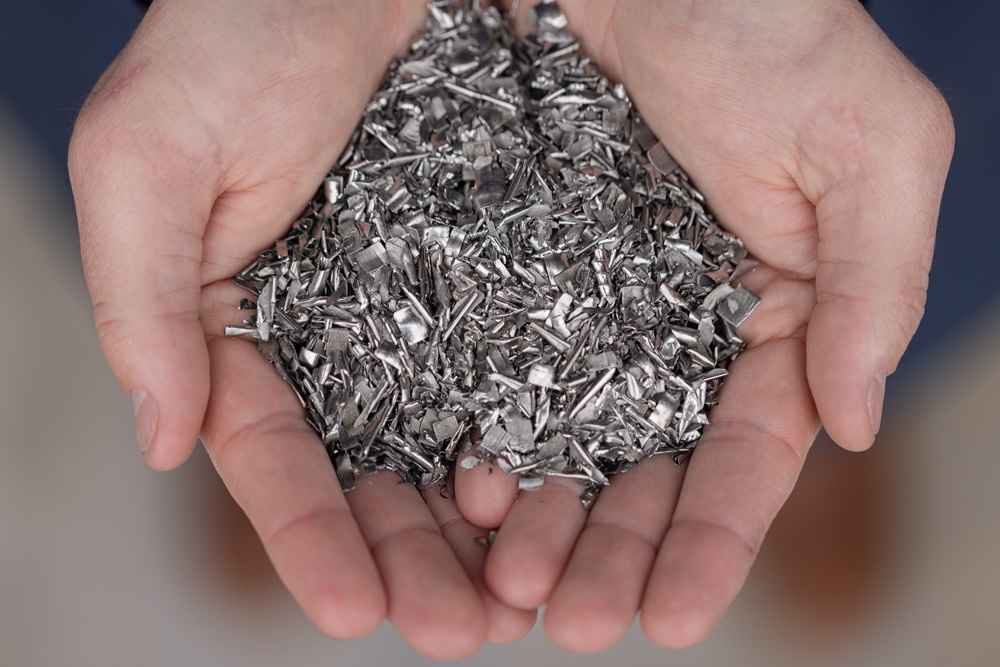
In a press release about the order for titanium plate components from Lockheed Martin, the CEO of IperionX, Anastasios (Taso) Arima, said, “This collaboration with Lockheed Martin is another important milestone towards the rapid commercialization of IperionX’s low-carbon titanium technologies. These patented technologies can either use titanium minerals or titanium scrap metal as feedstock to manufacture high quality titanium products at significantly lower cost and carbon footprint than existing production processes.”
Lockheed Martin’s senior fellow for AM Processes and Materials, Brian Rosenberger, said, “Reducing the cost of titanium components will mean broader use of this material to increase the performance of our products. With this order, Lockheed Martin will perform an initial evaluation of the material quality and mechanical performance of IperionX’s titanium plate material.”

Earlier this week, in a report issued surrounding the one-year anniversary of the Inflation Reduction Act (IRA), S&P Global found that the US mining industry is facing severe difficulties in trying to make domestic EV metal supply meet demand. Concerning the report, Daniel Yergin, an energy historian and the vice chairman of S&P Global, told Reuters, “The global trade in minerals will increasingly reflect the competition between the US and China, as well as Europe, for those supplies. Mineral supply is going to be increasingly entangled with geopolitics.”
As Yergin no doubt knows, mineral supply has always been entangled with geopolitics. The unique thing about the current era is the extreme extent to which not only all nations, but perhaps even more importantly at this point, all sectors, are wrapped up with one another. This is not going to change any time soon. What is changing, however, is that risk management methods are being embedded into the foundation of all new growth, such as the US’s budding domestic EV battery supply chain.
That is the backdrop against which one can understand Lockheed’s interest in companies like IperionX. Similarly, it is the same backdrop that explains Lockheed’s push for an AM Forward-centric small business investment fund (SBIF). If that fund is indeed established, the sorts of investments that will comprise it will likely take the form of ensuring that small and medium enterprises (SMEs) can do business with companies such as IperionX. The SBIF is the bare minimum starting point for what the Lockheeds of the world will have to do in order to truly take control of their own supply chains.
Images courtesy of IperionX
Subscribe to Our Email Newsletter
Stay up-to-date on all the latest news from the 3D printing industry and receive information and offers from third party vendors.
Print Services
Upload your 3D Models and get them printed quickly and efficiently.













You May Also Like
GKN Aerospace’s UAV Demonstrator with 3D Printed Engine Avoids ITAR Regulations
The US CIA director recently made an unannounced visit to Moscow that has naturally raised much speculation, while the EU and NATO have now officially accused Russia of being behind...
South Korea’s Lincsolution Announces AM Defense Hub as Nation is Caught in US-China Trade War
In my most recent post about RIMPAC, I noted that US military joint exercises appear to be the latest function of the US government to be leveraged by the Trump...
Lyten’s Graphene Filaments Power Modovolo’s US-Made 3D Printing Platform
Drone manufacturer Modovolo has selected Lyten as the primary filament supplier for its industrial 3D printing platform, a move the companies say will strengthen U.S.-based manufacturing for aerospace, defense, and...
The Drone Industry is Showing Where 3D Printing Delivers Real Value, AM Research Report Finds
The rapid rise of drones is creating one of the biggest opportunities for additive manufacturing (AM). Whether they’re used on battlefields, inspecting bridges or crops, or delivering supplies, drones need...