Transparent Display 3D Printing for AR Developed in Korea

In June, 2023, the materials science journal ACS Nano published a study by a research team at the Korea Electrotechnology Research Institute (KERI), on the development of 3D printing technology capable of producing transparent displays optimized for augmented reality (AR) devices. Entitled “Three-Dimensional Printing of Structural Color Using a Femtoliter Meniscus”, the study was conducted as part of a larger KERI project, “Development of 4D printing technology for circuit/housing integrated devices.”
The operation of meniscus-guided 3D printing is somewhat easier to understand than its frighteningly complex-sounding name might suggest. First off, a ‘meniscus’ in this context is a curve formed when tension is created between the liquid in a container and the liquid that the container has dispensed onto a surface.
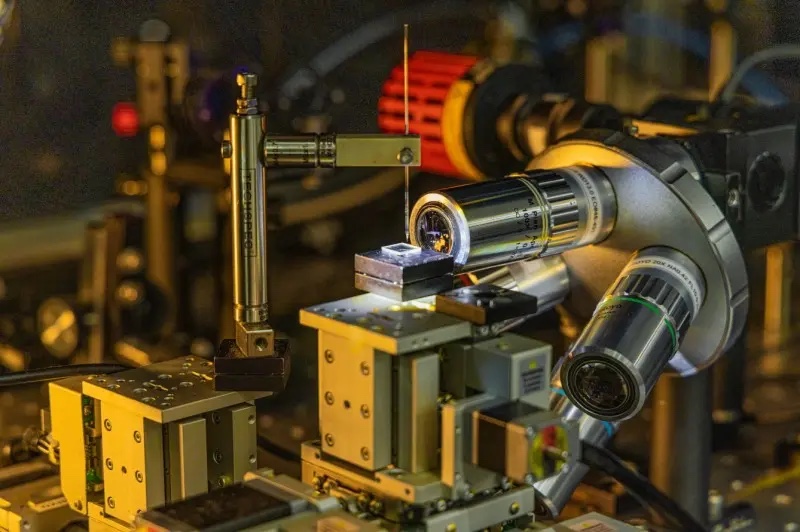
Second, a ‘femtoliter’ is a measurement equating to one-quadrillionth of a liter, highlighting the key detail relevant to this particular area of the additive manufacturing (AM) sector, which is that these techniques work because they happen at the nanoscale. The KERI team developed its method using a nanopipette combined with direct ink writing (DIW) 3D printing, which allowed the researchers to deposit polymer ink onto a variety of different substrates such as quartz, silicon, and platinum.
The goal of the study was to achieve the end-result of structural color on the finished displays. In nature, structural color is seen in things like chameleon skin, where the appearance of surface hues changes due to the interaction of light wavelengths with the microstructures at hand. In this case, the purpose of 3D printing to manipulate this process is to control color patterns without using dyes, which is essential, for one thing, because of the objective of creating a transparent end-product.
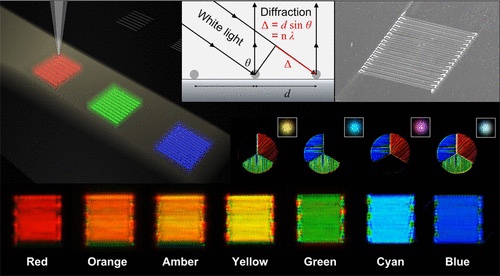
Components designed to achieve structural color — known as ‘diffraction gratings’ — are increasingly common in the optics industry, and are particularly instrumental to the burgeoning manufacture of AR and virtual reality (VR) hardware. Hence the team’s claim that it has developed the “world’s first” AM process for AR-specific displays, a claim I can’t vouch for, but I can certainly affirm that this is one of the most unique 3D printing methods I’ve stumbled across.
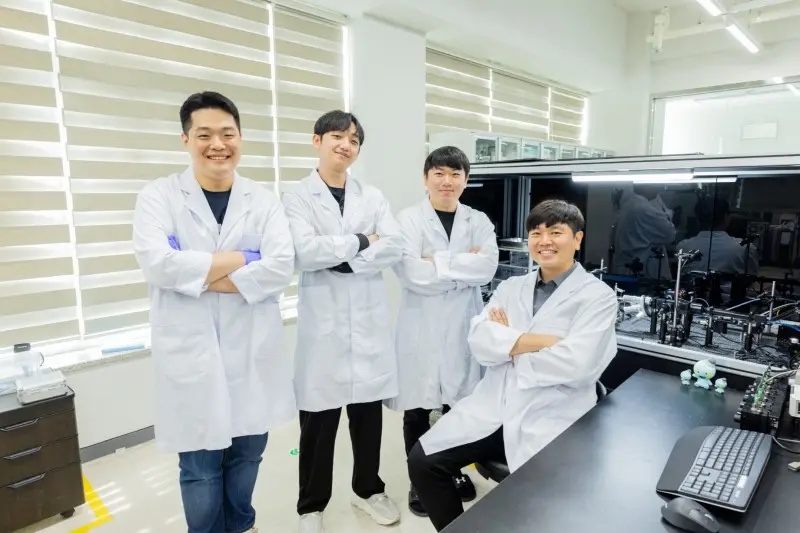
It is also something of a raison d’être for KERI, where years have been spent building up the technology for this exact purpose of transparent displays. The team that worked on this leg of the project has already filed the patent application, and in addition to the AR/VR industry, the researchers also anticipate that their findings will be relevant to the manufacture of things like environmental sensors and anticounterfeiting methods.
A non-profit funded by the South Korean government, KERI has multiple locations, including a headquarters in the southeastern coastal city of Changwon, home to “70% of South Korea’s defense industry”, as well as a number of manufacturing facilities for the nation’s largest corporations. Thus, there are more than a few potential customers right at KERI’s doorstep who have likely already shown interest in this R&D breakthrough.
That does not even include Apple, which in June held its first-ever Smart Manufacturing Forum in Pohang, South Korea, less than 100 miles from KERI. That event was part of an initiative forced on Apple by the Korea Fair Trade Commission, whereby the company agreed to share details with South Korean small and medium enterprise (SME) manufacturers as part of a payment of a fine dating back to 2021.
Apple, of course, recently announced the upcoming release of its first VR headset. In July, it was also reported that the company will be using metal AM for the next generation of the Apple Watch Ultra. That is obviously a product that 3D printed displays could eventually be quite useful to. Meanwhile, Meta acquired Luxexcel at the end of last year in order to 3D print lenses for its own AR and VR efforts.
Unless otherwise noted, images courtesy of Display Daily
Subscribe to Our Email Newsletter
Stay up-to-date on all the latest news from the 3D printing industry and receive information and offers from third party vendors.
Print Services
Upload your 3D Models and get them printed quickly and efficiently.











You May Also Like
From Monitoring to Measurement: Why Objective Inspection is Becoming Essential for Scalable Metal AM
Additive Manufacturing (AM) is no longer judged by its printing capabilities, but how it can print reliably, repeatedly, at scale. As metal AM continues its transition from prototyping to production,...
Cheap Printers Make Metal Powders Costly
Last year, on stage at AM Strategies, the argument was simple: additive manufacturing had to stop chasing elegance and start chasing economics. The 3D printing community had spent decades refining...
Advancing Workforce Development for Industrial Additive Manufacturing
As additive manufacturing (AM) continues its transition from a niche technology to a core element of industrial production, workforce development has emerged as one of the industry’s most pressing issues....
Analysis: HII’s Newport News Shipbuilding Buys Second NXG 600E
Nikon SLM Solutions has sold a second NXG 600E to HII’s Newport News Shipbuilding unit. This machine will be used to print in NiAlBr, Nickel Aluminum Bronze. The printer will...