Conductive Elastic Ink 3D Prints Self-Supporting Structures

Researchers from the Korea Institute of Science and Technology (KIST) recently demonstrated a conductive elastic ink that can print self-supporting structures in any direction. This new ink uses an emulsion system to achieve the desired print flow mechanics, and with its publication, could lead to numerous innovations in the stretchable and wearable electronic field.
3D printed electronics are growing, but the pace is difficult to understand, due to trade secrecy. One area that has received much attention has been 3D printed conductive elastomers. So far, printing conductive elastomers has been limited to a 2D plane because the rheological properties of most inks can’t support their weight immediately after printing. However, if a material could print free-standing structures while also being flexible enough to move with a person’s body, it could maximize the fidelity of the wearable devices and achieve the complex circuits needed to match the morphology of an individual patient.
Well, the Korean team did just that and found a way to manipulate an ink’s rheological properties to omnidirectionally print elastic conductors.
The KIST researchers used an emulsion system that consisted of a conductive elastomer composite (silver, Ag, multi-walled carbon nanotubes, MWCNTs, and polydimethylsiloxane, PDMS), an immiscible solvent (diethylene glycol, DEG), and emulsifying solvent (chloroform, CHCl3). Turns out, the DEG was the key ingredient to getting the proper rheological properties as it stopped the filler from settling in the dispersion and gave it pseudo-plastic and lubrication attributes which prevent nozzle clogging allowing for stable prints.
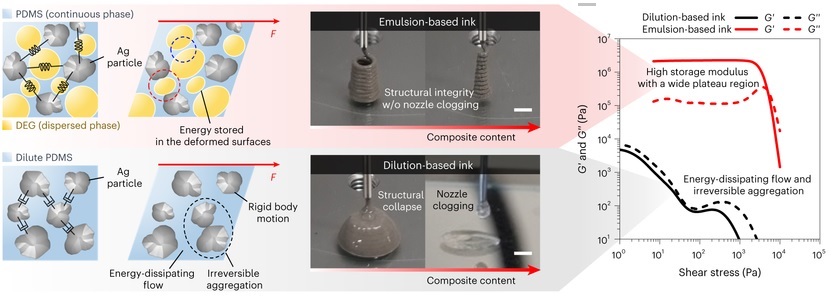 A schematic showing the difference between a dilution based conductive elastic ink and KIST’s emulsion based conductive elastic ink. (Source: Nature Electronics)
The emulsion ink reached a minimum feature size of less than 100 μm and a maximum feature size of a few millimeters. The inks also achieved an impressive stretchability of up to 150% and had improved electrical conductivity because of the surface localized microstructures formed when the dispersed solvent vaporized.
 Figure showing the printability, stretchability and the feature sizes of KIST’s ink. (Source: Nature Electronics)
KIST’s new method will allow for a variety of 3D wiring patterns to be printed, and they showcased its ability in the final figure. The researchers created a skin-mountable temperature sensor using their new emulsion conductive ink as wiring, mini LEDs, and a microcontroller unit with a temperature sensor. The sensor’s matrix-type stretchable display easily reads the temperature of the air around it and can be seen changing from 25°C to 32°C when a researcher first touches the device, and from 33°C to 42°C when a warm glass was introduced.
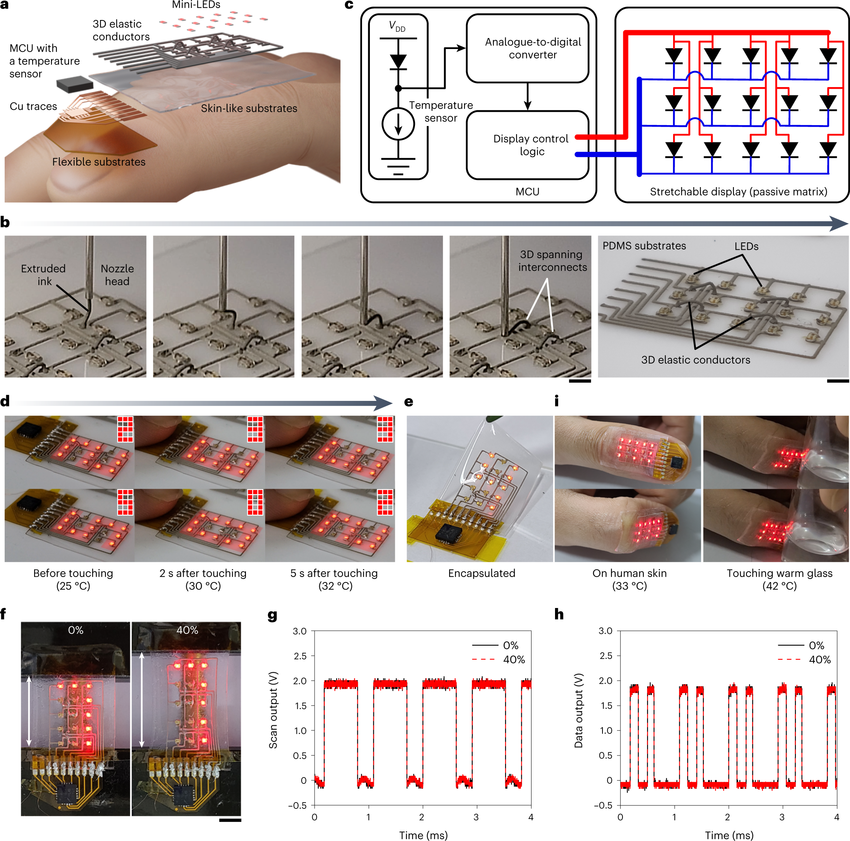 Figure showing the temperature sensor with KIST’s 3D printed wiring. (Source: Nature Electronics)
Now, this won’t be the end of the road, and more improvements will be needed before it heads to commercialization, but it still opens the doors to new possibilities in wearable and stretchable electronics. The authors even say the ink’s formulation can be easily modified to exhibit the desired characteristic an individual situation might need. Time will tell how this technology is implemented, but if it can help electronic devices interface with the human body easier and more efficiently, then it sounds like the field is heading in the right direction.
The full academic article can be found here at Nature Electronics.
Subscribe to Our Email Newsletter
Stay up-to-date on all the latest news from the 3D printing industry and receive information and offers from third party vendors.
Print Services
Upload your 3D Models and get them printed quickly and efficiently.











You May Also Like
Bridging the Gap: 2D to 3D AI in Manufacturing
For decades, the early stages of manufacturing have been defined by a simple, frustrating trade-off: you can have it precise, or you can have it fast. AI just broke that...
Takeaways From MILAM 2026: Defense’s Growing Role in Driving 3D Printing – Part I
The annual Military Additive Manufacturing Summit & Technology Showcase (MILAM 2026) once again brought together the defense sector’s top technologists, military leaders, and additive manufacturing (AM) innovators for three days...
Hardware is Dead. Here’s What Actually Wins in Additive Manufacturing.
Hardware is rapidly commoditizing across additive manufacturing. Specifications have converged. Price competition has intensified. Margins have compressed. For companies attempting to scale additive manufacturing beyond prototyping, this shift has profound...
The Real ROI of Personalized 3D Printed Medtech in Oncology
Discover how patient-customized 3D printed devices like Stentra™ significantly reduce high toxicity-related treatment costs and improve workflow efficiencies to handle more cases more effectively overtime. Introduction: The Economic Paradox in...