Mark Zuckerberg’s Latest Hobby: 3D Printing Dresses

From learning new languages to running marathons, Mark Zuckerberg is known to enjoy exploring new hobbies in his free time, and his latest passion is 3D printing dresses. The billionaire entrepreneur has been sharing his latest design projects with his followers on social media, providing a glimpse into his creative process and engaging with interested fans.
On April 29, Zuckerberg took to Instagram and posted a series of pictures of his daughters donning two 3D printed dresses. In the first picture, one of the children is seen wearing a green triangle-patterned dress on top of her regular clothes. A second photo shows another of Zuckerberg’s daughters wearing an aqua-colored chainmail dress – and also gives fans a closer look at the pattern design on a third pic. The technology entrepreneur captioned the pictures: “I love building things and recently started designing and 3D printing dresses with the girls. A few projects from the last month… (and yes, I had to learn to sew).”
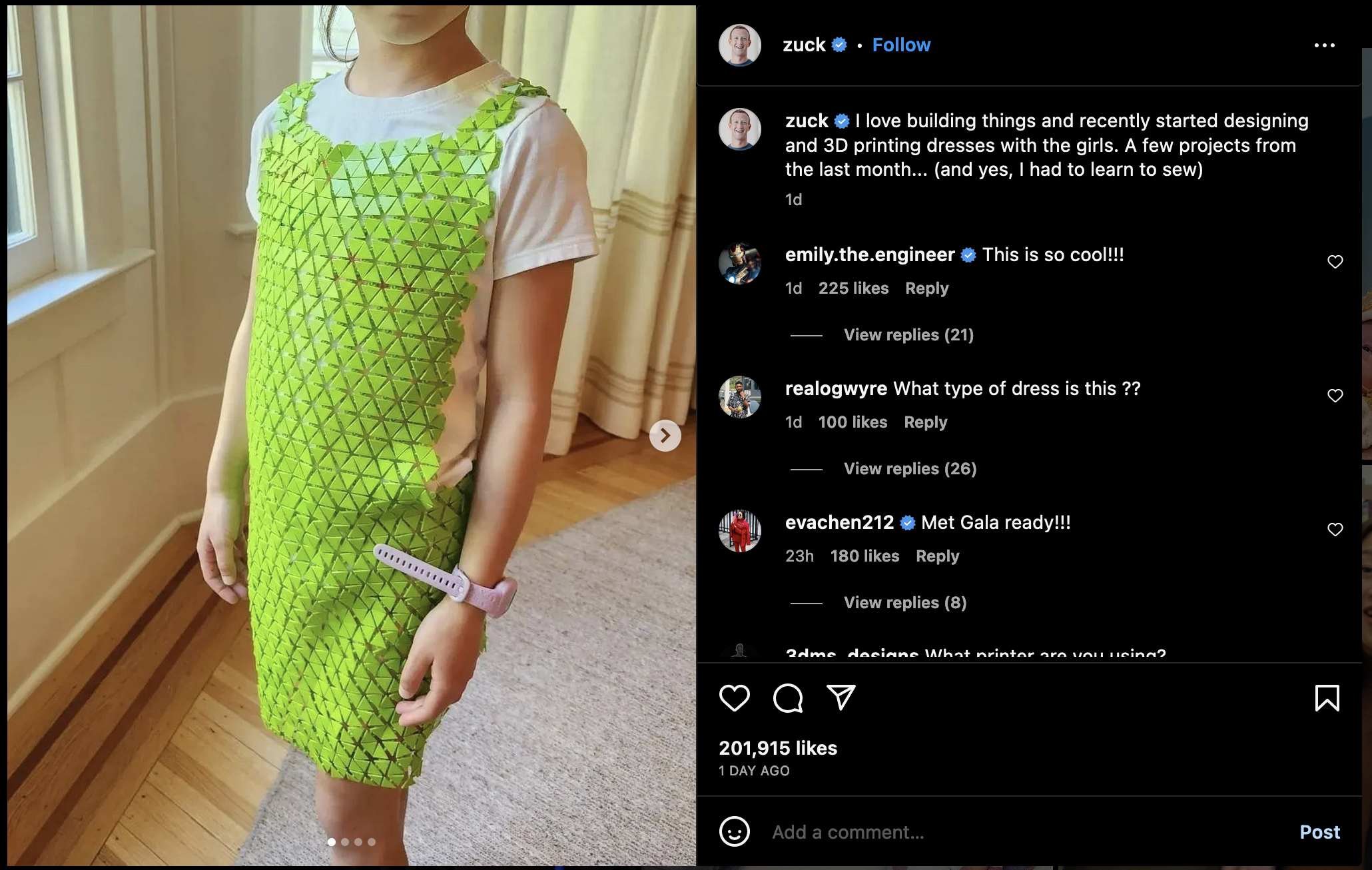
Several 3D printing enthusiasts dropped comments on the pictures. For example, mechanical designer and 3D printer Matt Steingraber (who goes under the Instagram handle 3dms_designs) asked Zuckerberg what printer he used for the job, to which he replied Prusa. In other responses, he explained to curious users that he used carbon fiber and PLA (polylactic acid) to make the chainmail “tough,” it took a while to sew the 3D printed parts together and indicated that the dresses were pretty light, probably weighing a couple of pounds.
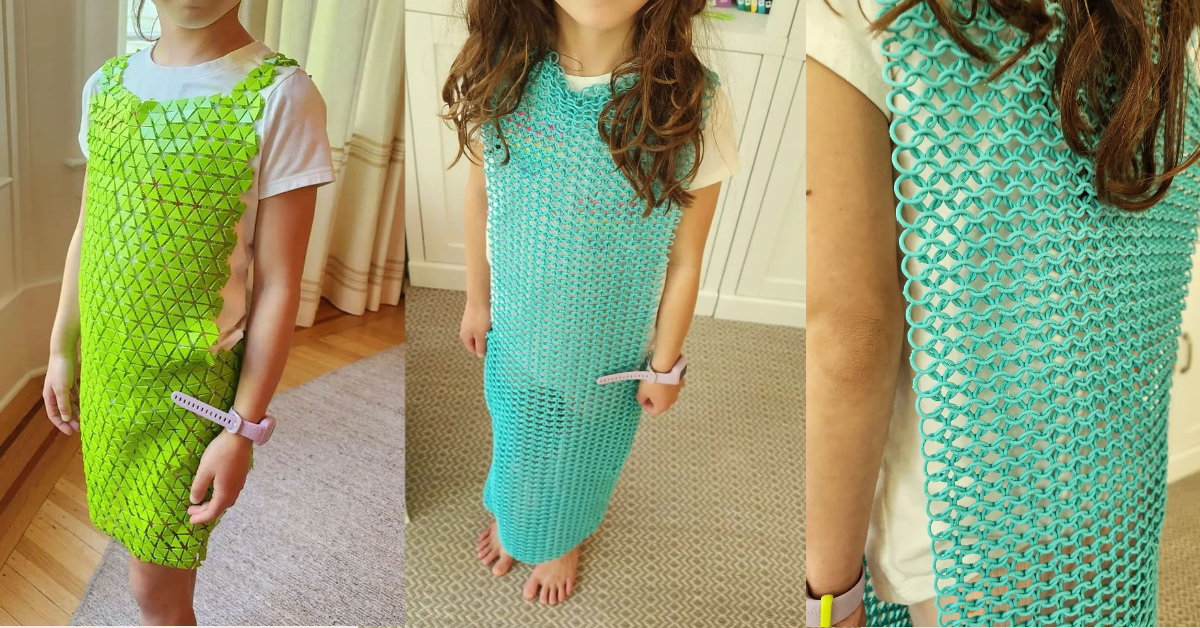 Mark Zuckerberg’s daughters wear 3D printed dresses. Image courtesy of Mark Zuckerberg via Instagram.
Also, Emily Yarid, aka Emily the Engineer, wrote, “This is so cool.” Her comment got an instant reply from Zuckerberg, who revealed: “Thanks! Your videos got us started on our journey into 3D printing, and I’m grateful for all your help along the way!”
Yarid, a mechanical engineer passionate about re-creating props, built her first Iron Man suit out of foam and hot glue at age 14 and has since recreated some of the most incredible superhero costumes. Aside from showcasing her work on Instagram to more than 208,000 followers, Yarid also has a photo of her with Zuckerberg from 2022 captioned: “Had a blast 3D printing some fun creations with @zuck and his daughter this week!”
 Mark Zuckerberg and Emily Yarid, aka Emily the Engineer, share a 3D printing passion. Images courtesy of Emily Yarid @emily.the.engineer
Zuckerberg is currently focused on developing new technologies that have the potential to revolutionize industries beyond social media. In addition to his work at Facebook, the self-taught computer programmer has invested in various cutting-edge 3D printing projects and even visited the offices of Carbon in 2014.
Furthermore, Zuckerberg’s 3D printed dress pics come just a few months after Facebook owner Meta (Nasdaq: META) bought Belgian-Dutch optics 3D printing firm Luxexcel. This exciting move will help Meta speed up the development of its mass-customized lenses for its AR platforms, particularly for producing Meta’s highly anticipated prescription AR glasses and giving the firm an edge in manufacturing and usability. This deal by Meta is not only engaging but also has practical benefits. It serves as a compelling demonstration of the unique advantages of additive manufacturing, allowing for optimizing the headsets in innovative ways that cannot be achieved with traditional manufacturing methods.
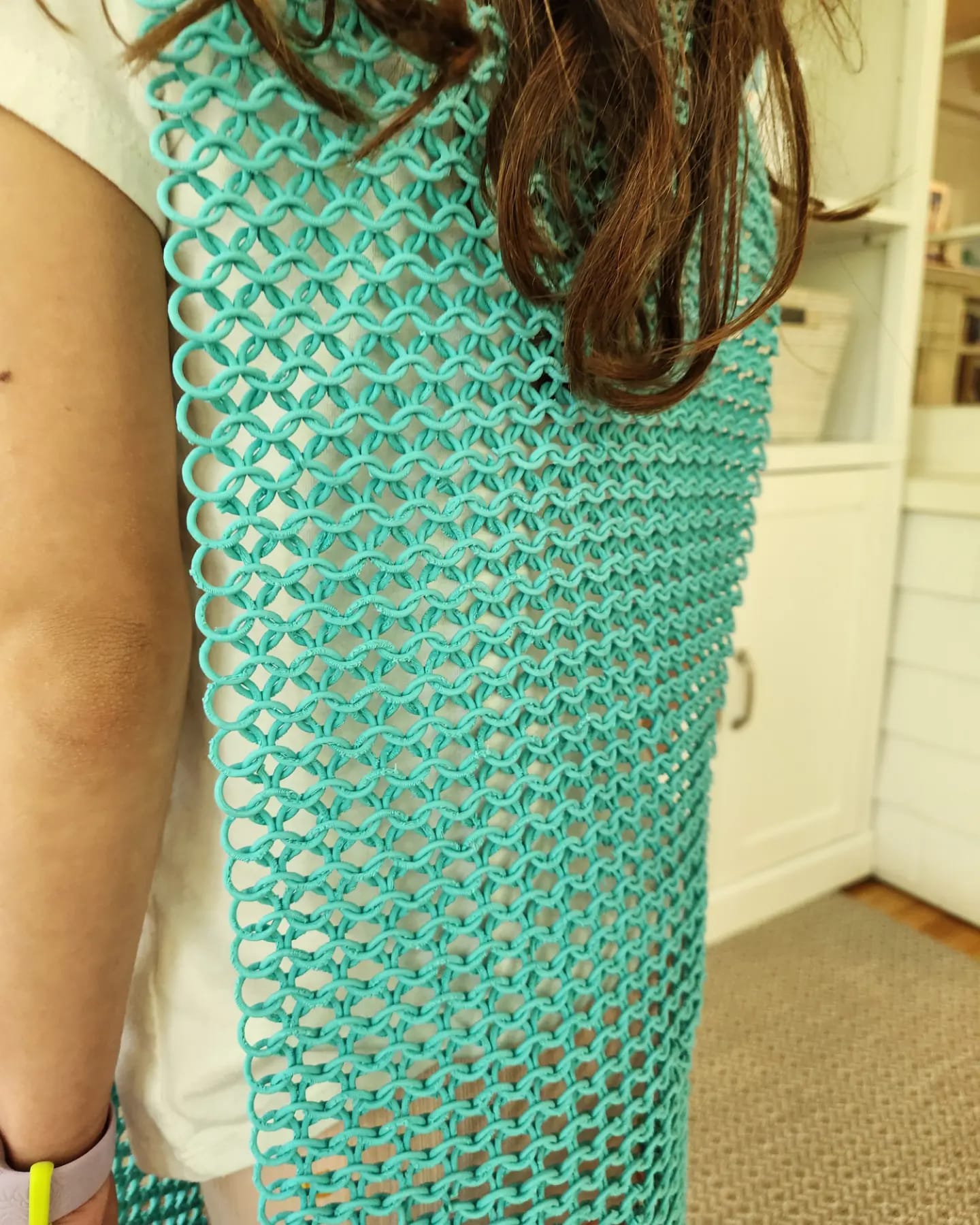 Mark Zuckerberg’s daughter wears a 3D printed dress made with Prusa. Image courtesy of Mark Zuckerberg via Instagram.
As an amateur hobbyist, Zuckerberg did an impressive job printing a series of intricate and stylish dresses, showcasing a passion for the art of 3D printing.
In recent years, the 3D printed fashion industry has grown significantly as more designers and brands incorporate technology into their creative processes. Bespoke, innovative, and customizable designs are very attractive to innovative individuals seeking to create designs that are more sustainably and efficiently made than with traditional manufacturing methods. Additionally, 3D printing offers opportunities for personalized fit and unique aesthetic details, which are highly valued in the fashion industry.
Some of the most renowned designers in this niche sector include Dutch fashion designer and innovator Anouk Wipprecht, better known for her futuristic and interactive fashion designs that incorporate technologies like sensors and microcontrollers; fellow Dutch designer Iris van Herpen whose experimental designs often include 3D printing; Ukrainian fashion designer Julia Daviy who specializes in creating eco-friendly 3D printed fashions; and Israeli artist Danit Peleg who gained international attention for her 3D printed fashion collection.
Subscribe to Our Email Newsletter
Stay up-to-date on all the latest news from the 3D printing industry and receive information and offers from third party vendors.
Print Services
Upload your 3D Models and get them printed quickly and efficiently.













You May Also Like
Metal 3D Printers for the Desktop Are Finally Starting to Feel Like Desktop Products
FDM 3D printing is becoming increasingly accessible, yet metal 3D printers designed for everyday desktop use remain rare on an ordinary workbench. The real challenge is not making a metal...
3D Printing Financials: 6K Additive Sales Rise as Aerospace and Defense Demand Grows
6K Additive (ASX: 6KA) grew rapidly in the first half of 2026 as demand for its metal powders increased, particularly from aerospace and defense customers. The newly public company also...
When Data Becomes the Differentiator: Qualified Material Data is Changing the Future of Structural Additive Manufacturing
For years, additive manufacturing has promised engineers greater design freedom. The challenge wasn’t printing the part—it was proving the part belonged on an aircraft. Designing a lightweight bracket or consolidating...
Amaero Builds U.S. Metal Powder Capacity for Additive Manufacturing
For metal additive manufacturing (AM) to grow in the United States, companies need more than printers. They also need a reliable supply of the powders that go into those machines....