
NIST Seeks Participants for New 3D Printing Powder Consortium

The National Institute of Standards and Technology (NIST), an agency within the US Department of Commerce (DOC), has issued a notice soliciting participants in its recently formed Metal Additive Manufacturing Powder (MAMP) Consortium. The group’s work will begin in July, 2023, and the NIST will accept qualified members to participate on an ongoing basis.
The purpose of the MAMP Consortium is to bring together experts from industry, academia, standards organizations, etc., to collaborate on developing “pre-competitive measurement science and standards” related to metal powders used in 3D printing. Members of the MAMP Consortium will need to sign a Cooperative Research and Development Agreement (CRADA) (with some exceptions, subject to NIST’s discretion).

Per the notice for the MAMP Consortium on the Federal Register website, “Completed letters of interest or requests for additional information about the Consortium can be directed via mail to the Consortium Manager, Dr. Shawn Moylan, Intelligent Systems Division of NIST’s Engineering Laboratory, 100 Bureau Drive, Mail Stop 8220, Gaithersburg, Maryland 20899, or via electronic mail to AMPowderConsortium@nist.gov, or by telephone at (301) 975-4352.”
Additionally, for further information, potential participants can contact, “J’aime Maynard, TPO Agreements Officer, National Institute of Standards and Technology’s Technology Partnerships Office, by mail to 100 Bureau Drive, Mail Stop 2200, Gaithersburg, Maryland 20899, by electronic mail to Jaime.maynard@nist.gov.”
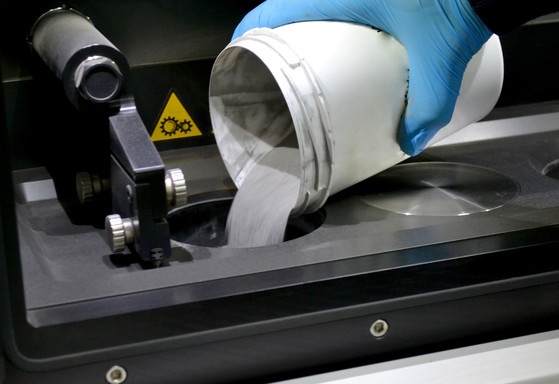
In this initial phase of the group’s activities, which is expected to last up to five years, participants will be required to contribute $25,000 to the organization — “or equivalent in-kind contributions”, presumably meaning resources and/or labor devoted to the research at hand. To begin, the Consortium will be focused above all on qualifying materials for laser powder bed fusion (LPBF) and directed energy deposition (DED) processes.
As I pointed out last year in a post about the ASTM’s International Conference on Additive Manufacturing (ICAM), the business trajectory that the AM sector takes over the next decade or so “will be signaled far in advance by the state of the sector’s ability to standardize as it scales up.” In other words, as it takes shape, the work done by NIST and other similar groups will, as a whole, constitute one of the most useful roadmaps for gauging in advance where the 3D printing market is headed.
This will be especially true in coming years concerning metal AM, where a more conscious and accelerated effort will be required to sufficiently universalize the underlying technological processes and inputs. Thus, $25,000 might seem like a steep fee for membership, but it will almost certainly be an investment with a uniquely high rate of return for whoever can afford it. Moreover, although direct participants will of course benefit the most, the entire industry should eventually reap the gains of the MAMP Consortium’s activities.
Subscribe to Our Email Newsletter
Stay up-to-date on all the latest news from the 3D printing industry and receive information and offers from third party vendors.
Print Services
Upload your 3D Models and get them printed quickly and efficiently.













You May Also Like
The Money Behind AM: What to Watch at AM Investment Strategies 2026
For years, simply being a 3D printing company could attract attention from investors. New machines, new materials, faster speeds, and the promise of mass production were often enough to get...
3D Printed Football Helmets Are Amazing Business. They’re Also So Much More
NFL football is by far the most popular sport in the US, followed by college football (a state-of-affairs oddly similar to the fact that the world’s largest air force is...
Continuous Composites Wins Navy SBIR for 3D Printed UAVs
In a diversification effort, Continuous Composites has decided to seek work outside of the courtroom. The company that has been successful in defending its patent portfolio in composite 3D printing...
When Data Becomes the Differentiator: Qualified Material Data is Changing the Future of Structural Additive Manufacturing
For years, additive manufacturing has promised engineers greater design freedom. The challenge wasn’t printing the part—it was proving the part belonged on an aircraft. Designing a lightweight bracket or consolidating...























































