Roboze Announces PRO Series of 3D Printers for PEKK and CF


Roboze, manufacturer of end-to-end additive manufacturing (AM) platforms, has announced the release of its latest machines, the One PRO and Plus PRO. Roboze made the announcement at this year’s AM Forum in Berlin.

Founded in Italy, Roboze also has an American headquarters, in Houston. The company’s high temperature extrusion printers are optimized for working with polymers such as PEEK, which allows users to quickly produce plastic components with the strength of metals, but at much lighter weights.
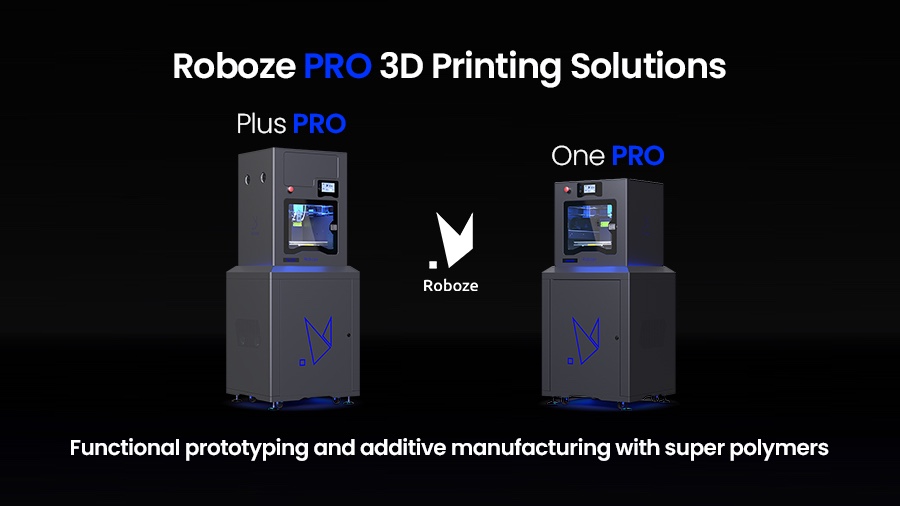
In a press release, the company’s founder and CEO, Alessio Lorusso, said, “With the Roboze PRO Series, production becomes stronger, faster, and less expensive….[We have created it] with the sole aim of providing a performance-oriented solution for manufacturing companies…We believe the quality of the systems, of the printing process and of the finished components can help companies limit risks, increase the safety of the supply chain and continue to keep their production alive and competitive.”
Along with the new printers, Roboze also announced the release of two new materials: Roboze PEKK (polyetherketonketone), and ToolingX CF (carbon fiber). As Roboze points out in the press release, these materials are already widely-used in the industry. The notable aspect is that, with the release of the PRO Series, the company has given its customers the ability to use PEKK and CF materials on Roboze platforms.

Both materials are ideal for meeting the industrial requirements of the major sectors Roboze provides equipment for, especially aerospace and oil and gas. More broadly, both the materials and the platforms are suited for any sector making metal components for mass industrial processes, which obviously covers a lot of markets. For instance, Roboze provided the example of one customer who used the Plus PRO and ToolingX CF material to replace aluminum in the manufacture of molds for paper pulp products. Among other advantages, this yielded the customer a cost savings of over 60 percent.
The other major upgrade to the new hardware is its improved integration with Roboze’s Prometheus software, by comparison with previous Roboze machinery. Along with a more reliable printing process, this could allow customers to cut print times by as much as half.
Roboze’s focus on the entire picture puts it in a perfect position to continue growing with the AM sector, as a whole. The company’s comprehensive outlook extends not just to the production process, but to the total supply chain. Moreover, its Houston headquarters give it a real asset in its ability to benefit from rising energy costs, which is leading to increasing activity in the oil and gas sector.
Subscribe to Our Email Newsletter
Stay up-to-date on all the latest news from the 3D printing industry and receive information and offers from third party vendors.
Print Services
Upload your 3D Models and get them printed quickly and efficiently.













You May Also Like
Lufthansa Technik Uses 3D Printed Titanium Latch for Aircraft MRO
Maintenance and interiors aircraft giant Lufthansa Technik is exploring 3D printing at greater depths, hoping to take its customers to the heights they’re accustomed to. A team at Lufthansa Technik...
3D Printing Financials: Creality Posts H1 Loss, Plans $80M AM Headquarters
Creality (HKG: 3388) sold more products in the first half of 2026, but lower margins and higher spending pushed the consumer 3D printing company into the red. At the same...
The Business Case for 3D Printed Stents
A new 3D printed stent developed at New York University (NYU) does not look like the devices doctors typically use today. Instead of a simple tube, the prototype resembles a...
AMS X Puts 3D Printing Business Center Stage; Registration Prices Increase August 26
The additive manufacturing (AM) industry has spent the last few years getting a lot more serious about business. Growth, profitability, consolidation, defense spending, supply chains, and scaling production now matter...