ExxonMobil Orders “World’s Largest” 3D Printed Pressure Vessel from AML3D


The Australian metal additive manufacturing (AM) firm, AML3D, has announced a $190,000 purchase order for a high-pressure piping vessel, from global oil megalith ExxonMobil. Specifically, ExxonMobil’s Asia Pacific division has ordered what AML3D touts as the “world’s largest” metal 3D printed commercial pressure vessel. AML3D completed its first successful print of the component last November.
In a press release, AML3D’s managing director, Andrew Sales, said, “Signing this deal with ExxonMobil is a further demonstration of delivery against our multi-phase growth strategy. We have a major focus on building our capability and presence in the global oil and gas sector…Our understanding is, due to supply chain constraints, some traditional manufacturers were estimating a delivery date in excess of 12 months. AML3D will deliver a superior component in less than half that time.”
According to the company, it can produce the eight-ton, eight-meter-long part in around 12 weeks. This decrease in manufacturing lead-time more or less tracks with other recent uses of AM in the oil and gas sector.
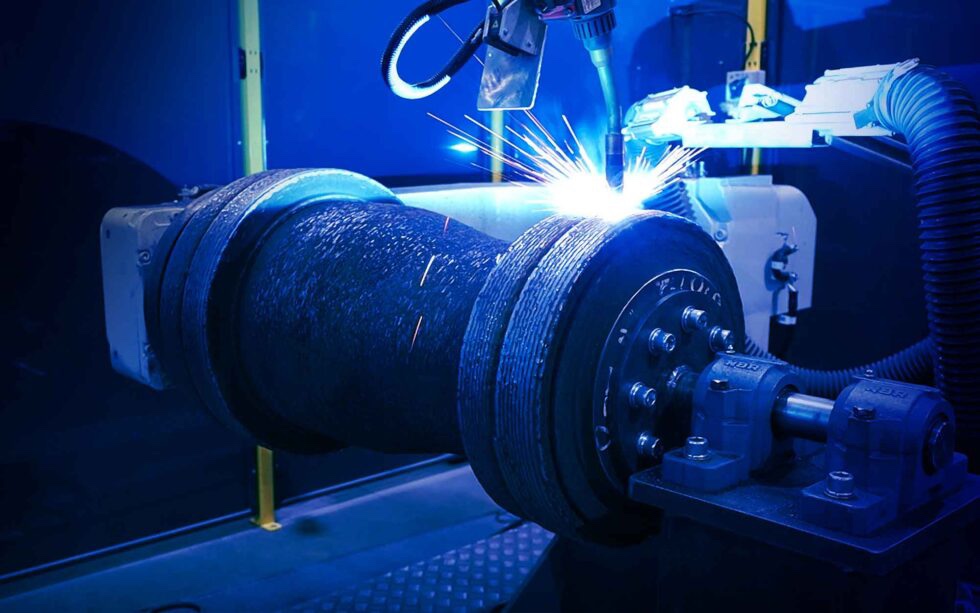
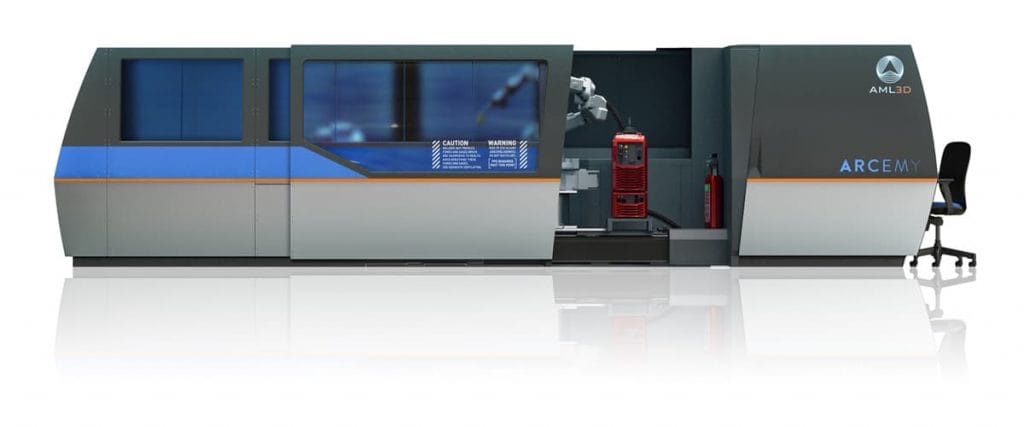
To meet its deadline within such a compressed timeframe, AML3D states that it will be devoting up to 75% of the capacity of its Adelaide facility exclusively to the part. Moreover, five out of the facility’s eight installed Arcemy machines will be used for the job. The Arcemy is AML3D’s proprietary system for AM-driven wire arc melding.
Largely due to its inextricability from all other industrial and commercial processes — as well as, quite simply, consumer demand in general — the dynamics shaping the oil and gas market are more complex than in any other sector. Such uniquely volatile supply and demand pressures are currently making a compelling argument for increased incorporation of digital supply chains in general, and AM in particular, in the oil and gas industry.
In addition to the present example, this year, Chevron has used AM to procure right-on-time replacement parts for one of its refineries in the U.S., which allowed the corporation to avoid output delays. At the RAPID + TCT event in May, metal parts for oil and gas production were one of the most commonly-touted applications for metal AM. And Shell has used AM to produce impellers for its Dutch refinery, after becoming, last year, the first European company to receive third-party certification for a printed part, from LRQA (formerly Lloyd’s of London). LRQA also certified the first version of the AML3D part that was produced last November. According to “The Market for Additive Manufacturing in the Oil and Gas Sector 2018-2029” report from SmarTech Analysis, 3D printing for the oil and gas industry could represent a $2 billion revenue opportunity by 2029. Large-format 3D printing may play a crucial role, as SmarTech’s “DED and Large-Format Additive Manufacturing Markets: 2021-2030” report projects that this sector will be worth $739 million in 2026.
The entire world is presently struggling from the price volatility created by fluctuations in the oil market. In simplest terms, the increase in price catalyzes more production, which — if not supported by equivalent demand — quickly leads to price swings in the opposite direction, in turn leading production to plummet once more, etc. Long-term planning is thus hampered in the area of the economy where it’s probably most necessary. AM won’t solve this, but it will give companies a powerful weapon in their toolkits for remaining agile in the face of continued supply chain disruptions.
Images courtesy of AML3D
Subscribe to Our Email Newsletter
Stay up-to-date on all the latest news from the 3D printing industry and receive information and offers from third party vendors.
Print Services
Upload your 3D Models and get them printed quickly and efficiently.












You May Also Like
Beyond Thermoplastics: Why JuggerBot Is Betting on Hybrid AM
For years, thermoplastics have been the workhorse of additive manufacturing (AM). They are pretty easy to process, available, and compatible with many of today’s industrial 3D printers. From prototypes to...
RIC Robotics Collaborates with K4k Construction on 3D Printed ADU in Sacramento
In 2024, RIC Robotics, the additive construction (AC) firm based in Denver, completed the build of an accessory dwelling unit (ADU) in Walnut, California, which was apparently an industry first....
Printing Money Episode 40: 3DP/AM Deal Analysis and More with Matthias Schmidt-Lehr, AMPOWER
Welcome to Printing Money Episode 40. Matthias Schmidt-Lehr (AMPOWER, Executive Partner) joins Danny for this episode and we are very thankful to have him back. In Episode 40, Danny and...
Additive Manufacturing at a Crossroads
Additive manufacturing is at a crossroads. Simultaneously, we find ourselves between certain very different modalities, applications, and industries. Rather than being able to explore them all, companies will now have...