Shell 3D Prints Impellers for Its Dutch Refinery

The oil and gas industry hasn’t adopted additive manufacturing (AM) techniques to the same extent as some other large-scale industries, like the aerospace and automotive sectors. Nonetheless, oil and gas companies were fairly early adopters of AM, and some of the largest companies have made substantial investments in the technology.
Moreover, it appears that, with investor money gradually starting to return to the sector, oil and gas companies are picking up the pace with which they incorporate new manufacturing processes. One such company is Shell: among the largest companies in the world, and a user of AM for over a decade. According to the company’s 3D printing technology lead, Angeline Goh, Shell recently put into action 3D printed impellers for a centrifugal pump at the Shell Energy and Chemicals Park in Rotterdam.
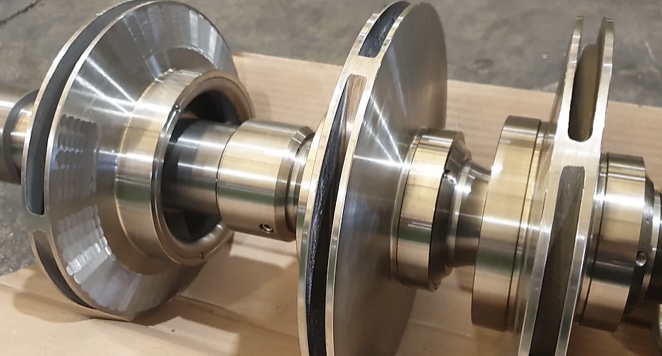
In a press release, Goh explains, “[AM] has been used at Shell over the last ten years. Still, the criteria and testing to ensure the technical integrity of 3D printed parts remains very demanding. It is not easy to qualify a 3D printed part for deployment in our operations, especially for production critical applications.”
This is why, on an earlier project, Shell worked for four years to gain third-party certification of its 3D printed pressure vessels. When Shell gained certification from LRQA (formerly Lloyd’s register) for the pressure vessels, it became the first European company to have a CE certified, in-house printed part.
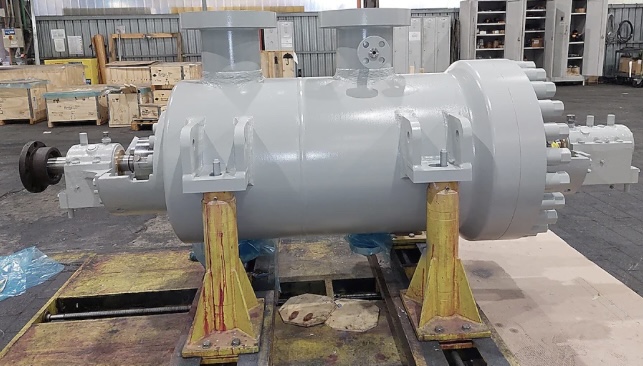
On the 3D printed impellers project, Shell also worked with Texas-based Baker Hughes, one of the largest oilfield services firms in the world. Similarly to the work on the pressure vessels, Goh notes that, “A key objective of this collaboration…was to design a repeatable qualification process for vendors of 3D printed parts.” She adds that Baker Hughes has been qualified by Shell to supply the company’s oil operations in Italy, and that the two firms are working together to create a digital portfolio of impellers.
Keeping spare parts on hand for each pump in operation costs Shell about $100,000, so switching to a digital, print-on-demand supply chain could obviously save a great deal of money. This is especially important at a time when oil supermajors are trying to attract investor dollars, and thus need to prove that they can streamline and effectively manage supply chains. The oil industry also operates in remote locations all over the planet, adding an extra incentive for a company like Shell to take its inventory control into its own hands.
That this story, as well as one last month from Chevron, have been released in such close proximity to one another, suggests that the oil and gas industry has entered a new phase in its incorporation of 3D printing. The fact that regulatory requirements for 3D printed parts are now being established and met means that more and more companies are likely to follow suit. It’s no surprise then that SmarTech Analysis projects AM for oil and gas to be a $2 billion opportunity by 2029, according to its “The Market for Additive Manufacturing in the Oil and Gas Sector 2018-2029” report.
Subscribe to Our Email Newsletter
Stay up-to-date on all the latest news from the 3D printing industry and receive information and offers from third party vendors.
Print Services
Upload your 3D Models and get them printed quickly and efficiently.













You May Also Like
3D Printing News Briefs, October 10, 2026: Drones, WAAM, Ceramics, & More
We have a packed 3D Printing News Briefs for you this weekend! First, America Makes celebrated the recent National Manufacturing Day with 3D printed drones, and then it’s on to...
10 Years of Multi Jet Fusion: Onsite at HP’s Vancouver, Washington Facility
At this year’s RAPID event in Boston, HP Additive Manufacturing Solutions celebrated ten years in the additive manufacturing (AM) market. The company ushered in the milestone with several innovations, including...
PharmaTher Plans U.S. Network to 3D Print Medicines on Demand
3D printing medicines has often been tied to the idea of personalization, basically making a pill in the right dose, shape, or drug combination for a patient. PharmaTher is now...
3D Printing News Briefs, September 17, 2026: 3D Printed Boat, UAS Development, & More
We’ll start with maritime manufacturing in this week’s 3D Printing News Briefs, and continue on to defense 3D printing. We’ll end with funding for Tripo AI. Read on for all...