First Load-Bearing Metal 3D Printed Spare Part for Airplanes Unveiled by Lufthansa and Premium AEROTEC

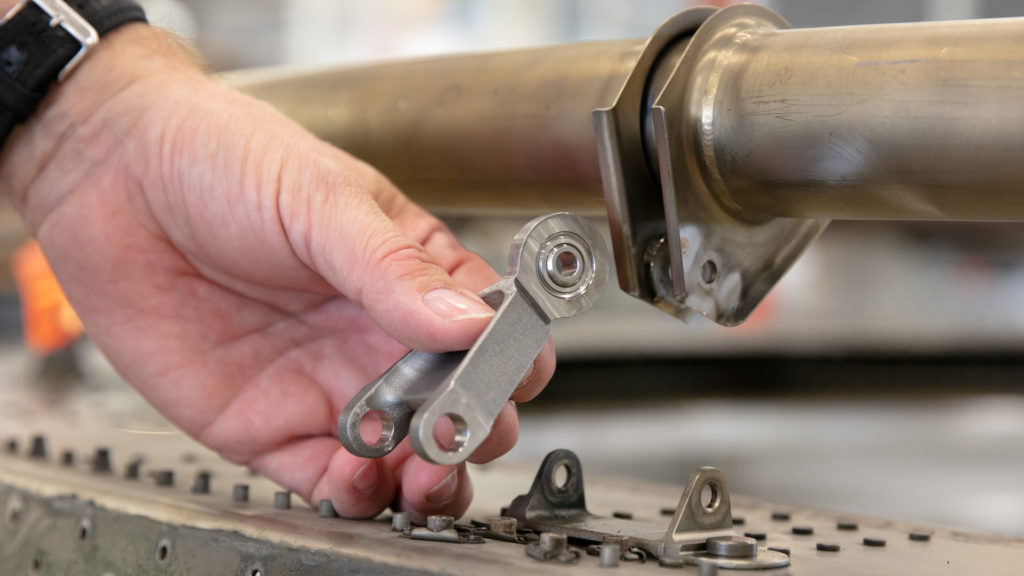
The part is called an “A-Link,” nine of which fix a circular hot air duct within the engine’s inlet cowl, in turn protecting it from ice buildup. Traditionally made with forging, these A-links, tend to wear at their mounting holes due to the vibrations that occur, necessitating replacement every few years. Now, Lufthansa and Premium AEROTEC have 3D printed spares with laser powder bed fusion (LPBF). The companies report:
¨Premium AEROTEC carried out a large number of so-called ‘print jobs’ with test specimens, with constant settings of all process-relevant parameters. This way, it was finally possible to establish a constant and reliable process and to prove that the highest requirements in terms of material properties are also achieved here. In terms of tensile strength, the additively manufactured A-Link is even superior to the original part.¨

This component is to be used on the Lufthansa fleet and marks the first time that Premium AEROTEC is making a 3D printed part available outside of Airbus. In this case, they’re being applied to engines made by International Aero Engines, a joint venture between Pratt & Whitney, Rolls-Royce plc, the Japanese Aero Engine Corporation and MTU Aero Engines.
“Premium AEROTEC is an international pioneer and technology leader in the additive manufacturing of aerospace components. Our company has already been applying this technology in the series production of complex structural components since 2016. I am very pleased that in cooperation with Lufthansa Technik we can now once again demonstrate our comprehensive expertise in 3D printing,” said Ulrich Weber, Chief Operating Officer at Premium AEROTEC.
“We have been producing components for the aircraft cabin, the vast majority of which are made of plastic, using 3D printing for years. Now we are able to demonstrate that structurally relevant metal parts for use outside the cabin can also be manufactured additively and approved for flight operations. In this way, we have not only achieved a cost saving for the component in question, but also defined and qualified all the necessary processes for the application of this groundbreaking manufacturing method for structurally relevant metal parts,” said Soeren Stark, Chief Operating Officer of Lufthansa Technik.
This first load bearing part is a huge step and means that we now potentially have load bearing parts flying on passenger aircraft. This is both exciting and terrifying. Lufthansa Tecnik has a near unassailable lead in terms of respect within maintenance circles. The large German aircraft MRO and outfitter has a stellar reputation. Premium Aerotec is an aerospace Tier 1 aero structures supplier and an Airbus subsidiary. Therefore, I know that everyone crossed their “t’s” and dotted their “i’s” on this. Their combined experience and technical nous is world-leading in their fields.
However, as a 3D printing person, part variability in the build means that I’m intensely skeptical of any long-term load bearing parts. Internally, components could still have some variability and respond differently to loads over time. This is a huge leap, but we’re in the the big leagues now. Lives are in our hands, this time.
Subscribe to Our Email Newsletter
Stay up-to-date on all the latest news from the 3D printing industry and receive information and offers from third party vendors.
Print Services
Upload your 3D Models and get them printed quickly and efficiently.













You May Also Like
The Manufacturing Race Behind the Drone Revolution
We are in the middle of a major manufacturing shift focused on the production speed and payload capacity of uncrewed aerial systems (UAS), or drones. A recent Manufacturing Dive article...
ADDMAN to Buy Up to $10.8M in Nickel 718 Powder from 6K Additive Over 30 Months
After years of buildup, we’re finally starting to see what the US metal additive manufacturing (AM) market could look like at scale. To be sure, it’s still not quite there,...
Metal AM in a Multipolar World, Part 2: How PBF and DED Could Change by 2035
The first decades of PBF development were heavily shaped by machine capability: more power, more lasers, larger build volumes, better recoating, and improved process monitoring. These developments will continue, but...
Advanced Manufacturing at IMTS 2026: 3D Printing and AI and Drones, Oh My!
Last week’s International Manufacturing Technology Snow (IMTS) in Chicago welcomed over 90,000 attendees to the jungle that is McCormick Place. With over 1.17 million square feet of exhibit space, and...