ESA’s New Microgravity 3D Printer Could Revolutionize Space Manufacturing

A ground-based prototype for a new microgravity 3D printer is now complete and awaits deployment to the International Space Station (ISS) for testing. Capable of 3D printing parts much larger than itself, the new machine dubbed IMPERIAL overcomes one of the main constraints of current off-Earth 3D printers, limited build volume.
Up until now, we have been amazed by a handful of additive manufacturing (AM) systems that have successfully built components in orbit, such as Made In Space (now part of Redwire)’s Additive Manufacturing Facility (AMF), which became operational in space in 2016, or Tethers Unlimited Refabricator 3D printer onboard the ISS. Now the European Space Agency (ESA) announced that its highly anticipated IMPERIAL 3D printer model is finalized. Once at the ISS, the 3D printed parts could demonstrate extraterrestrial manufacturing potential, enabling new maintenance and life support strategies for human space flight.
Built to operate in weightlessness––meaning it can work upside down on Earth––the printer is capable of creating high-performance polymer parts of unlimited dimensions along a single direction and with mechanical and thermal properties like PEEK. Moreover, according to the technical characteristics of the machine, it can develop large parts with minimal waste that are ready to use directly after their removal from the 3D printer, as post-processing would imply the presence of additional dedicated facilities.
The project was undertaken for ESA by a consortium led by German space technology firm OHB SE, with Berlin-based space engineering company Azimut Space; the Athlone Institute of Technology in Ireland, and Portuguese 3D printer manufacturers BEEVERYCREATIVE. Now that the ground-based prototype is complete, the next step would be to test it in orbit aboard the ISS.
Commenting on the development, OHB SE Project Manager Antonella Sgambati noted that “fused filament fabrication with high-performance polymers has been already demonstrated to be unimpacted by a reduced gravity environment, paving the way for new challenges such as the possibility to print unlimited parts in one direction or else exploit batch production. In the frame of the project, new technological gaps have been identified and covered by development and prototyping testing at BEEVERYCREATIVE which led to this unique achievement, bringing out-of-Earth manufacturing one step closer.”
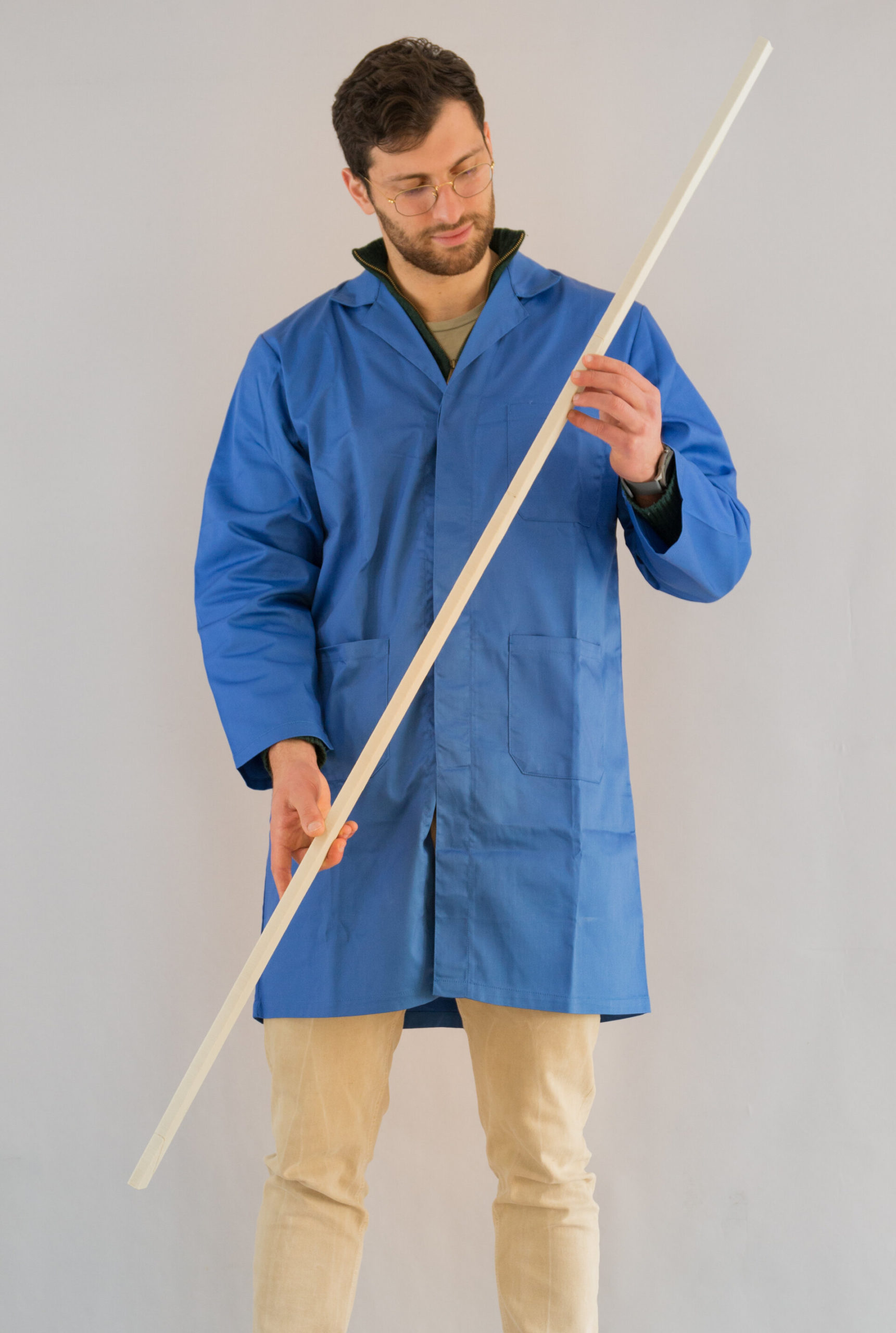
ESA engineer 3D prints a pillar that is longer than the 3D printer’s size. Image courtesy of ESA.
One of the biggest accomplishments of the team behind IMPERIAL is that it can print under microgravity conditions with a quality comparable to printing under nominal circumstances. Moreover, the developers designed the 3D printer to fit the available upload configurations and corresponding loads. Taking into account the environmental, interface and operations, and safety requirements of the ISS, the technology was selected based on the resources available onboard the ISS. And since the station is permanently occupied by a crew of at least seven people, IMPERIAL said the machine guarantees their general health and safety.
This is not the first time ESA and this same international consortium have worked together. Back in 2018, the team presented MELT, short for Manufacturing of Experimental Layer Technology, a fully functional 3D printer prototype able to work under the ISS’s microgravity conditions and 3D print with engineering polymers with high-end mechanical and thermal properties. Project MELT was successfully delivered to the ISS in 2018 as a fully functional microgravity 3D printer prototype.
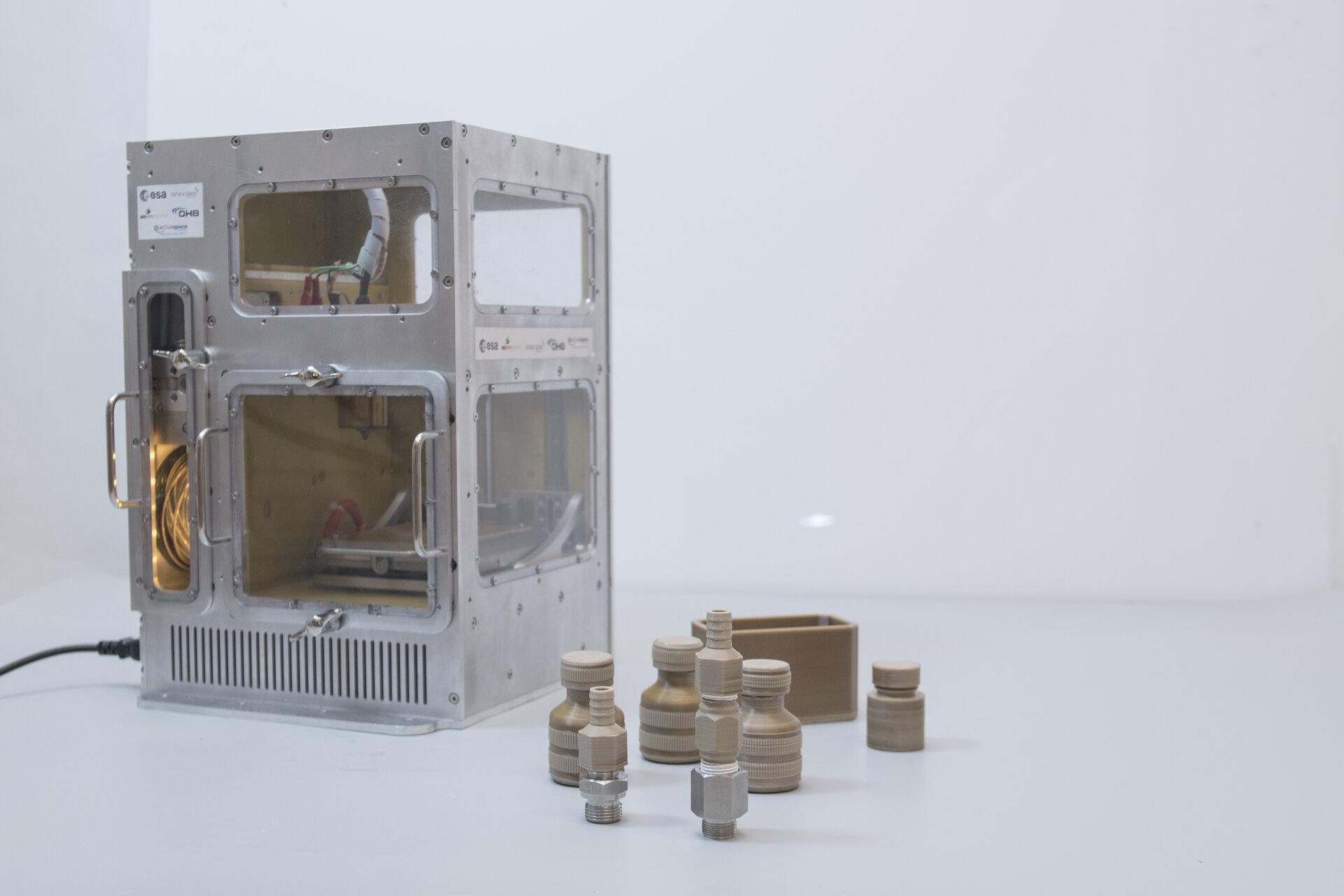
ESA’s MELT project printer for off-Earth 3D printing. Image courtesy of ESA.
Much like its predecessor, the IMPERIAL project found the team working once again to supply off-world crews with a fully functioning 3D printer model that uses engineering thermoplastics, but this time, it has the added advantage of alleviating build volume constraints. Structurally the two 3D printers are similar, but IMPERIAL goes one step further by releasing the 3D printed part as it is printed, and that advantage will make a huge difference to future space explorers that will require machines to churn out spare parts or tools that might exceed the size of the printer.
Once operational, IMPERIAL could contribute to increasing the autonomy and sustainability of future long-duration space missions. Or as BEEVERYCREATIVE’s Chief Technology Officer Mario Angelo pointed out “this new project is a validation of our ability to develop technology in an area [aerospace] which will certainly have a great impact on our future lives.”
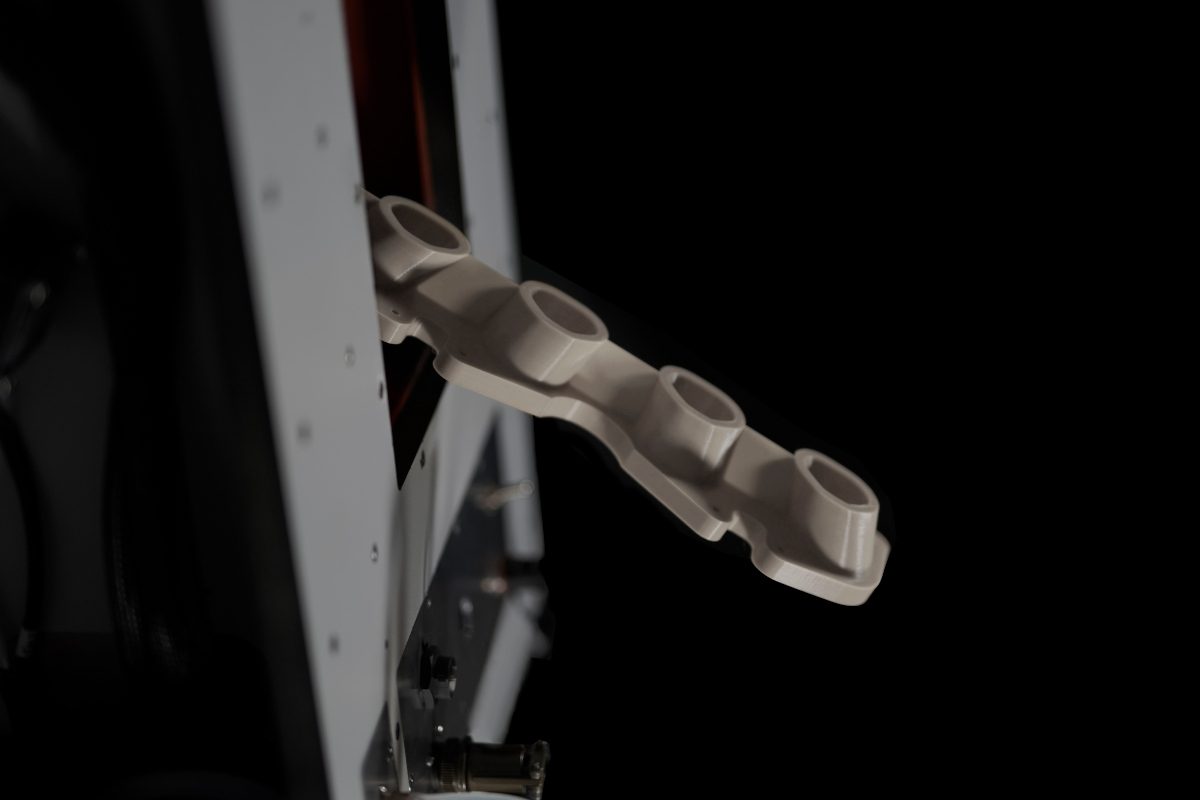
IMPERIAL 3D printer churns out parts. Image courtesy of BEEVERYCREATIVE.
Even though the platform will travel 248 miles for testing aboard the station, the technology itself and the knowledge gained from the IMPERIAL project could be leveraged to develop new, industry-oriented 3D printers for product development needs right here on Earth. In fact, facilitating the commercialization of space technology in non-space markets is quite common. NASA for example has turned plenty of space ideas into Earth-bound products. As promising space technologies continue to emerge, advanced products will trickle down into many other non-related industries that will benefit from time and cost reductions in manufacturing processes.
Subscribe to Our Email Newsletter
Stay up-to-date on all the latest news from the 3D printing industry and receive information and offers from third party vendors.
Print Services
Upload your 3D Models and get them printed quickly and efficiently.













You May Also Like
Bambu Launches A2L: What the New Printer Reveals About Its Strategy
Bambu Lab continues its relentless march for 3D printing domination with the launch of the A2L. The 330 × 320 × 325 mm printer will have a nozzle temperature of...
3D Printing News Briefs, May 30, 2026: RIMPAC 2026, Acquisition, Ceramic Implants, & More
We’re kicking things off with materials news in this weekend’s 3D Printing News Briefs. Then it’s on to a hybrid manufacturing system for a maritime exercise, an expansion of industrial...
3D Printing News Briefs, May 28, 2026: Continuous Fiber Reinforcement, Bioprinted Trachea, & More
In today’s 3D Printing News Briefs, America Makes announced the winners of its JAQS-SQ Project Call. Axtra3D is partnering with Keystone Industries to expand its dental material ecosystem, while BigRep...
Peopoly Unveils $15,000 Giga 800 FGF 3D Printer for Large Pellet Prints
Peopoly is known for its Magneto X, a printer that eschews belts and uses linear motors instead. The company also has a vat polymerization system, and now is moving into FGF...