Innovators in Residence Program for DLP 3D Printing Launched by IN-VISION

IN-VISION Technologies AG, based out of Austria and Boston, is a leader in high-precision optical systems and light engines for Digital Light Processing (DLP) 3D printing. Now, the company, which converted into a stock corporation in October as part of its expansion strategy, wants to share its DLP knowledge with other innovators who are interested in the applications that this technology opens up. That’s why IN-VISION has launched a new program, called Innovators in Residence, which is now accepting applications from the microfluidics, bioprinting, and biofabrication fields.
“Our DLP light engines have shown to be an amazing enabling technology, that provides our customers with the means to realize new ideas and generate innovations in many different areas. Who knows what the future will bring? We are ready for tomorrow’s applications now, that’s why we are launching the Innovators in Residence program,” Florian Zangerl, the CEO of IN-VISION, explained in a press release.
“Our team is ready to help and share their knowledge and love of precision light!”
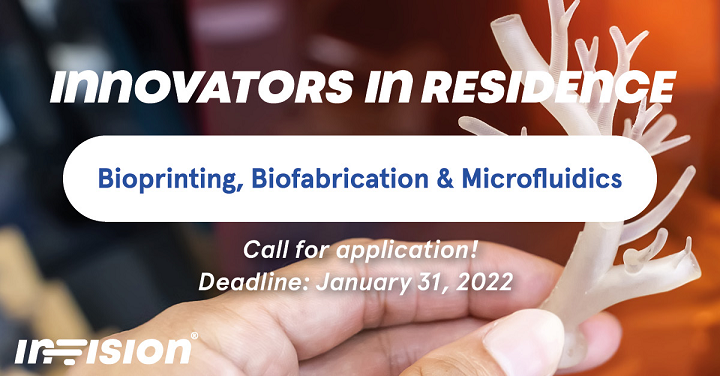
The overall goal of the company’s new Innovators in Residence program is to, according to IN-VISION, “spur collaborations,” in addition to speeding up “the emergence of promising applications based on structured light.” Ever since it was first invented in the late 1970s, DLP projection has been responsible for a number of interesting applications, including digital cinema project, machine vision, 3D scanning, bioprinting, calculators, microcontrollers, and 3D printed orthotics.
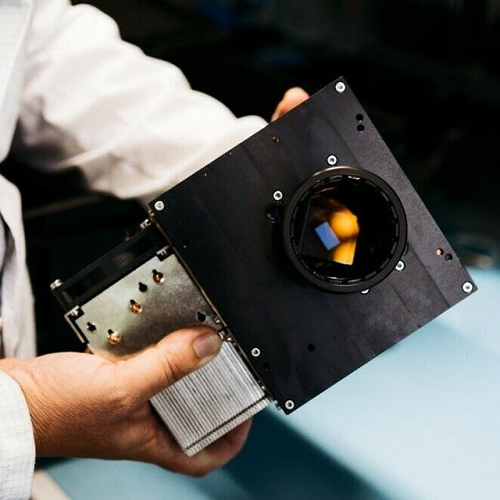
IN-VISION has been a design house partner for Texas Instruments (TI) for more than two decades, during which time it’s collaborated with a lot of different research labs and companies. The Austrian DLP specialist has learned a lot during its time working with TI’s micromirror arrays, and has also shared its expertise of fast, high-precision DLP projection, and how it can be used to improve fields like metrology and lithography. Now, with its new Innovators in Residence program, the company can share its knowledge with others.
Karine Blandel, the Senior Manager in charge of IN-VISION’s new Innovators in Residence program, stated, “Researchers, students, and innovators from university labs, startups and private companies are most welcome to apply. We are very much looking forward to the ideas applicants will want to test. It can be anything from testing new materials to developing a new 3D-printer or software, or any other new application that nobody has thought about yet.”
As mentioned previously, the first call for applications to the program will focus on biofabrication, bioprinting, and microfluidics which the company chose because they “have the potential to enhance our healthcare and quality of life through digital and personalized patient solutions.” Those who are chosen to participate can expect an immersive experience in DLP optics, with the opportunity to work at IN-VISION’s facilities in the South of Vienna with the company’s interdisciplinary team of electronics, mechanical design, and optics specialists.
“As an Innovator in Residence, you will have access to our R&D lab incl. our DLP projectors. The configuration of the projector will depend on your application,” the program website states.
“The only requirement is to have an idea for a new DLP-based application. It can be anything from testing new materials to developing a new 3D-printer or software, or any other cool application that you can think of.”
The deadline for applications for the Innovators in Residence program’s first topic call is January 31st, 2022; a second call for different topics will come later this year.
Subscribe to Our Email Newsletter
Stay up-to-date on all the latest news from the 3D printing industry and receive information and offers from third party vendors.
Print Services
Upload your 3D Models and get them printed quickly and efficiently.











You May Also Like
StoneFlower 3D Launches Laboratory-Scale 3D Printer for Construction Materials
StoneFlower 3D has launched a new 3D printer designed for laboratory-scale research and development with concrete, mortars, clays, and other advanced mineral materials. The system is intended for researchers, designers,...
3D Printing News Briefs, February 7, 2026: Generative AI, USVs, Microgravity, & More
Today’s 3D Printing News Briefs is a bit of a mixed bag. We’re starting with generative AI tools for 3D design from MIT, and then news about USVs. Moving on,...
Breaking the Bottleneck: How Automated Post-Processing Is the Key to Scalable Dental 3D Printing
The dental industry has undergone a dramatic transformation over the past decade. Traditional fabrication methods, such as manual casting, milling, and hand finishing, are being steadily replaced by digital workflows...
3D Printing News Briefs, February 5, 2026: Advisory Board, Virtual Twins, & More
We’re starting with business in today’s 3D Printing News Briefs, including a new website launched by Metamorphic AM. Massivit appointed two senior leaders to its advisory board, and Dassault Systèmes...