3D Printing Market Set for Biggest Q4 in History, Says SmarTech Analysis

According to the latest quarterly data report from SmarTech Analysis, the 3D printing industry’s third quarter of 2021 is continuing a trend of “robust recovery”. Metals expanded by about 18 percent compared to 2020, while polymers grew by 12 percent. All combined—including additive hardware, materials and services—the sector grew by 15 percent over the course of nine months compared to the first three quarters of 2020. Revenues over the same period grew about two percent versus pre-pandemic levels. This has led the additive manufacturing (AM) sector’s leading market research firm to anticipate Q4 of 2021 leading to the industry’s biggest calendar year in terms of revenues.
This information is available in SmarTech’s newest quarterly report on the metal and polymer AM markets, which is available as a one-time purchase for non-subscribers at the SmarTech website. The firm has been tracking critical market metrics regularly since 2017, establishing the most insightful database for 3D printing. Subscribers are able to access this information on a quarterly basis so they can track trends and segment performance.
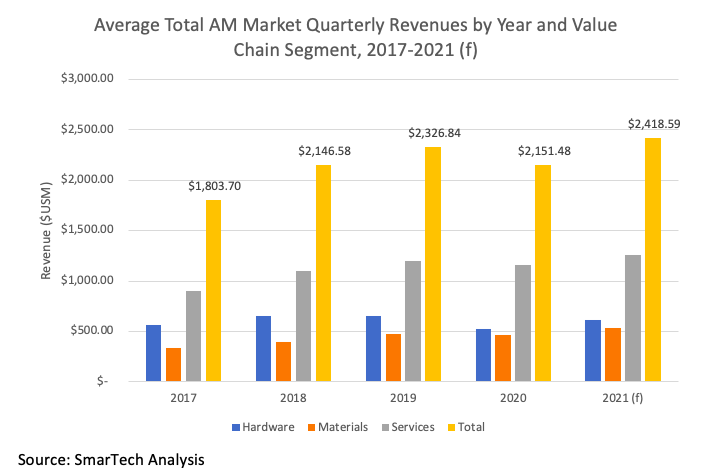
The report describes in detail how larger trends in the global economy are propelling the 3D printing market forward for 2022. This comes despite the fact that supply shortages, inflation, and energy-related issues in China have resulted in a number of uncertainties globally, driving businesses to remain cautious. It is in fact due to supply change challenges that there is an opportunity for manufacturers to rely on additive and other solutions. Because industrial suppliers and contract manufacturers, such as Ipsen, Acerinox Group, Oerlikon, Trumpf and others, had very positive results for H1 2021, SmarTech anticipates renewed corporate spending toward innovation and manufacturing throughout a number of verticals in 2022.
The rebound in metal 3D printing continues, as the sector expanded from Q2 and from 2021 numbers. SmarTech noted that only three businesses in this segment did not grow from last quarter and all but three others achieved year-on-year growth compared to last year.
Two key acquisitions in Q3 shook up the polymer 3D printing space: Desktop Metal’s purchase of Aerosint and Essentium’s purchase of Collider. SmarTech suggests that this reflects a greater desire to have diversified offerings in the polymer AM market, as they can “cast a relatively broad net in order to capture as much of the enormous potential upside of AM opportunities as possible.”
Of course, most market analyses are going to generally anticipate greater growth forever. All businesses have fiduciary duties to their investors to keep generating profit, which entails expansion. In this case, it’s hard not to agree with SmarTech’s predictions, given the immense excitement in the industry right now. The slew of SPACs, mergers, acquisitions, private investments have provided plenty of investment capital for these companies to keep growing. It’s possible that the AM industry will deflate once more in the near future, but for at least the next year or so, we should be good.
To learn more about SmarTech’s quarterly data services or to purchase a single report, visit the SmarTech Analysis website here.
Subscribe to Our Email Newsletter
Stay up-to-date on all the latest news from the 3D printing industry and receive information and offers from third party vendors.
Print Services
Upload your 3D Models and get them printed quickly and efficiently.











You May Also Like
“A More Complete End-to-End Solution”: Stratasys Launches Post-Processing Partnership Program
I think it’s safe to say that post-processing is no longer considered the “dirty little secret” of 3D printing that it once was, with users realizing that finishing is just...
Why SiC-Dedicated Additive Manufacturing Is Gaining Industrial Relevance
Silicon carbide is not a material problem—it’s a manufacturing one. Silicon carbide (SiC) has become a critical material across semiconductors, aerospace, energy, and defense. Its exceptional thermal stability, chemical resistance,...
Championing a Made-in-America Future for Additive Manufacturing
As the additive manufacturing industry continues its rapid global evolution, one theme has risen to the top of strategic conversations: the importance of strengthening domestic production to support national competitiveness...
Friendshoring and Additive Manufacturing: Turning Australia’s Research Strength into Commercial Impact
Global supply chains are being re-written. After decades of globalisation driven primarily by cost efficiency, geopolitical tensions, trade disputes and pandemic-era disruptions have exposed the risks of concentrating manufacturing and...