3D Printing Shrinks Lab-on-a-Chip Devices Even Smaller

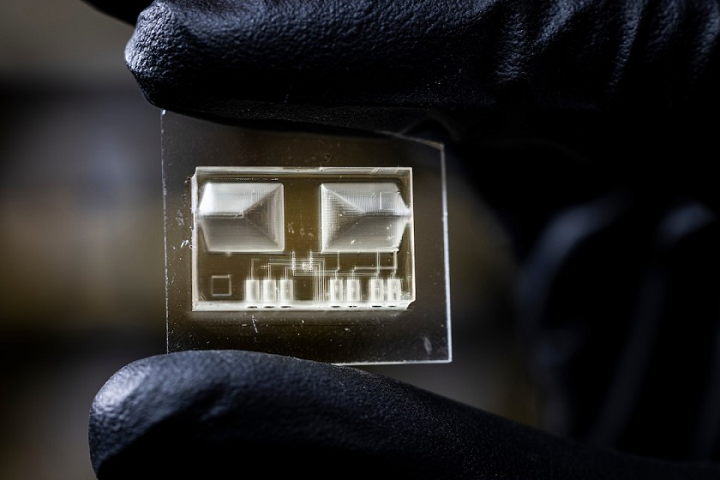
Microfluidic devices are tiny microchips that have almost completely microscopic channels, pumps, and valves etched into them for the purposes of sorting and analyzing cells, disease biomarkers, and other miniature structures from liquids. Researchers at Brigham Young University (BYU) have been working with microfluidics for several years now, and recently demonstrated a new 3D printing process to create microfluidic lab-on-a-chip devices with valves and channels measuring only 15 microns in size, which they claim is smaller than any ever made before, yet still completely functional.
“We have taken the conventional 3D printing approach and generalized it to something that is broader in scope and has significantly more capability. This kind of expansion of the 3D printing paradigm to something beyond the traditional approach is what has enabled us to do all this miniaturization and integration,” said BYU engineering professor Greg Nordin.
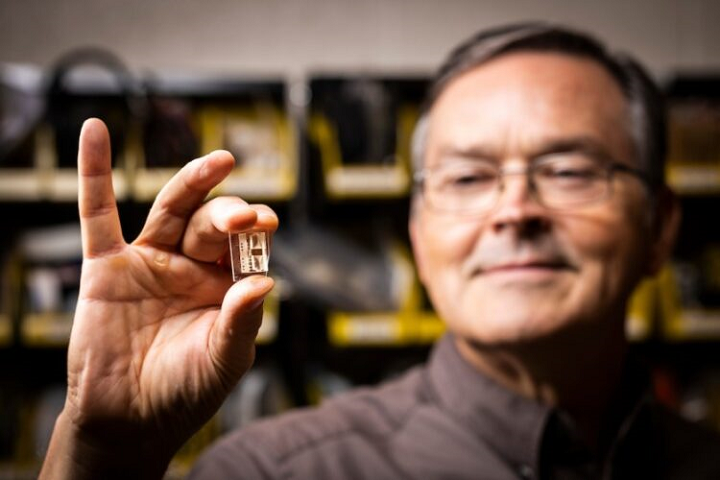
Engineering professor Greg Nordin and a team of students and professors have found a way to 3D print microfluidic devices smaller than ever before, yet fully functional.
Nordin and the rest of the interdisciplinary team of students and professors published a paper in Nature Communications that describes their new generalized 3D printing process, which makes it possible to create 3D components at a much higher resolution without having to expand the actual printer’s resolution.
Applications like rapid blood diagnosis could certainly benefit from the development of smaller microfluidic devices, but Nordin says that most commercial 3D printers can’t achieve the necessary tiny size of the valves and channels. According to him, 27 microns is usually the smallest that even the most sophisticated of commercial 3D printers can achieve. But the BYU team’s new 3D printing technology was able to print microfluidic lab-on-a-chip devices down to 7.6 microns.
“The bottom line is that commercial 3D printers and commercial materials just can’t meet the resolution needs we have for this type of technology. We’re printing chips with sophisticated components that have 60-70 tiny valves and 20-30 pumps — components that couldn’t be printed before now,” Nordin explained.
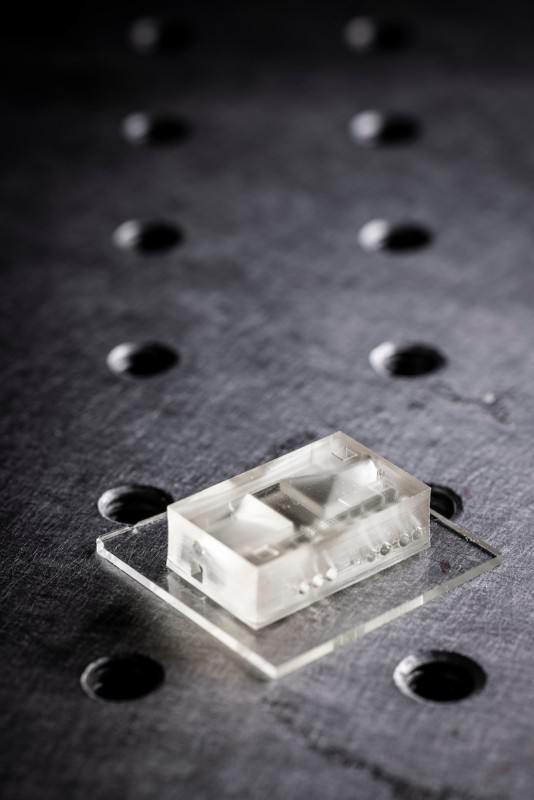
The team, which included several undergraduate students, achieved their breakthrough by changing up how the 3D printed layers on the chip are stacked. While most traditional 3D printing processes fabricate uniform layers, this method adjusted the number, order, and thickness of the stacked layers. Just by doing this, the BYU researchers say that their lab-on-a-chip device can be printed at a much smaller scale, and for much less money as well.
Another potential major benefit of the team’s work in achieving tiny 3D printed lab-on-a-chip devices is more accessibility in microfluidics research. For instance, cleanrooms aren’t necessary when using a 3D printer to make the devices, and because the cost of fabrication should go down, more people will be able to work with microfluidics, hopefully leading to more innovative progress and discovery.
“People have been working on lab-on-a-chip devices for 20+ years, but making prototypes in cleanrooms is an inhibitor to success. The road to market stops with clean rooms. With 3D printing, there is a road to market,” Nordin said.
“Our new approach gets you over some of the big hurdles that block using this technology in real world applications. We have yet to see that someone takes that and runs with it, but we certainly hope they will.”
The team’s exciting development is already making a positive impact in terms of future work at the university—right now, Nordin is paving the way for multidisciplinary research with six other professors at BYU to gain a better handle on what this new 3D printing method can be used to achieve, including setting up treatment plans for patients with lung disease, more accurately concluding preterm birth biomarkers, and understanding cell and tissue activity on a much smaller scale.
(Source/Images: BYU)
Subscribe to Our Email Newsletter
Stay up-to-date on all the latest news from the 3D printing industry and receive information and offers from third party vendors.
Print Services
Upload your 3D Models and get them printed quickly and efficiently.











You May Also Like
Campbell’s Exec Fired After “3D Printed Chicken” Claim — But What’s Really Going On?
Campbell’s is dealing with an unusual crisis this week, and somehow 3D printing ended up in the middle of it. It all began when a former employee, Robert Garza, released...
3D Printed Food for Those with Chewing Difficulties Now Available for Home Delivery
One interesting but overlooked use of 3D printing is in special food for hospitals and care facilities. This is a big potential market, as through additive, foods can be enriched...
UMAMI Bioworks to 3D Print Cultivated Fish Pet Food
UMAMI Bioworks is partnering with Friends & Family Pet Food Co. to produce 3D printed pet food. They will start with cat treats, which will be introduced to the markets...
3D Printing News Unpeeled: Tails, Wasteful 3D Prints & Salmonella
A photo on Reddit of a user making a color 3D printed model and getting 15 times the amount of waste has sparked a mini debate. But, with a 1000...