Ricoh & IBM Launch New Workflow Solution for 3D Printed Anatomical Models


This spring, Ricoh USA, Inc. partnered with enterprise imaging solution IBM Watson Health to develop an end-to-end solution for 3D printing anatomical models. It seems this partnership is continuing, as today Ricoh USA has announced RICOH 3D for Healthcare, a new workflow solution that integrates with IBM iConnect ® Access from IBM Watson Health to make it easier to develop, design, and fabricate accurate 3D printed anatomic models. With easier access to custom, patient-specific anatomic replicas, physicians will be able to better connect with their patients over complex surgical procedures, and get a closer look at what they’ll be working on in the operating room as well.
“Currently, access to 3D-printed models is limited to very few healthcare organizations, meaning the vast majority of clinicians – and their patients – cannot benefit from this critical tool. RICOH 3D for Healthcare offers a turnkey and cost effective solution that can drastically expand access to 3D models and allow healthcare providers at any size facility to learn from and inform the overall patient experience,” Gary Turner, Managing Director, Additive Manufacturing, North America, Ricoh USA, Inc., explained in a press release.
Though Japan-based Ricoh has been working with 3D printing since 2014, it wasn’t until 2017 that the multinational imaging and electronics company announced a shift in focus to AM technology, and shift it has. This year alone, Ricoh and its branches in various countries have worked on generative design, composite 3D printing, materials, and more, and in 2019, Ricoh bought 34.5% of Baltimore-based bioprinting company Elixirgen Scientific, Inc. That move towards bioprinting and the healthcare industry hasn’t slowed down either, with the company creating a DNA plate for genetic testing and continuing to work with IBM on 3D printed anatomical models.
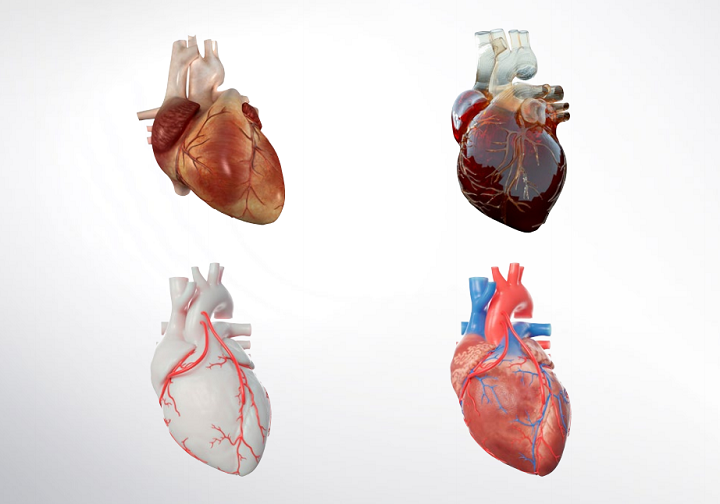
With the 3D printed lifelike replicas resulting from this new end-to-end workflow, healthcare providers around the country will have the capability to develop and print patient-specification representations of bone and tissue, which will act as what Ricoh calls a “physical simulator” to give physicians a closer look inside a patient’s anatomy, and help them explain procedures to their patients. Any facility that has access to IBM iConnect Access should be able to pick up the 3D printed model process pretty quickly, because it uses the existing enterprise imaging solution that’s already used to view patient’s studies.
“We democratize access to these critical tools by providing seamless interoperability between the institution’s native EMR, radiology PACS, DICOM viewer and Ricoh 3D’s Printing Case Management Portal,” the company said about its new RICOH 3D for Healthcare Solution.
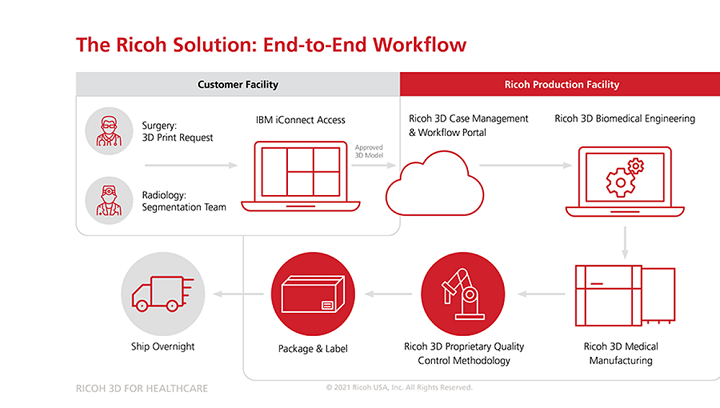
As you can see in the image above, the RICOH 3D for Healthcare workflow is fairly simple, starting with a 3D print request from the surgery/radiology care team. 3D print files can be uploaded to Ricoh’s HIPAA-compliant portal, and Ricoh will then prepare segmented files for 3D printing. Once the care team provides final approval, the files are sent to Ricoh’s production specialist and output on Stratasys technology for printing. Ricoh’s 3D printing service can be accessed directly from IBM iConnect Access, which streamlines the process, and after the 3D printed model goes through Ricoh’s quality control measures, it’s packaged up and sent out for overnight shipping. It is important to note, however, that these 3D printed models are for non-diagnostic/treatment use only.
RICOH 3D for Healthcare offers fast, accurate 3D printed anatomical models that only require a small initial cost. In addition, surgical education simulation labs and medical schools can also use the new workflow, and connect students and residents with lifelike, cadaver-free replicas of specific case studies. This new solution from Ricoh USA and IBM Watson Health will be available starting in September, and will also be demonstrated at the American Academy of Orthopaedic Surgeons (AAOS) 2021 Annual Meeting in San Diego this week, in Booth #4251.
Subscribe to Our Email Newsletter
Stay up-to-date on all the latest news from the 3D printing industry and receive information and offers from third party vendors.
Print Services
Upload your 3D Models and get them printed quickly and efficiently.













You May Also Like
Metal 3D Printers for the Desktop Are Finally Starting to Feel Like Desktop Products
FDM 3D printing is becoming increasingly accessible, yet metal 3D printers designed for everyday desktop use remain rare on an ordinary workbench. The real challenge is not making a metal...
What 3D2GO Says About 3D Printing’s Growth in Southeast Asia
The Philippines offers an interesting case study in how 3D printing can develop in Southeast Asia, and Manila-based 3D2GO helps illustrate it. 3D printing in Southeast Asia doesn’t have to...
The Frankenservice Part 2: Have Your Cake and Eat it Too
This series of articles delves into a thought experiment. What if we let go of using a few machines very optimally, but instead use lots of different machines to meet...
Silencer Market Set to Test Metal Additive’s Readiness for Production Prime Time With Enormous Market Expansion
Throughout the history of additive manufacturing (AM) technologies, there are only a couple of really interesting case studies in which we see a market significantly disrupted and revolutionized by AM....