First Lithium Solid State Battery Produced by 3D Printing Startup Sakuu


Bay Area startup Sakuu Corporation has reached the first step in fulfilling its promise to 3D printing solid-state batteries (SSBs). The company has announced that it has produced a 3Ah lithium SSB that “equals or betters current lithium-ion batteries”.
Sakuu has developed a unique multi-material binder jetting process that can combine such materials as ceramics and metals for a variety of applications. The first demonstrator application will be the production of lithium SSBs, which the startup suggests can be manufactured at scale using its multi-material multi-method (4M) technology.
The first-generation batteries unveiled by the company are made up of 30 cells, which combines lithium with a proprietary ceramic separator. The startup says that it uses standard cathode materials, but could feature even higher voltage cathodes in the future with the potential for 25 percent more energy.
In our recent interview with the firm, we were told that “the platform will be able to print solid state batteries. We, we have been able to print batteries in the past. We’re not advertising the fact that we’re in the market to print batteries at the moment. We’re focused on finishing the platform that can do it. We are working in parallel with all of the battery chemistry and everything else.”
In those case, the first generation SSB battery was not 3D printed using its 4M platform. In the company’s press release, it notes, “Sakuú has been developing its first generation SSB battery technology alongside its flagship additive manufacturing platform, set for commercial launch by the end of this year.”
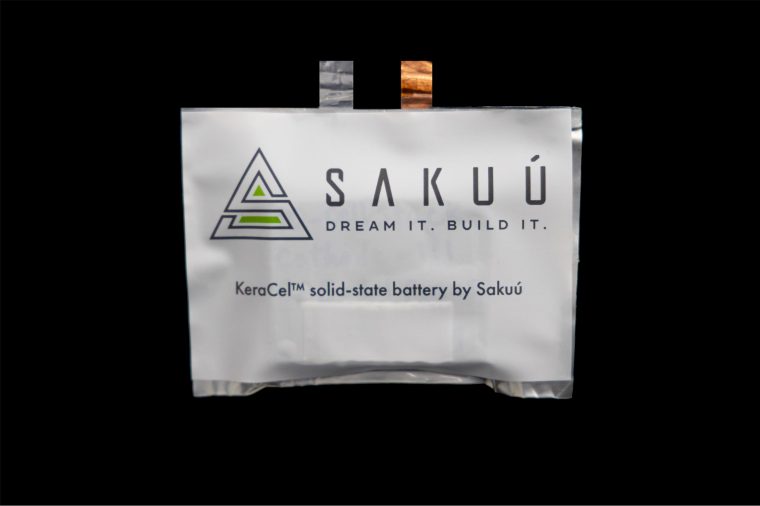 Sakuu’s first generation solid-state battery. Image courtesy of Sakuu.
Nevertheless, the release of a battery is evidence that Sakuu is on its way to achieving its promises. It will be delivering batteries to “strategic” partners in late Q3 2021 and “early access” partners in Q4. Volume production is targeted for early 2022, as Sakuu CEO and Founder Robert Bagheri said:
“We developed this first generation of SSB’s to prove the viability of our battery technology in anticipation of the Sakuú 1000 advanced AM platform. Over the last year, we have improved our battery energy capacity by a factor of 100 and our volumetric energy efficiency over 12 times and are planning to begin volume production of the batteries in early 2022 to meet the needs of our strategic partners.”
3D printed SSBs could have strong potential for a variety of sectors, due to the ability to feature greater energy density in smaller spaces with unique geometries. One could imagine batteries integrated directly into the products they serve, particularly once Sakuu introduces polymer 3D printing to its platform.
Subscribe to Our Email Newsletter
Stay up-to-date on all the latest news from the 3D printing industry and receive information and offers from third party vendors.
Print Services
Upload your 3D Models and get them printed quickly and efficiently.












You May Also Like
3D Printing News Briefs, June 24, 2026: Name Change, Digital Foundry, & Yeast
In today’s 3D Printing News Briefs, we’re starting with a formal name change for an African industrial technology company that’s a major user of additive manufacturing (AM) in the oil...
3D Printing News Briefs, May 2, 2026: Soft Robots, Agricultural Waste, & More
In this weekend’s 3D Printing News Briefs, we’ll start off with a multi-laser metal powder bed fusion 3D printer and post-processing news. We’ll end with research into soft robotics and...
Polymaker Goes Direct in Europe
Rather than just going through resellers, Chinese filament giant Polymaker is also going direct in Europe. The company wants to continue to work with 3D printing shops, webshops, OEMs, and...
Lucky 7: Free 3D Printed Models to Help You Welcome the New Year
Last week was Christmas, and in just a few days, it will be New Year’s Eve, and then New Year’s Day. 2025 will end, and 2026 will begin. Out with...