Zortrax Introduces Strong, Radiation-Resistant Z-PEEK 3D Printing Material

Poland-based company Zortrax has built up a pretty strong 3D printer portfolio over the years, but it’s also developed its fair share of advanced materials as well, such as PEI and PEEK. In fact, the company actually partnered with the European Space Agency (ESA) to develop a composite 3D printing technology using two blends of PEEK at the same time. Zortrax claims its latest material, Z-PEEK, is the strongest polymer filament in the world.
Composed entirely of polyetheretherketone, Zortrax says that Z-PEEK, with a strength-to-weight ratio comparable to stainless steel, is one of only a few polymers that can be used in Low Earth Orbit (LEO) and in deep space. Zortrax has partnered with space agencies in the past, so it would know better than many companies that space-grade materials have to be able to withstand rapid transitions between extreme heat and extreme cold, as there is no air on orbit and therefore no convection to evenly distribute heat throughout the environment. Additionally, as Zortrax explained in a blog post, components launched into outer space are exposed to atomic oxygen bombardment, heavy vibrations, and radiation, so the materials they’re 3D printed out of have to be tough.
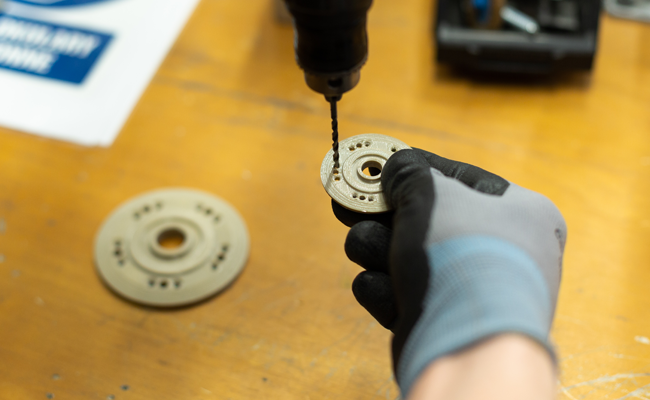
3D printed gaskets: Seals for piping in oil industry 3D printed with Z-PEEK on the Zortrax Endureal 3D printer.
Zortrax says that its new Z-PEEK filament was made to “withstand it all with healthy margins,” and that models printed out of the material on the Endureal have already passed thermal vacuum space qualification tests at the ESA’s ESTEC facilities in Netherlands. Its resistance to radiation was tested short-term at the ground facilities of the Japanese Space Agency (JAXA), and for longer periods of time onboard the International Space Station, and apparently came through with flying colors, proving to be highly resistant to both atomic oxygen bombardment and gamma irradiation.
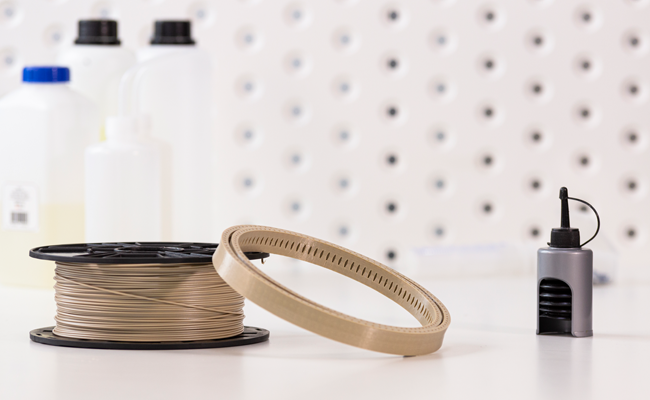
Radiation-resistant bearing ring for a spacecraft gimbal 3D printed with Z-PEEK on the Zortrax Endureal
“Introduction of Z-PEEK is the result of a long cooperation with our partners in space industry. A capability to 3D print with this material is a game changer for any enterprise willing to build cost-effective, affordable spacecraft and for large space agencies like ESA seeking to bring the cost of space exploration activities down,” explained Michał Siemaszko, Head of Research & Development at Zortrax. “But Z-PEEK can also find applications in oil industry, aerospace, nuclear energy, and numerous other high-tech fields. With excellent thermal properties, resistance to radiation, and strength-to-weight ratio comparable to stainless steel, Z-PEEK redefines the boundaries of what polymer extrusion-based 3D printers can do.”
3D printed Z-PEEK samples underwent 500 cycles from down to -70°C and up to 130°C with, according to Zortrax, “no adverse effects on their structure or mechanical properties.” Additionally, the material was able to hold up under rapid cooling to cryogenic temperatures as low as -196°C, and can supposedly also withstand high heat over 300°C as well.
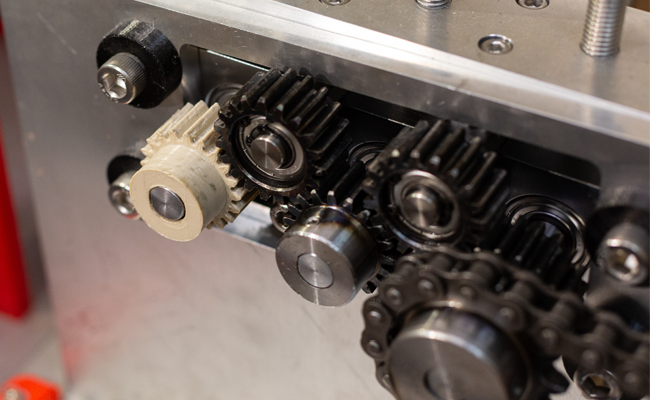
Z-PEEK is strong enough for heavy-duty gears operating at high speeds under significant loads.
If you think the material’s thermal characteristics are great, prepare to be equally as impressed by its mechanical performance, as Zortrax says its Z-PEEK has been tested, and excelled, in polymer/metal gear systems doing more than 22 million cycles, under 1 Nm load, at 1600 rpm. The company says that the material is extremely wear-resistant, which also means that debris accumulation on the parts is pretty low and can result in a longer lifespan for mechanisms that use Z-PEEK 3D printed parts.
Because Z-PEEK is so tough, support structures printed with the material can be hard to remove from the printed model, which is why Zortrax calibrated its Endureal system to print Z-PEEK in dual-extrusion mode along with its Z-SUPPORT HT breakaway support material—much easier to remove.
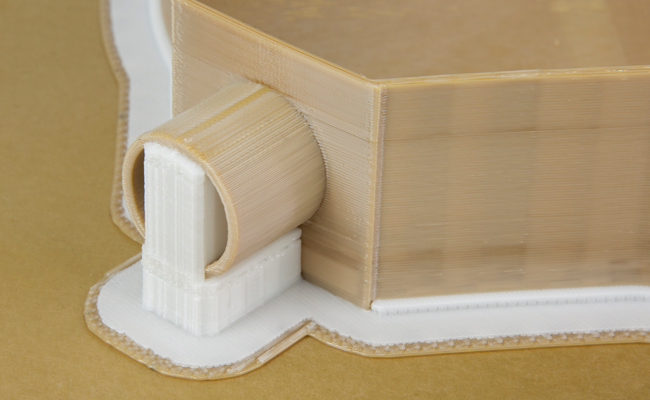
Pressure-resistant pump: Breakaway support structures enable printing partially trapped volumes with Z-PEEK.
“In this workflow, it is possible to print supports that can be peeled out of hardly accessible places. Once the printing is done, the model can also be automatically annealed in the Endureal’s printing chamber to relieve internal stresses and ensure that the material retains its excellent mechanical properties,” Zortrax wrote in its blog post.
The new Z-PEEK material for the Zortrax Endureal 3D printer is available in 1.75 mm diameter on 1,000 g spools, and for optimal properties, should be put through an automated drying procedure pre-print and an automated annealing process post-print, both of which can be completed with the printer by itself. Depending on where you’re located, you can purchase Z-PEEK through a Zortrax Reseller, or order it through the Zortrax Online Store.
(Source/Images: Zortrax)
Subscribe to Our Email Newsletter
Stay up-to-date on all the latest news from the 3D printing industry and receive information and offers from third party vendors.
Print Services
Upload your 3D Models and get them printed quickly and efficiently.












You May Also Like
Reinventing Reindustrialization: Why NAVWAR Project Manager Spencer Koroly Invented a Made-in-America 3D Printer
It has become virtually impossible to regularly follow additive manufacturing (AM) industry news and not stumble across the term “defense industrial base” (DIB), a concept encompassing all the many diverse...
Inside The Barnes Global Advisors’ Vision for a Stronger AM Ecosystem
As additive manufacturing (AM) continues to revolutionize the industrial landscape, Pittsburgh-based consultancy The Barnes Global Advisors (TBGA) is helping shape what that future looks like. As the largest independent AM...
Ruggedized: How USMC Innovation Officer Matt Pine Navigates 3D Printing in the Military
Disclaimer: Matt Pine’s views are not the views of the Department of Defense nor the U.S. Marine Corps Throughout this decade thus far, the military’s adoption of additive manufacturing (AM)...
U.S. Congress Calls Out 3D Printing in Proposal for Commercial Reserve Manufacturing Network
Last week, the U.S. House of Representatives’ Appropriations Committee moved the FY 2026 defense bill forward to the House floor. Included in the legislation is a $131 million proposal for...